

The fastest way to create a season schedule is to feed a scheduling generator a complete inventory of teams, venues, and time slots, run an autoschedule pass, then validate the output against a short checklist before you publish. Most organizers can produce a workable draft in under 30 minutes using round-robin math to check the numbers, then spend another hour catching fairness issues before sharing it through a tool like Roster.
TL;DR:
- Organizers must gather accurate team rosters, venue details, blackout dates, and scheduling constraints before using an autoschedule tool to prevent delays and conflicts.
- A single round-robin format suits leagues with up to 12 teams over 8 to 12 weeks, while larger or more competitive leagues should split divisions or use double round-robins with playoffs.
- Properly configuring scheduling rules and constraints before generating matchups ensures minimal manual adjustments and avoids reintroducing conflicts later.
- Checking for hard errors like double bookings and fairness issues such as unbalanced home/away games reduces complaints and improves schedule acceptability.
- Sharing the schedule through multiple channels ahead of the season, with clear details and reminders, helps teams confirm attendance and minimizes last-minute chaos.
Table of Contents
- What Information Do You Need Before You Create a Season Schedule?
- Which Schedule Format Fits Your League?
- How Does the Autoschedule Feature Actually Work?
- What Should You Check Before Publishing the Schedule?
- How Do You Share a Season Schedule With Every Team?
- How Roster Turns a Published Schedule Into a Full Roster
- What Actually Prevents Scheduling Chaos Midseason
- Get Your Season Schedule Off the Spreadsheet and Into Players' Hands
- Where to Learn More About Building a Season Schedule
- Sources
What Information Do You Need Before You Create a Season Schedule?
A generator is only as good as what you put into it. Before opening any scheduling tool, gather five things: your final team list, season start and end dates, a target number of games per team, your venue list (with operating hours and how many fields or courts run simultaneously), and the days and time slots actually available at each site. Skip any of these and you will spend more time fixing the output than you would have spent collecting the data upfront.
Constraints are the part most organizers underestimate. Send teams a short form with a hard deadline, asking three questions: which dates are blackout dates, does the team have a facility preference, and are there back-to-back scheduling conflicts (a coach who runs two teams, for example). A season-building checklist built around these inputs prevents the mid-season scramble that happens when a team suddenly announces it can't play on Tuesdays.
- Team names and final roster count
- Season start/end dates and total weeks available
- Games-per-team target
- Venue list with hours, field count, and surface type
- Blackout dates and hard constraints, collected by a fixed deadline
Quick math check: for a single round-robin, total games equal n x (n-1) / 2, where n is your number of teams. With ten teams, a single round-robin yields a certain number of total games. If each venue-night supports multiple games, you'll want to confirm you have enough venue-nights booked before the season starts to accommodate the schedule.
Which Schedule Format Fits Your League?
Format choice depends on team count, season length, and how competitive the league wants to be. A single round-robin works cleanly for 6 to 12 teams over 8 to 12 weeks. Push past 12 teams and a single round-robin either drags the season too long or forces multiple games per week, so splitting into divisions or running a double round-robin (each team plays every other team twice, home and away) usually fits better.
- Small league, short season (6 to 10 teams, under 10 weeks): single round-robin, no divisions, straightforward home/away alternation.
- Medium league (10 to 16 teams): split into two divisions, run round-robin within each division, add 2 to 3 crossover games near the end.
- Large or competitive league (16+ teams, or a title on the line): double round-robin within divisions, then a knockout bracket for playoffs.
- Tight venue availability: reduce games per team rather than adding late-night slots that hurt attendance.
When setting generator parameters, define games per team, number of rounds, whether byes rotate evenly, and whether home/away balance is enforced automatically. Most generators let you paste in these presets rather than configuring each round by hand, which saves real time once you have more than eight teams.
How Does the Autoschedule Feature Actually Work?
Vendor scheduling tools follow a consistent pattern: you add your venues and time slots, configure scheduling rules, generate the full matchup list, then run autoschedule to slot every matchup into an open time and place. SportsEngine's Scheduling Assistant documents this exact flow, and most competing generators mirror it closely because the underlying constraint problem is the same regardless of sport.
Good generators let you express real constraints instead of forcing you to work around them: max games per day per team, minimum rest hours between games, and venue preferences tied to specific teams. Enter these before you generate, not after. Retrofitting constraints onto a finished schedule usually means starting over.
- Import your team list and confirm the count matches your roster
- Define every venue, field, and time slot as a distinct bookable unit
- Generate the full matchup list and eyeball the total against your n x (n-1) / 2 math
- Run autoschedule to place every matchup into an open slot
- Review flagged conflicts before touching anything manually
Pro Tip: When you find a problem after autoscheduling, lock the games that are already correct and re-run the generator only on the unresolved slots. A full re-run can undo fixes you already made and reintroduce conflicts you thought were solved.
What Should You Check Before Publishing the Schedule?
Two categories of errors sink a schedule: hard errors that make it unusable, and fairness issues that generate complaints for the next ten weeks. Check both before you send anything to teams.
Hard errors first: no venue double-booked at the same time, no team scheduled for two games at once, and every team hits its target game count exactly. Fairness checks come next: home/away games should be roughly even, no team should get four home games in a row, byes should rotate rather than always falling on the same team, and travel distance across venues should be reasonably balanced.
- Double-booked venues or overlapping team times
- Games-per-team totals matching your target exactly
- Home/away balance within one game of even
- No team with three or more consecutive home or away games
- Bye weeks distributed evenly across the season
Leagues that apply these checks consistently, along with balanced pairing and a clear makeup policy, cut scheduling complaints by 60 to 80 percent compared to leagues that publish and hope. Reserve one standing makeup slot, such as a Thursday evening, and set a firm deadline for rescheduled games so postponements don't drag into the following month.
How Do You Share a Season Schedule With Every Team?
Publishing isn't a single event, it's a channel decision. Most organizers use a combination: a public web calendar for anyone to browse, an ICS or CSV export for teams that want the schedule in their own calendar app, and a shareable link that updates automatically when something changes. Schedule maker tools typically support all three formats out of the box.
Timing matters as much as the format. Publish the full draft two to three weeks before the season opens, giving teams a window to flag real conflicts without inviting a stream of last-minute requests. Send reminders 48 hours before each game, and keep a visible change log any time you adjust a slot. Every published game should list arrival time, exact field or court number, and a point of contact. Details practitioner guides consistently flag as the difference between a schedule people check and one they ignore.
- Public calendar link plus ICS/CSV export for personal calendars
- Publish 2 to 3 weeks before opening day
- Reminders 48 hours before every game
- Visible change log for any schedule edit
- Arrival time, field number, and contact listed on every game entry
How Roster Turns a Published Schedule Into a Full Roster
Publishing the schedule is only half the job. Getting the right players to actually show up is the part that eats an organizer's week, and it's the part Roster is built around. Once your season schedule is finalized, Roster turns each game into a single shareable link instead of a group chat thread nobody reads.
The workflow runs in four steps: publish the schedule, share one link per game or the full season, let RSVPs come in automatically, and let the app fill open spots from a waitlist the moment a regular drops out. Reminders go out without you typing them.
- Publish the finalized schedule as individual game links
- Share once, players RSVP directly through the link
- Open spots auto-fill from the waitlist in real time
- Reminders sent automatically ahead of each game
Pro Tip: Build your waitlist before the season starts, not after your first no-show. A ready list of alternates is what makes the auto-fill feature actually save you time.
What Actually Prevents Scheduling Chaos Midseason
Most schedule failures aren't math problems, they're discipline problems. Set one hard deadline for constraint submissions and publish a draft while there's still time to fix it, not the week before opening day. Reserve a standing makeup slot in your venue contract rather than negotiating one after the first rainout, and pick a single notification format teams learn to trust and check.
— Daniel
Get Your Season Schedule Off the Spreadsheet and Into Players' Hands
Roster picks up exactly where your schedule generator leaves off. You've built the fixture list, checked the round-robin math, and validated home and away balance, the next problem is getting every player to actually confirm and show up without you chasing texts all week.
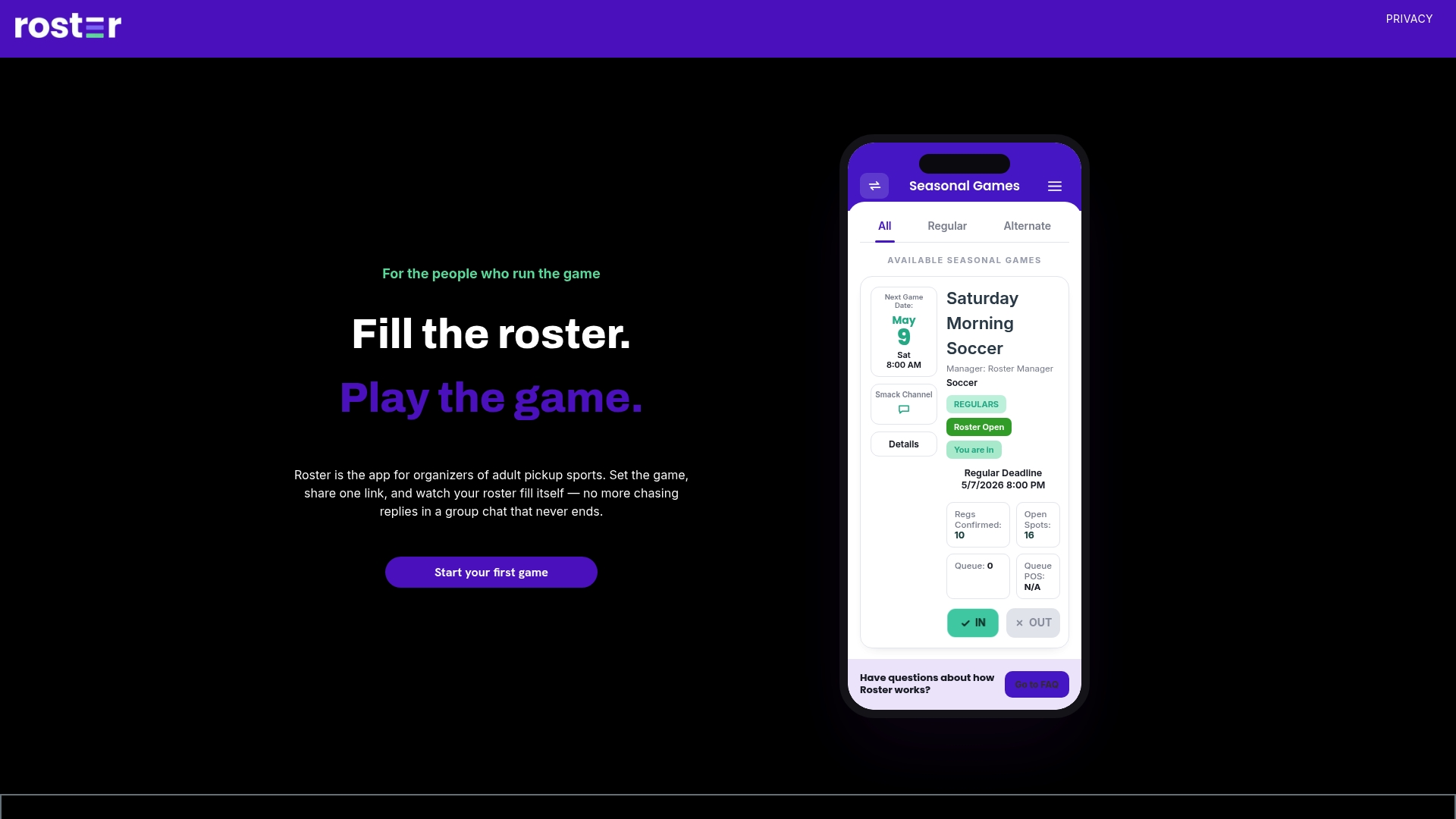
Once a season schedule is set, Roster turns each game into one link you share with your group. Players RSVP through that link, the app automatically fills open spots from a waitlist the second someone drops, and reminders go out without you sending a single message. Setup takes a few minutes: add your schedule, share the link, and RSVPs start coming in immediately. If you're coordinating a full season of adult pickup games, see how the app organizes signups and rosters and get your next game link ready before your current schedule review is even finished.
Where to Learn More About Building a Season Schedule
- MatchGrid Labs' season-building checklist covers the full input list before you start scheduling.
- leaguearc's scheduling guide explains round-robin math and fairness balancing in detail.
- OpsNine's field allocation notes break down makeup-window planning.