

Teams fill roster spots through five main channels: trades, free-agent signings (including veteran-minimum deals), waiver claims, two-way and G League call-ups, and short-term or hardship contracts signed under emergency exceptions. Which route a front office picks depends on timing. A trade deadline, a training-camp cut date, and salary-cap math all push a team toward one option over another, and the same logic (weighing speed against fit) scales down surprisingly well to a weekend pickup league.
TL;DR:
- Most teams fill roster spots through trades, free-agent signings, waiver claims, or internal promotions, each suited to different timing and needs.
- Deadlines like the trade deadline and training-camp cuts heavily influence whether teams act quickly or hold spots open for better options.
- In-season injury or hardship exceptions create short windows for emergency signings, while internal promotions from G League or practice squads offer low-cost continuity.
- Managing roster changes involves complex cap considerations, reserve lists, and contract counts that can trigger chain reactions of moves to stay within league limits.
- Pickup organizers can streamline last-minute roster management by automating signups, waitlists, and player replacements, similarly to professional team strategies.
Table of Contents
- The Main Ways Teams Fill Roster Spots
- Deadlines That Force a Team's Hand
- Two-Way Contracts, G League Call-Ups, and Internal Promotions
- Salary Cap, Contract Counts, and Reserve Lists
- What Pickup Organizers Can Steal From Pro Roster Management
- Patience or Urgency? Knowing Which One Wins
- A Faster Way to Fill Open Spots on Your Roster
- Sources
- FAQ
The Main Ways Teams Fill Roster Spots
Every open roster spot gets filled through one of a handful of well-worn paths, and each one solves a different problem.
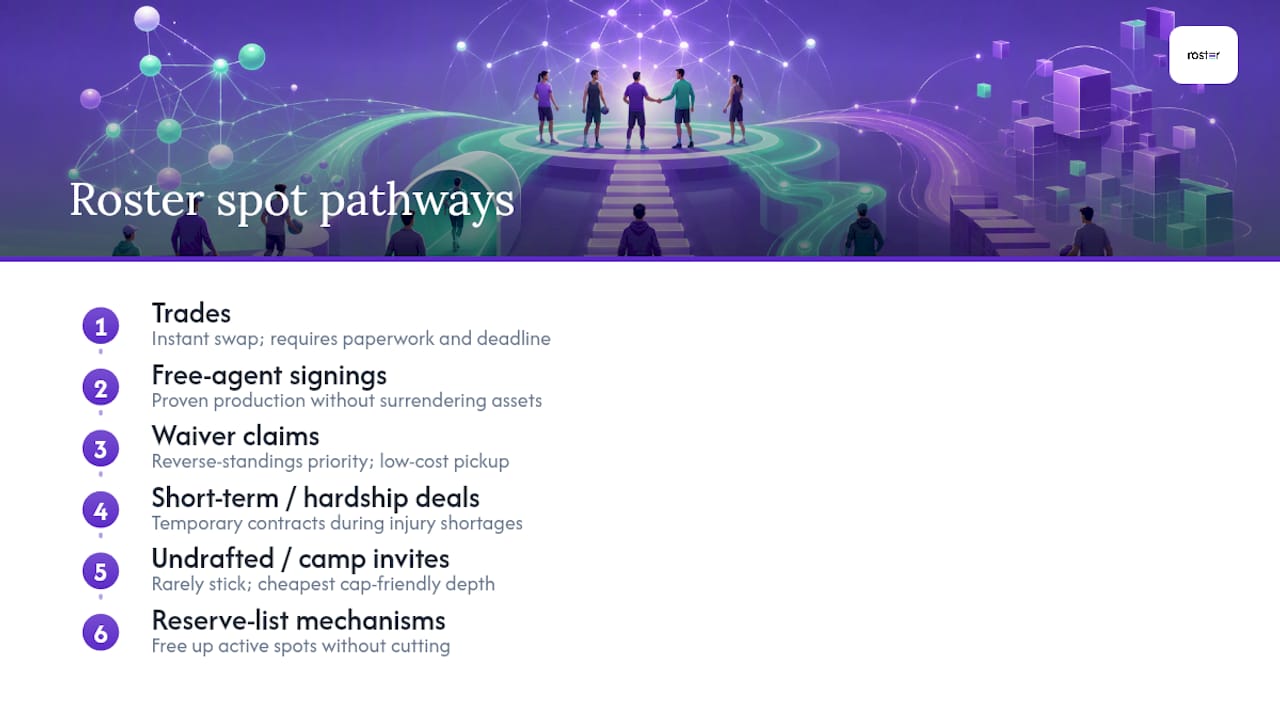
Trades move a roster spot instantly, and teams use them when they need a specific skill set right now rather than a projection. A trade also comes with paperwork: physicals, contract verification, and a hard deadline for finalizing terms before the transaction posts. Because a trade usually sends bodies out as well as bringing them in, it changes two rosters at once instead of one.
Free-agent signings cover everyone from a max-contract star to a journeyman on a one-year, veteran-minimum deal. Teams lean on these when they want proven production without giving up assets, and minimum deals are often the fastest way to plug a bench gap in the middle of a season.
Waiver claims let a team pickup a player another team has cut loose, and priority typically runs by reverse standings order, so struggling teams get first crack at talent that clears waivers. It is a low-cost way to add a rotation piece without negotiating a contract from scratch.
Short-term and hardship contracts exist for exactly the situation their name implies: a sudden run of injuries leaves a team short of bodies, and the league allows temporary deals to keep a roster legal until healthier players return.
Undrafted free agents and training-camp invites round out the list. Most of these players never make an opening-night roster, but the ones who do often become the cheapest, most cap-friendly depth a team has. Reserve list mechanisms like injured reserve and physically-unable-to-perform designations, common across major professional rosters, also factor in here since they free up active spots without cutting a player outright.
Deadlines That Force a Team's Hand
Roster decisions rarely happen on a whim. They happen because a calendar date is closing in.
- The trade deadline forces teams to decide whether a marginal roster spot is worth keeping open for a buyer's-market deal or filling immediately with a stopgap. Some front offices deliberately wait, betting a better fit becomes available once other teams start cutting players loose closer to the deadline.
- Training-camp cut dates set the final boundary for turning an invite into a contract. Once that date passes, the door closes on players who haven't already impressed enough to earn a spot, a dynamic seen clearly when LSU filled its final two roster spots and effectively ended the chances of other prospects still waiting for an offer.
- In-season windows open up around injury designations and hardship exceptions, giving teams a short runway to sign a replacement before a game they'd otherwise be short-handed for.
Teams sometimes leave a spot open on purpose, treating it as a flexible asset rather than a vacancy that has to be filled immediately.
Two-Way Contracts, G League Call-Ups, and Internal Promotions
Not every open spot gets filled from outside the organization. Two-way contracts let a team carry a player who splits time between the NBA roster and its G League affiliate, and a call-up usually happens when an injury or a matchup problem creates a sudden need for depth. Because the front office has already watched that player practice and perform inside its own system, promoting from within carries less risk than signing an unknown free agent.
Practice-squad invites and G League standouts follow a similar logic. A player who spends a season absorbing a team's offense and its expectations around effort and conduct is a known quantity by the time a roster spot opens.
- Two-way call-ups keep continuity intact since the player already understands the playbook and the locker room.
- Internal promotions cost less against the cap than a veteran free-agent signing.
- The tradeoff is experience. An outside veteran often brings a level of polish a G League call-up hasn't had the reps to develop yet.
Pro Tip: If two options look equally talented on paper, lean toward the internal promotion. Chemistry costs nothing to maintain once it already exists, but it takes weeks to build from scratch with a new signing.
Salary Cap, Contract Counts, and Reserve Lists
Every signing is a math problem before it's a basketball decision. Adding one more body to an active roster can push a team closer to the luxury tax, and shifting one player to a reserve list can be the cleanest way to open a spot without losing that player's rights.
Front offices generally run through the same short checklist before finalizing a move:
- What does this signing cost against the cap this season and next?
- Does it lock the roster into a contract count that limits future flexibility?
- Does the player's role overlap with someone already on the roster, or does it fill a genuine gap?
- Is there a reserve-list option (injured reserve, PUP, non-football injury) that solves the problem without adding a new contract?
Professional leagues enforce hard limits on active-roster size, and teams manage that number constantly. The Patriots' set of roster moves to reach the mandated 53-man limit shows how many transactions, releases and reserve-list shifts alike, it can take just to get under a single number. Public roster pages that flag player status as active, injured reserve, or otherwise, like the Atlanta Falcons' roster listing, make that accounting visible in real time. Signing one veteran can trigger a chain reaction: clearing a roster spot, adjusting a two-way contract, and rethinking the tax picture all in the same afternoon.
What Pickup Organizers Can Steal From Pro Roster Management
The mechanics scale down better than most weekend organizers realize. A pro front office is really just solving the same problem you are: get enough of the right people to a game on time, without wasting hours chasing confirmations.
- Set a real signup deadline the way teams treat a camp cut date, so you're not scrambling an hour before tip-off.
- Keep a short list of reliable alternates, the amateur equivalent of a G League call-up, who already know your group and can slot in without a learning curve.
- Automate the RSVP and waitlist process instead of tracking replies across three group chats.
That last point is where a dedicated game management app earns its keep. Automated RSVP links and waitlists close open spots the moment someone drops, the same way a waiver claim replaces a cut player without a manager lifting a finger. For more on cutting down the friction that causes last-minute scrambling, see how to reduce no-shows in pickup games.
Patience or Urgency? Knowing Which One Wins
The best front offices treat an open roster spot as leverage, not an emergency, unless the calendar says otherwise. Waiting for the right fit works when a team has cap room and time on its side. Filling the spot immediately wins when a game, or a season, is on the line and a warm body beats an empty seat. Amateur organizers face the identical trade-off every single week: hold out for your best players to confirm, or grab a reliable alternate before the roster falls apart. The instinct to wait for "better" is often just indecision wearing a strategic costume.
— Daniel
A Faster Way to Fill Open Spots on Your Roster
Trades, waivers, and call-ups work for the NBA because someone in the front office is grinding through cap sheets and transaction wires all day. Pickup organizers don't have that luxury, which is why so many spots go unfilled until someone finally answers a group text at 9 p.m. the night before a game.
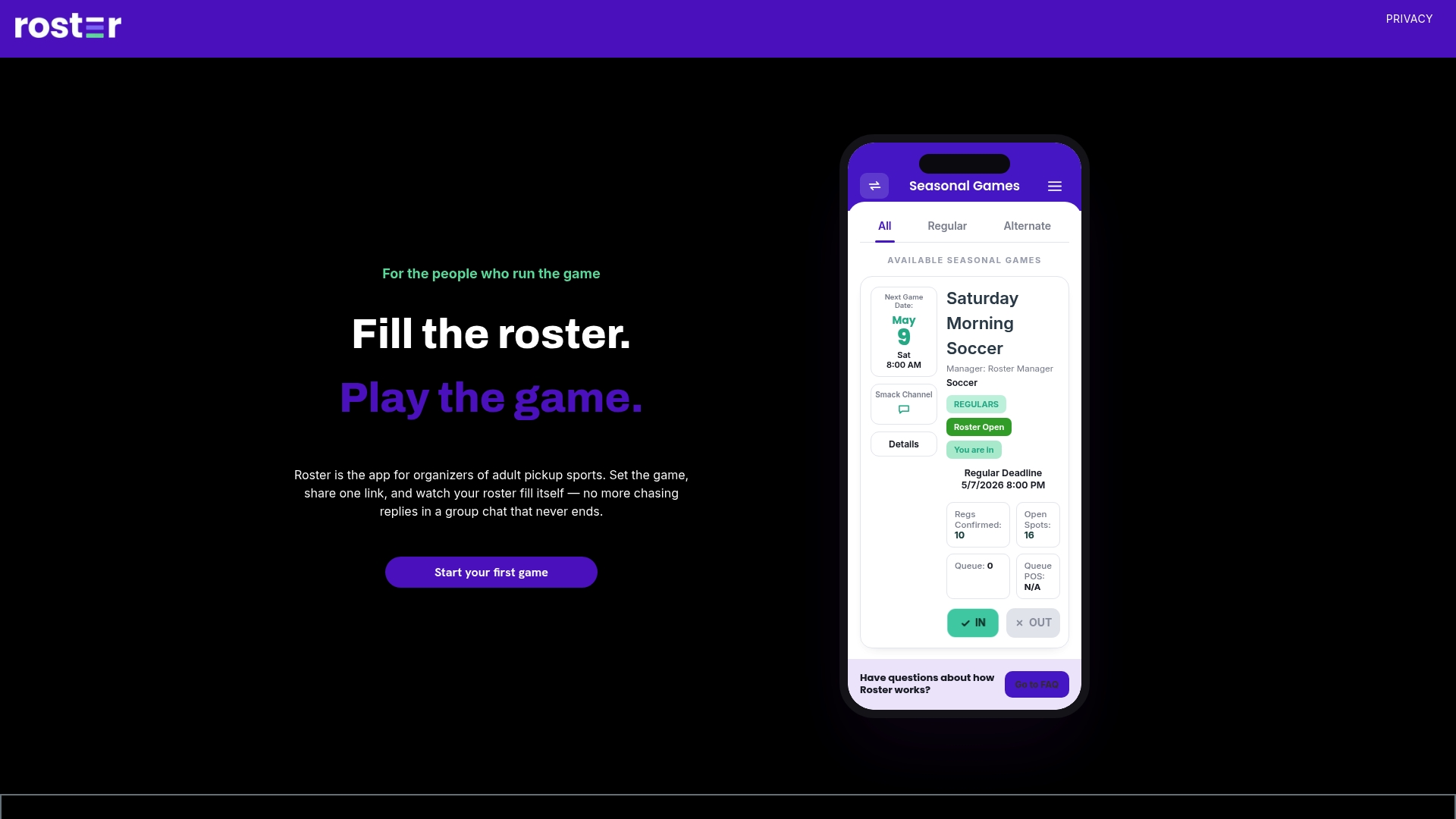
Some game management apps automate parts of roster management to save organizers time. By setting the game details and sharing one link, the app can handle signups, track regulars and alternates, and move the next available player off the waitlist as soon as someone drops out without chasing replies through chat. Some also track payments related to the game to reduce organizer workload. If you're tired of playing unpaid general manager for your weekend league, take a look at the Roster Sports app and set up your next game in minutes.
Sources
FAQ
What does "roster spot" mean?
A roster spot is one of the limited number of active positions a team is allowed to fill under league rules, and it can be occupied by a player, or opened up through a release, trade, or reserve-list move.
How do teams decide which open roster spots to fill first?
Teams generally prioritize positions tied to injuries or immediate performance gaps, then weigh cap space and contract flexibility before adding a free agent, a waiver claim, or a call-up.
How do I fill an empty slot in my fantasy league or pickup roster?
Check the available free-agent or waiver pool first, and if you're organizing a real-life pickup game rather than a fantasy team, an app like Roster Sports can automatically move a waitlisted player into an open spot the moment someone cancels.
Why do some roster spots stay open even when a team could fill them?
Front offices sometimes hold a spot open deliberately to preserve cap flexibility or to wait for a trade or free agent that fits better than whoever is currently available.
What happens if a team misses a roster deadline?
Missing a cut date or signing deadline can permanently close the door on certain moves for that period, forcing the team to wait for the next roster window to make a change.