
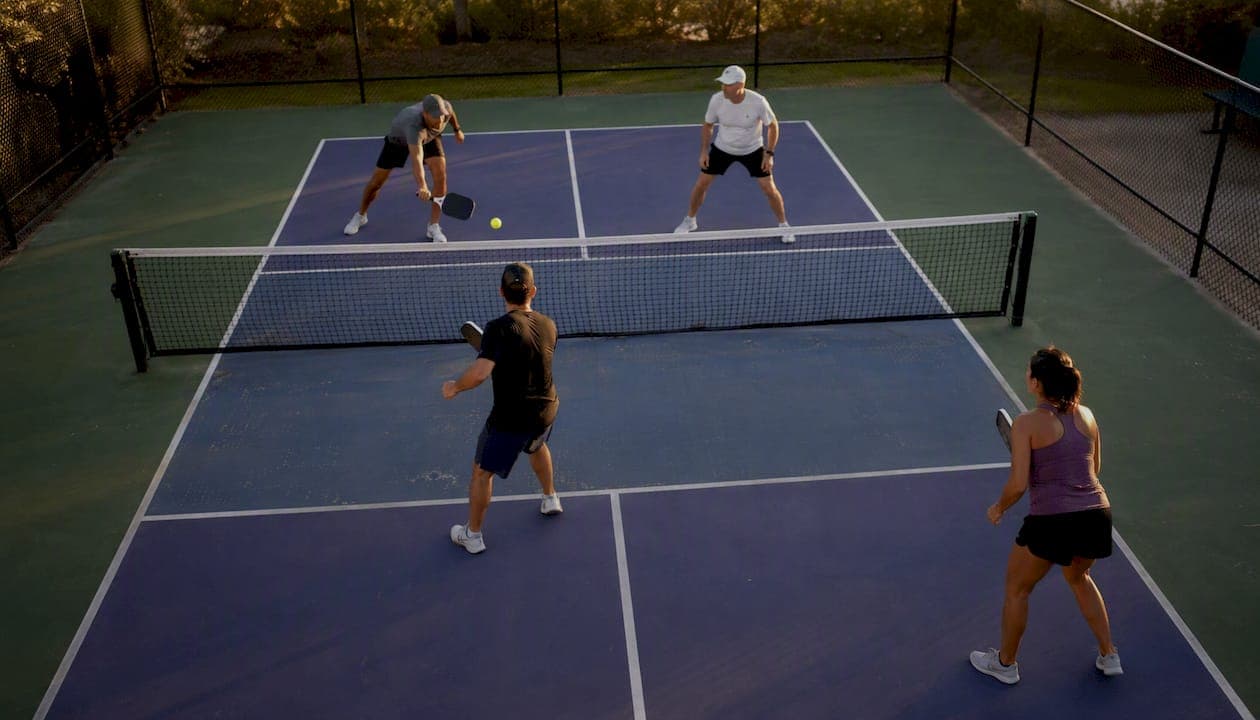
King of the Court is a continuous rotation game where the player or team holding the "king" court keeps it by winning, and anyone who loses steps off to let the next challenger in. One rule ties every sport-specific version together: make it, take it — win the point or possession and you stay; lose it and you rotate out. That single mechanic is why the format works equally well as a high-pressure training drill and a social pickup night.
Here is how the core mechanic looks across sports:
- Volleyball: The king court plays a rally; the winning side stays and a new challenger rotates in from the queue.
- Basketball: The offensive player attacks; a defensive stop flips possession and the defender becomes the new attacker, while the beaten player exits.
- Pickleball/Padel: Winners move up one court toward the king court; losers move down, keeping all courts active simultaneously.
Key Takeaways
The single rule that makes King of the Court work across every sport is make-it-take-it: win and you stay, lose and you rotate out.
| Point | Details |
|---|---|
| Core mechanic | Winners retain the king court; losers rotate out or move down a tier. |
| Default house rule | Replay the point unless both sides agree to let the next challenger in — covers most disputes without a referee. |
| Format by group size | Use first-to-7 for 3–6 players; timed 4-minute rounds for 8–14; multi-court timed brackets for larger events. |
| Sport-specific highlight | Volleyball's official Golden Ball rule and basketball's free-throw-to-seal variant both add a high-pressure single-shot moment that changes session dynamics. |
| Rostersports | Automates signups, waitlists, and real-time alternates so organizers spend less time managing logistics and more time playing. |
Table of Contents
- What is the king of the court format, and how does it work universally?
- How do volleyball King of the Court rules work?
- How do you run basketball King of the Court?
- How does King of the Court work for pickleball?
- How does King of the Court adapt to padel and tennis?
- Organizer checklist for running a King of the Court night
- How apps can automate signups, waitlists, and in-game replacements
- How to tune King of the Court for your group size and goals
- Ready-to-use scoring templates for common group sizes
- How to handle disputes and edge cases on the fly
- Less admin, more game time with Rostersports
- Sources
What is the king of the court format, and how does it work universally?
Every King of the Court session shares the same skeleton, regardless of sport. Understanding these building blocks lets you run a session on any court with any group.
The core components:
- King court — the top court where the reigning player or team competes.
- Challenger courts — one or more lower courts where players compete to earn the right to move up.
- Rotation rule — winners retain the king court (or move up one tier); losers move down one tier or join the back of the queue.
- Session end condition — a time cap (e.g., 45 minutes), a point cap (first to reach a target score), or a "longest reign" tally that crowns whoever held the king court the most consecutive rounds.
Visualizing the court flow (2–4 courts):
[Court 1: KING] ← Winner stays / Loser drops to Court 2
[Court 2]       ← Winner moves to Court 1 / Loser drops to Court 3
[Court 3]       ← Winner moves to Court 2 / Loser joins queue
[Queue]         ← Next challenger enters Court 3
With two courts, the loser of the king court simply swaps with the winner of the challenger court. With four courts, the ladder extends, and a player at the bottom of the queue may wait two or three rounds before reaching the top — which is why a time cap matters more as group size grows.
Default house rule set for when players disagree: King court plays to 7 (or one timed round of 4 minutes). Winner stays. Loser rotates to the back of the queue or the lowest court. Ties go to a single sudden-death point. No coaching calls during play — disputes are replayed from the last clear state.
Pro Tip: Seed the first rotation by skill level rather than arrival order. Put mid-level players on the king court to start — if the strongest player wins immediately and holds the court for 20 straight rounds, the format stops being fun for everyone else. A balanced first draw keeps energy high.
How do volleyball King of the Court rules work?
Volleyball has the most formalized version of this format. The official Queen & King of the Court rules govern competitive events and are the clearest single reference for organizers running volleyball-specific sessions.
Key volleyball-specific rules to know:
- Court tiers: Teams are assigned to courts ranked from the king court down. After each rally or set, winners move up and losers move down.
- Golden Ball: A special rule used in official events where a designated "golden ball" rally carries extra weight — winning it can mean an automatic promotion or a bonus point depending on the event's specific ruleset. Check the official rules page for the current version, since the exact mechanic can vary by event format.
- Scoring: Rallies are typically played to a short point cap (often 7 or 15 points depending on the tier) rather than full sets, keeping rotations fast.
- Serve order: The incoming challenger typically serves first, giving the king court a slight defensive challenge from the start.
- Ties: When courts finish simultaneously, the team with the higher win streak on the king court holds position; lower courts replay a sudden-death rally.
Pro Tip: Run a single warm-up rotation before the session officially starts — let every team play one short rally on every court. It surfaces obvious skill mismatches early, gives players a feel for the ball and surface, and cuts down on "we weren't ready" disputes once the real rotations begin.
How do you run basketball King of the Court?
Basketball KOTC is where the format first became a staple coaching drill. Basketball for Coaches describes it as a make-it-take-it drill that forces repeated high-pressure possessions — exactly what makes it useful for both training and pickup play.
Standard flow:
- One offensive player (or small team) starts on the king court with the ball.
- They attack the defender(s). Score = stay on offense. Stop = the defender becomes the new attacker, and the beaten player exits.
- The next challenger enters as the new defender.
- Play continues until the session time cap or point cap is reached.
Common house rules (pick a set before play starts):
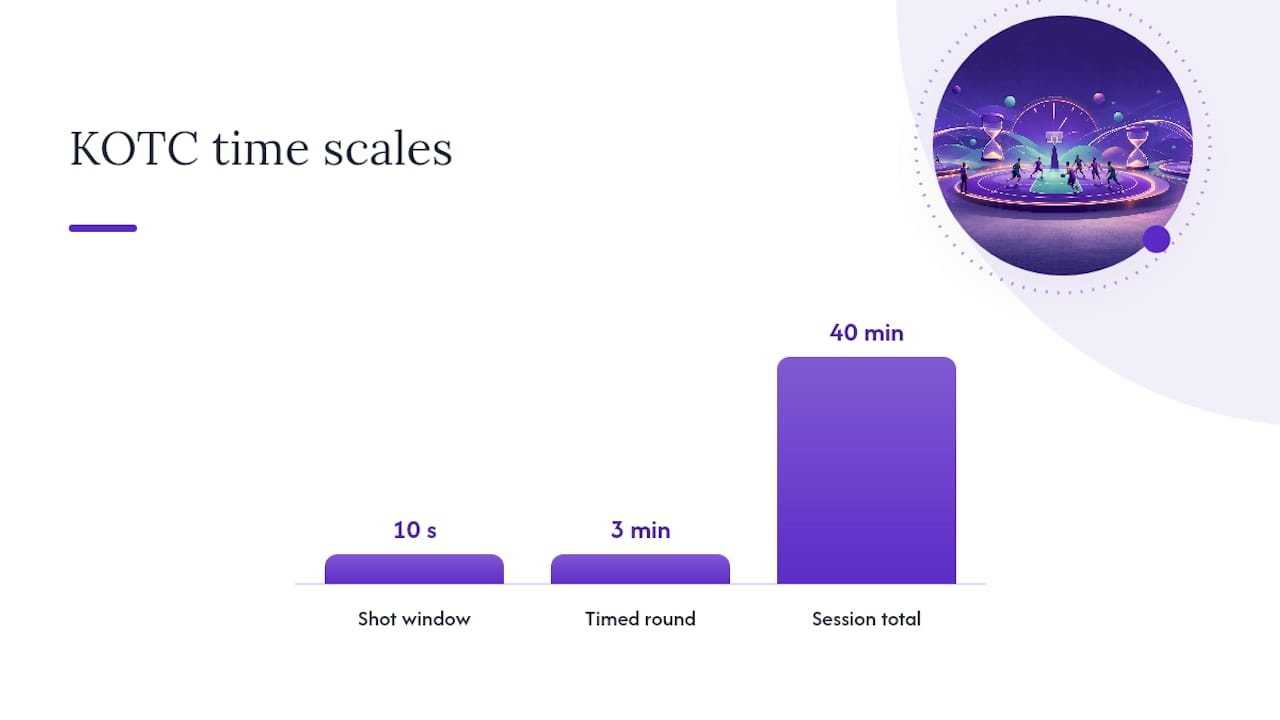
- Dribble limit: Intramural rules at some institutions cap the offensive player at 3 dribbles and require a shot within 10 seconds — this forces quick decisions and prevents stalling.
- First-to-12: A common session cap; the first player to reach 12 offensive scores wins the round.
- Free throw to seal: The king must convert a free throw to officially "close out" a winning streak. Miss it, and the challenger gets possession.
- Timed rounds: Some gyms run 3-minute rounds instead of point caps, which works better for larger groups where wait times would otherwise stretch.
Sample session (6 players, 1v1):
First to 12 offensive scores wins the round. Offensive player gets 3 dribbles and 10 seconds to score. Defender who gets a stop becomes the new attacker. King must make a free throw to seal a streak of 5+ consecutive scores. Session runs 40 minutes total.
The free throw rule alone changes the dynamic noticeably. Without it, a hot offensive player can run the court indefinitely. With it, pressure shifts to a single shot under fatigue — which is exactly the kind of high-pressure repetition coaches want to simulate.
How does King of the Court work for pickleball?
Pickleball KOTC runs across multiple courts simultaneously, which is what makes it efficient for large groups. The most common community format uses 3 courts and roughly 14 players, with winners moving up and losers moving down after each game.
Typical rotation pattern with three courts involves the king court as Court 1 and challenger courts as Courts 2 and 3. After each short game, winning teams move up courts and losing teams move down courts. Players waiting in the queue enter the lowest court as losers step off. Partners may either remain fixed or rotate to vary matchups depending on the organizer's preference.
Pickleball-specific house rules commonly cover serving order (incoming team serves first on the king court), partner rotation options, scoring methods (rally scoring preferred for speed), and handling odd player counts with byes or ghost spots.
Pro Tip: Keep a visible rotation board (a whiteboard or a shared phone screen) showing which team is on which court. When players self-manage rotations without a visual reference, someone always ends up skipping a court or jumping the queue — and that argument kills momentum faster than anything else.
How does King of the Court adapt to padel and tennis?
Padel is a natural fit for the King of the Court format because matches are short by nature and courts are compact enough to run multiple simultaneously. Padel-focused guides describe the format as continuous rotation with winners moving up to the king court and recommend keeping individual matches short to maintain pace.
Common padel/tennis adaptations:
- Match length: Play to 4 or 6 games (not full sets) or use a 10-minute timed round. Full sets kill the rotation rhythm.
- Service order: The incoming challengers serve first on the king court. On lower courts, alternate who serves each match.
- Single break between matches: Allow 60–90 seconds between matches for players to switch sides, collect balls, and hydrate. More than that and courts go cold.
- Scoring shortcut: Some groups use a "super tiebreak" format (first to 10, win by 2) as the entire match — fast, decisive, and easy to track.
Organizer etiquette tips:
- Call court changes loudly and clearly. In a padel facility with glass walls, players on adjacent courts often can't hear each other well.
- Designate one person per court to collect balls before the next match starts — stray balls during play are a safety issue and a pace killer.
- Let new players warm up for 5 minutes before their first match, especially on padel courts, where the wall angles take adjustment.
Pro Tip: *Post the rotation order on the court door or a nearby wall before the session starts. Padel players moving between courts often lose track of where they are in the ladder, especially in sessions with 5+ courts.
Organizer checklist for running a King of the Court night
A smooth session lives or dies on what happens in the 20 minutes before the first ball goes up. Here is a run-sheet you can follow directly.
Pre-event setup:
- Confirm court count and assign court numbers (tape or cones work fine).
- Set the rotation rule and scoring format in writing — text it to players before they arrive.
- Prepare a score-sheet or whiteboard with fields: court number, player names, current score, win streak, substitution log.
- Designate a "rotation caller" — one person (or a rotating role) who signals when rounds end and who moves where.
- Set a visible timer (phone on a stand, gym clock, or a shared screen) so players self-manage round endings.
Player check-in and warm-up:
- Check players in against your roster as they arrive. Note alternates separately.
- Run one warm-up rotation (unscored) so players settle into the format.
- Assign starting courts based on skill seed or random draw.
During play:
- Call round endings clearly. Give a 30-second warning before time expires.
- Log win streaks after each round — this is your tiebreaker data if the session ends in a tie.
- Rotate substitutes in at the start of a new round, never mid-round.
End-of-session wrap-up:
- Announce the final king court winner and longest-reign holder.
- Collect score-sheets and note attendance for billing or future seeding.
Sample score-sheet fields to track:
- Court number
- Player/team names
- Round start time
- Points scored (or games won)
- Win streak count
- Substitutions made
- Final placement
Pro Tip: Stage substitutions so the next challenger is standing courtside and ready before the current round ends. A 15-second swap beats a 2-minute scramble to find who's next. Announce "you're on deck" one round in advance and downtime drops sharply.
How apps can automate signups, waitlists, and in-game replacements
Running KOTC manually works for small groups. For recurring nights with 12+ players, a few simple automations save the organizer real time and prevent the most common lineup disputes.
Where an app adds the most value:
- Automated signups with a single shareable link — no group chat polling
- Real-time waitlist that fills open spots when players drop out before the session
- Push alerts to notify the next alternate that they are now in the lineup
- Attendance logging for per-player billing or future seeding
A practical workflow:
Create the event and set player cap → players RSVP via link → app fills alternates automatically as spots open → alternates receive a push notification → organizer sees the confirmed roster at game start, no manual tracking needed.
Rostersports maps directly to this workflow. Managers set game details once, share a link, and the app handles real-time roster fills, waitlist management, and group communication — so the organizer arrives at the court ready to run the session, not still managing a text thread. The platform also tracks per-player participation for billing, which matters for recurring KOTC nights where alternates rotate in and out each week.
How to tune King of the Court for your group size and goals
Not every group needs the same format. Here is a quick comparison of the four most common variations and when each one fits.

| Variation | Best for | Key trade-off |
|---|---|---|
| Timed rounds (e.g., 4-min per round) | Large groups (12+), social play | Less intensity per point; more rest between rounds |
| First-to-X (point cap) | Small groups (3–8), training focus | Rounds vary in length; hot players dominate longer |
| Longest reign (win streak tally) | Medium groups (8–14), competitive nights | Requires careful tracking; rewards consistency |
| Team KOTC (2v2 or 3v3) | Mixed skill levels, festival events | Slower rotations; better for social engagement |
For small groups (3–6 players), first-to-X is the cleanest option — rounds stay short and everyone gets frequent touches. For medium groups (7–16), a timed round with a longest-reign tiebreaker balances fairness and intensity. For large events with multiple courts, timed rounds are almost always the right call because they guarantee predictable rotation windows and prevent one dominant player from locking up the king court for the entire session.
The training vs. social split matters too. Coaching resources note that KOTC's value as a drill comes from the repeated high-pressure possessions it generates — which means shorter, faster rounds with stricter rules serve training goals better. Social nights benefit from slightly longer rounds and looser rules that keep the energy fun rather than grinding.
Ready-to-use scoring templates for common group sizes
Copy these directly into your sign-up message or score-sheet.
Quick pickup (3–6 players): First to 7 points wins the round. Winner stays on the king court. Loser rotates to the back of the queue. Session runs 30 minutes or until one player reaches 3 round wins. Ties broken by sudden-death point.
Club night (8–14 players): Timed rounds of 4 minutes per court. Winners move up one court; losers move down. Longest-reign tally determines the session winner. Substitutes enter at the start of each new round. Session runs 60 minutes.
Tournament-style (multiple courts with finals): Courts ranked 1 (king) through N. Timed rounds of 25 minutes running time per bracket stage. Top two teams from the king court after all rounds advance to a final. Finals played first-to-15, win by 2.
Sample score-sheet fields:
| Field | Suggested format / example |
|---|---|
| Court number | 1, 2, 3 (1 = king court) |
| Player/team name | "Team A" or individual names |
| Round start time | 7 PM |
| Points this round | 5–3 |
| Cumulative win streak | 3 consecutive rounds |
| Substitution note | "Player X in for Player Y, Round 4" |
Matching point caps to session length: A 7-point cap with 6 players typically produces a 6–10 minute round. A 12-point cap with the 3-dribble/10-second rule runs closer to 8–14 minutes. If your session is 60 minutes and you want 6+ rotations, keep the cap at 7 or use timed rounds of 4–5 minutes.
How to handle disputes and edge cases on the fly
Even well-run sessions hit a moment where two players disagree on a call. Having a short default rule set prevents these from derailing the night.
Common dispute scenarios and quick resolutions:
- Ambiguous in/out call: Replay the point from the last clear state. No arguments — if neither side can agree it was clearly in or out, it didn't count.
- Contested service order: Refer to the pre-set rule (incoming challenger serves first, or coin flip). If no rule was set, coin flip on the spot.
- Late arrival mid-rotation: Late players join the back of the queue, not the current round. No exceptions — inserting someone mid-round disrupts the win-streak count.
- No-show mid-session: If a player drops out and no alternate is available, the team that would have faced them gets a bye win and moves up.
- Exact tie at session end: If two players or teams finish with identical win streaks, play one sudden-death round on the king court to determine the session winner.
It defaults to fairness (replay) rather than forcing a judgment call, and it keeps the game moving.
Three lessons that make King of the Court nights run better
Running this format a few times teaches you things no rulebook covers. Three patterns show up consistently.
First, pacing beats intensity every time. Organizers who push for maximum competitive pressure in every round burn players out by the halfway point. Build in one short water break after every third rotation and the second half of the session plays noticeably better.
Second, skill mismatches are a format killer. When one player or team is clearly outclassing everyone else, the king court stops being contested and the format loses its point. A simple fix: after 15 minutes, manually reseed the courts based on observed performance rather than the original draw.
Third, new players need a soft entry. Put first-timers on the lowest court for their first two rounds regardless of stated skill level. It gives them time to learn the rotation rhythm without the pressure of the king court, and players who feel comfortable early are far more likely to come back the following week.
Less admin, more game time with Rostersports
The biggest time drain in running a recurring King of the Court night isn't the session itself — it's the 45 minutes of texts, confirmations, and last-minute dropouts that happen before anyone steps on the court.
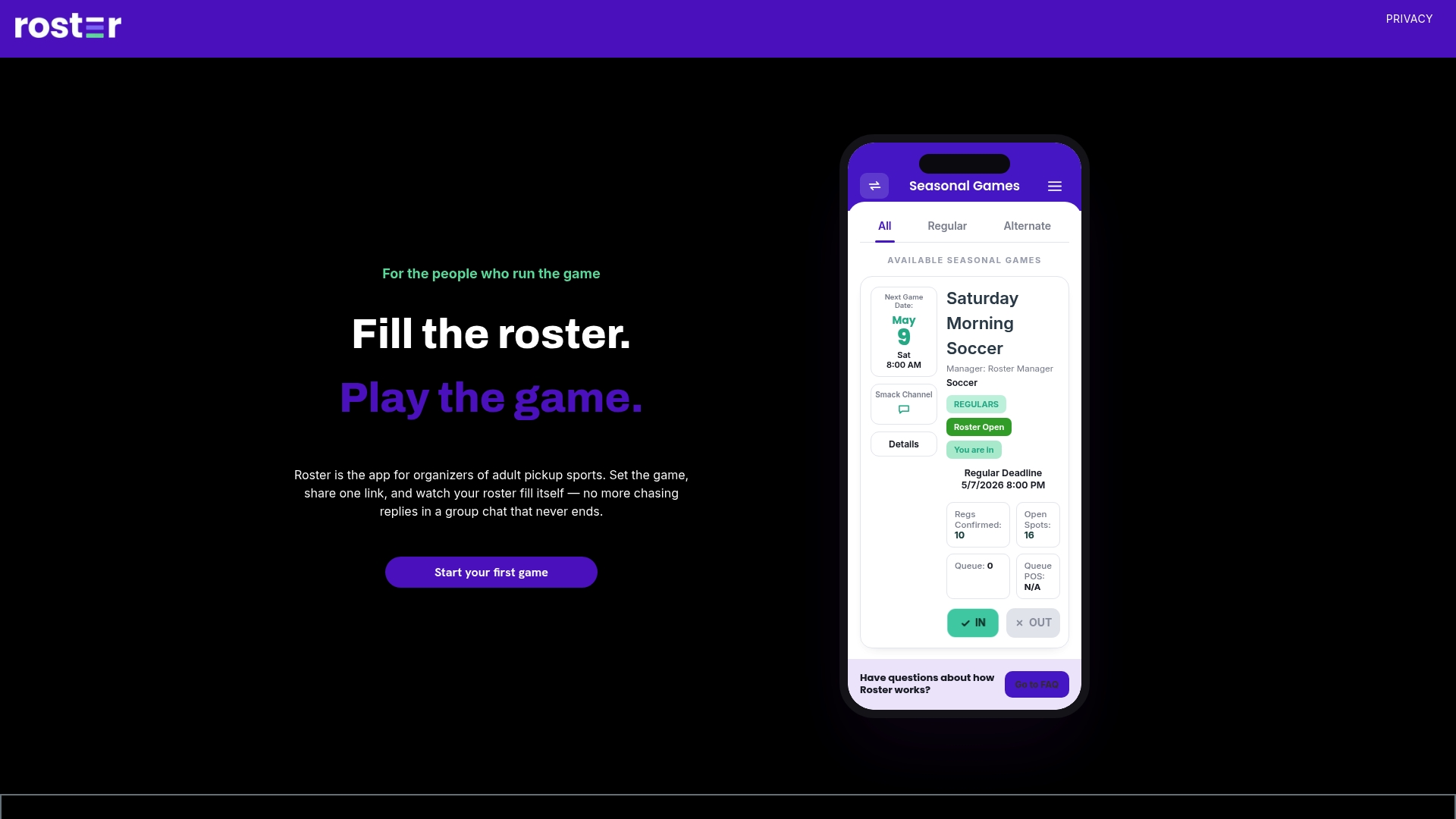
Rostersports cuts that overhead directly. Set your game details once, share a single link, and the app handles signups, waitlists, and real-time alternates automatically. When a player drops out an hour before tip-off, the next person on the waitlist gets a push notification and the roster fills itself — no group chat chaos, no manual tracking. For organizers running weekly KOTC nights, the per-player billing and attendance log also mean you always know exactly who showed up and what they owe. Download the app and set up your next session in minutes.
Sources
- Rules of the Game
- King of the Court (Fun Basketball Game and Drill)
- Intramural Sports — King of the Court rules
- King of the Court Padel: Rules, Format & How to Organize One
- How Do You Play King Of The Court Basketball?