
Every outdoor sports program needs one non-negotiable rule: stop play the moment anyone sees lightning or hears thunder, wait a full 30 minutes after the last strike before resuming, and send everyone to a substantial building or hard-topped vehicle in the meantime. That's the whole policy in one sentence. Everything else, the role assignments, the monitoring tools, the shelter maps, exists to make that single rule work under pressure, when a storm is rolling in during the third quarter and 200 parents are still in the bleachers.
The stakes are real enough to justify the friction of stopping a game. Lightning produces 20 to 25 million cloud-to-ground flashes across the U.S. every year, and roughly 30 people die from lightning strikes annually, with two thirds of those deaths tied to outdoor recreation. Sports fields are exactly where organizers have the most control over that risk, and exactly where a written lightning policy sports programs can rely on actually earns its keep.
A defensible policy needs these core elements, and skipping any one of them is how organizations end up explaining a preventable injury to a lawyer instead of a reporter:
- A named Weather Safety Official who tracks conditions continuously, separate from anyone coaching or officiating
- A named Authorized Decision-Maker with the sole authority to suspend and resume play
- A clear stop trigger: lightning seen, thunder heard, or a detection system flagging a strike inside a defined radius
- The 30/30 rule as the baseline resume standard, with a reset any time thunder or lightning recurs
- A shelter standard that only counts substantial buildings or enclosed vehicles as safe, never dugouts or open pavilions
- At least two independent monitoring sources, so no single missed alert becomes the reason someone gets hurt
30/30, quick version: if you can't safely count 30 seconds between a lightning flash and the thunder that follows, or you simply hear thunder, get everyone to shelter. Don't return until 30 minutes have passed since the last lightning or thunder, and restart that clock every time a new flash or rumble happens.
Table of Contents
- When Should You Suspend Outdoor Sports for Lightning?
- Where Should Athletes and Spectators Shelter From Lightning?
- When Is It Safe to Resume Play After a Lightning Delay?
- Who Decides When to Stop or Resume Play?
- What Do You Do if Someone Is Struck by Lightning?
- Which Weather-Monitoring Tools Should You Use for Lightning Safety?
- How Do You Write a Venue-Specific Lightning Safety Policy?
- How Should You Communicate a Lightning Delay to Players and Spectators?
- What Official Resources Should Organizers Consult First?
- A Few Common Lightning Myths That Get People Hurt
- An Organizer's Note on Lightning Policy in the Real World
- Key Takeaways: The Lightning Policy Essentials
- Where to Find Official Lightning Safety Guidance
- Frequently Asked Questions
- Sources
When Should You Suspend Outdoor Sports for Lightning?
Suspend immediately when anyone on-site sees lightning or hears thunder. That's the trigger. Not "when it looks close," not "after we finish this set," immediately. The National Weather Service is explicit that activity should stop the moment lightning is observed or thunder is audible, because by the time thunder reaches your field, the storm is already within striking distance.
Here's the part organizers underestimate: thunder can travel roughly 10 miles, and a storm doesn't have to be directly overhead to be dangerous. Lightning can strike from the edge of a storm cell that looks, from your sideline, like it's still miles away. Waiting for a visibly threatening sky is waiting too long.
The 30/30 rule governs both when you stop and when the clock resets. Count the seconds between a lightning flash and the thunder that follows, then divide by five to estimate distance in miles. A count of 30 seconds or less roughly means the storm is within 6 miles, which is the University Interscholastic League's recommended suspend threshold when no detection technology is available. Any new flash or thunderclap during your wait resets the 30-minute countdown to zero. That reset clause is the one coaches forget, and it's the one that matters most on a night with rolling, intermittent storm cells.
Where budgets allow, a lightning detection network or app that flags strikes within a defined radius (commonly 8 to 10 miles) gives you a head start over waiting for audible thunder. Treat that as a supplement, not a replacement: if your app is down or delayed and someone hears thunder, thunder wins.
Pro Tip: Build your stop trigger around how long it actually takes to move your slowest group to shelter, not how long it takes your fastest athlete. A youth soccer complex with 300 spectators parked a quarter mile from the nearest building needs a wider safety margin than a single-field practice with 20 players standing next to a gym door.
Where Should Athletes and Spectators Shelter From Lightning?
Only a substantial building, one with wiring and plumbing, and a fully enclosed hard-topped vehicle with the windows up count as safe shelter. Everything else on most athletic campuses, dugouts, press boxes, open-sided pavilions, metal bleachers, is a place people gather because it has a roof, not because it protects them from lightning.
Rank your shelter options this way, from safest to least safe:
- Substantial buildings: gymnasiums, school buildings, field houses, clubhouses with electrical and plumbing systems
- Enclosed hard-topped vehicles: cars, buses, or vans with windows closed (the metal frame, not the rubber tires, is what helps)
- Small, open-sided structures: dugouts, rain shelters, sheds, no protection despite the appearance of cover
- Open-air structures: pavilions, metal bleachers, scaffolding, effectively no protection at all
That fourth category surprises people. A dugout has a roof and walls on three sides, so it feels like shelter. It isn't. NWS training materials are direct on this point: small outdoor structures without wiring or plumbing offer no meaningful lightning protection, and metal bleachers are actively dangerous because they conduct current across a crowd.
| Shelter Type | Safety Level | Examples | Planning Notes |
|---|---|---|---|
| Substantial building | Safe | Gymnasium, school, field house, clubhouse | Primary destination; confirm capacity and travel time before the season starts |
| Enclosed hard-topped vehicle | Safe (secondary) | Cars, buses, vans, windows closed | Good for remote fields with no nearby buildings; count available vehicle capacity |
| Small/open structure | Unsafe | Dugout, rain shelter, shed, open pavilion | Do not direct anyone here despite having a roof |
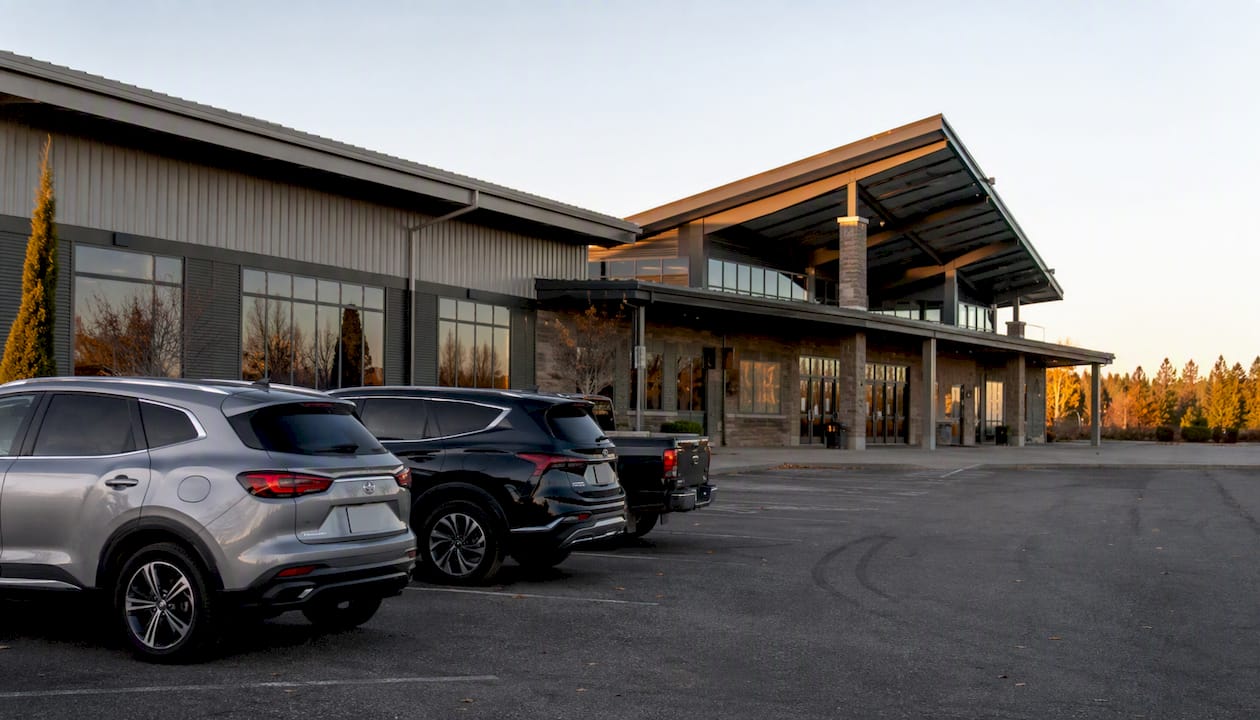
Before the season starts, walk every venue and time the route from field to shelter. If your safe shelter can't hold everyone, predefine an evacuation priority, players and officials first, then spectators, particularly anyone with mobility limitations, and stage people to avoid a bottleneck at the parking lot. A written plan that skips this step tends to produce exactly the chaotic scramble it was supposed to prevent.
When Is It Safe to Resume Play After a Lightning Delay?
Wait at least 30 minutes after the last lightning strike or thunderclap before resuming, and reset that timer completely if anything new occurs during the wait. The NFHS Sports Medicine Advisory Committee frames this as the operational standard, not a suggestion, and it's the same standard the NWS applies to outdoor sports broadly.
Before anyone steps back onto the field, run through this verification sequence:
- Confirm no new lightning strikes have registered within your monitoring radius in the past 30 minutes
- Do a visual and audio check yourself, don't rely solely on an app if you can still see flashes
- Get explicit sign-off from the Authorized Decision-Maker, not a verbal "looks clear" from a parent or assistant coach
- Verify the shelter area is fully cleared and accounted for before giving the resume signal
- Confirm no one needed medical attention during the delay before restarting competitive play
A quick resume checklist worth posting at your scorer's table:
- Detection system shows no lightning in the defined radius for 30 minutes
- No one on-site has seen lightning or heard thunder in that window
- The 30 minute clock ran uninterrupted, with no resets
- Shelter areas are clear and equipment/field checked for safety
- Decision-maker has given explicit verbal or written resume approval
Who Decides When to Stop or Resume Play?
Two distinct roles need to exist before the first whistle blows: a Weather Safety Official who watches conditions, and an Authorized Decision-Maker who has sole authority to call a suspension or resumption. CISA's guidance is specific that this chain of command should include an athletic director, on-site official, or lead event coordinator, and it needs to be communicated before the event, not improvised mid-storm.
The reason these can't be the same person, and often shouldn't be a coach or referee, is workload. A coach mid-game is watching the field, managing substitutions, and arguing a call. Nobody is checking the sky. The Weather Safety Official's entire job is tracking radar, detection alerts, and audible thunder, then flagging concerns to the decision-maker the instant a threshold is crossed.
Weather Safety Official duties: monitor NOAA Weather Radio, a detection app, and visual/audio conditions continuously; alert the decision-maker at the first sign of a stop trigger; log observations and timestamps.
Authorized Decision-Maker duties: hold sole authority to suspend or resume activity; communicate the decision to staff, officials, and spectators; sign off on the resume checklist before play restarts.
Write both names, and a backup for each, into your pregame notes and post them at the scorer's table or check-in desk. A tool like Roster Sports can help organizers keep those role assignments and event details centralized so nobody's digging through a group chat mid-storm trying to figure out who's actually in charge.
Pro Tip: The single most common authority conflict happens when a head coach overrides the decision-maker because "the storm looks like it's passing." Solve it before the season: put the delegation in writing, post it publicly, and tell every coach in the preseason meeting that the call is final regardless of rank on the roster.
What Do You Do if Someone Is Struck by Lightning?
Call 911 immediately, then start CPR and use an AED if the person isn't breathing or has no pulse. Move the victim only if the immediate location is still dangerous. That sequence, in that order, is what saves lives in the first few minutes after a strike.
The myth that stops bystanders cold: lightning strike victims do not carry an electrical charge. They are safe to touch and treat the instant they're struck. This single misconception has delayed CPR at real events because people were afraid of being shocked themselves. There's no danger in that regard, treat the person as you would any cardiac arrest.
On-site responder steps:
- Ensure the scene is safe before approaching, don't create a second victim
- Check responsiveness and breathing right away
- Call 911 and request EMS, giving your exact location
- Begin chest compressions immediately if there's no pulse or normal breathing
- Use an AED as soon as one is available; follow its prompts
- Continue care until EMS arrives and takes over
Cardiac arrest is the leading cause of death from a lightning strike, which is exactly why immediate CPR and AED use matter more than any other single response. Once EMS takes over, document the time of the strike, the weather conditions, and every action taken. That record matters for both the victim's ongoing care and your organization's incident file.
Which Weather-Monitoring Tools Should You Use for Lightning Safety?
Use at least two independent monitoring sources so no single failure point leaves your event blind. Relying on one weather app is how organizers get caught off guard when that app lags, loses signal, or simply misses a fast-forming cell.
| Tool | Typical Latency | Best For |
|---|---|---|
| NOAA Weather Radio | Near real-time alerts | Continuous background monitoring at a fixed venue |
| NWS forecasts/radar | Updated regularly through the day | Pregame planning and identifying storm risk windows |
| Lightning detection network/app | Near real-time, strike-by-strike | Setting a precise stop trigger by radius |
| On-site strike sensors | Real-time | Large venues with dedicated safety staff |
| Off-site meteorologist service | Real-time, interpreted | High-attendance events, tournaments, multi-field complexes |
NOAA Weather Radio gives you a steady, low-effort baseline that doesn't depend on cell signal, which matters at rural fields where data coverage is spotty. A detection app or network layered on top gives you the specific radius data you need to set a numeric stop trigger rather than waiting purely on eyes and ears. Larger tournaments with multiple simultaneous fields often bring in a contracted meteorologist, worth the cost when a missed call could affect hundreds of participants across several venues at once.
One rule overrides every tool on this list: if a human being on-site sees lightning or hears thunder, that observation takes precedence over any app, sensor, or forecast that hasn't caught up yet.
How Do You Write a Venue-Specific Lightning Safety Policy?
Start your emergency action plan with a single opening statement: "Activity will be suspended by the Authorized Decision-Maker at the first sign of lightning or thunder, and will not resume until 30 minutes have passed since the last observed strike or thunderclap." Everything else in the document builds out how that sentence gets executed at your specific venue.
CISA and similar organizations recommend tailoring plans to venue-specific factors rather than importing a generic template wholesale. A single-field youth practice and a multi-field regional tournament need the same core rule but very different shelter logistics and staffing.
Your policy checklist should cover:
- Chain of command with named roles and backups
- Stop and resume criteria (the 30/30 rule, stated explicitly)
- Shelter locations, mapped by field, with capacity estimates
- Monitoring sources and which one triggers action first
- Communication channels for staff, players, and spectators
- Medical response protocol, including AED locations
- Incident reporting process and where records get filed
- Annual review date and staff training schedule
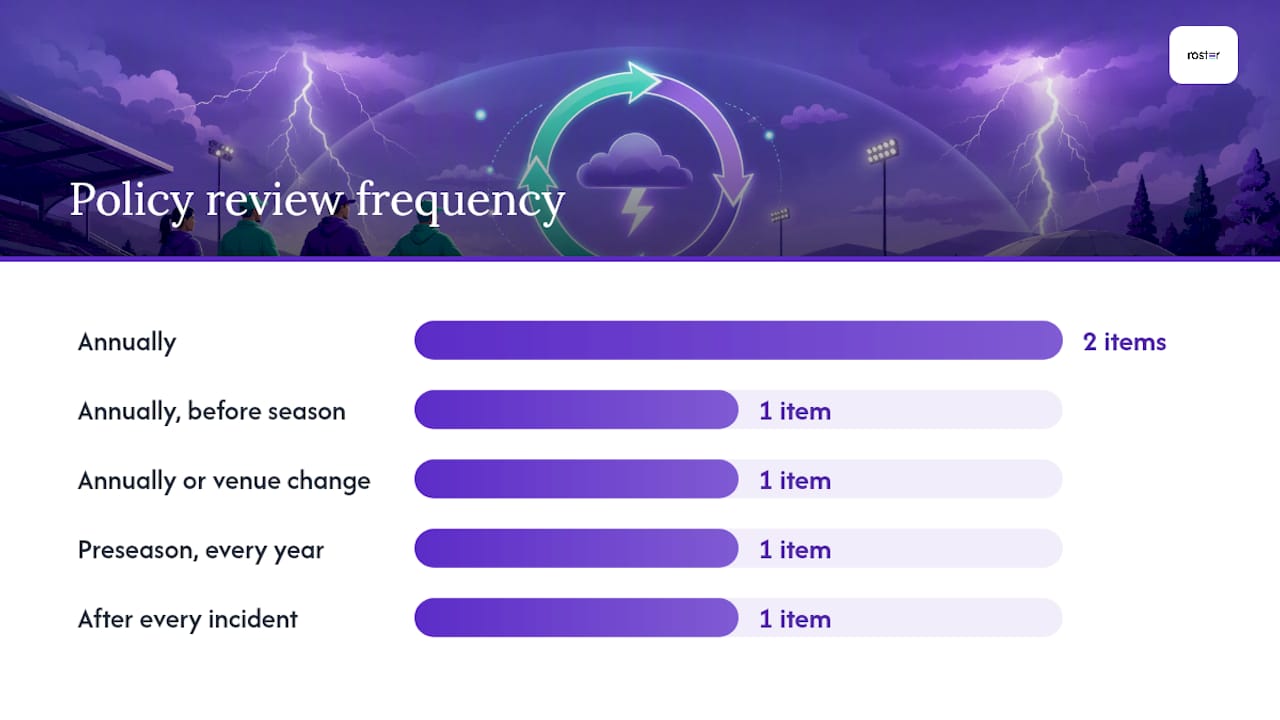
| Policy Element | Responsible Role | Review Frequency |
|---|---|---|
| Chain of command | Athletic director / event coordinator | Annually, before season start |
| Stop/resume criteria | Weather Safety Official | Annually |
| Shelter capacity mapping | Facilities coordinator | Annually or after any venue change |
| Monitoring source setup | Weather Safety Official | Annually |
| Staff training/drills | Head coach or athletic director | Preseason, every year |
| Incident reporting | Authorized Decision-Maker | After every incident |
A short editable snippet you can paste directly into a policy document: "[Organization name] designates [name] as Weather Safety Official and [name] as Authorized Decision-Maker for all outdoor events at [venue]. Play will be suspended immediately upon sighting lightning or hearing thunder. Shelter locations are: [list]. Play will resume no sooner than 30 minutes after the last observed lightning or thunder, subject to sign-off by the Authorized Decision-Maker."
After any real delay, hold a short debrief: what triggered the stop, how long evacuation took, whether shelter capacity held, and what you'd change. Review the full policy annually with coaches, facilities staff, and, where applicable, local EMS.
How Should You Communicate a Lightning Delay to Players and Spectators?
Pre-scripted alerts and regular drills cut evacuation time more than any single piece of equipment. A crowd that has heard the shelter announcement once, in a calm preseason walkthrough, moves faster and with less confusion than one hearing it for the first time as thunder cracks overhead.
Keep every alert short, directive, and repeatable across channels:
- PA announcement: "Lightning has been detected. All participants and spectators must proceed to [shelter location] immediately."
- Text/app alert: "Weather delay: Game suspended for lightning. Shelter at [location]. Updates to follow."
- Scoreboard message: "WEATHER DELAY, PROCEED TO SHELTER"
- Social media post: brief, timestamped, with the shelter location and a follow-up promise
Run drills at least once per season, ideally during preseason staff training, with every coach, official, and volunteer marshal participating. Evaluate on two metrics: how long it took to clear the field, and whether everyone reached an actual safe shelter rather than the nearest roof. Post shelter-location signage at every field entrance so first-time spectators aren't guessing during an actual delay.
Staff marshals stationed at exits prevent the parking-lot bottleneck that turns a 5-minute evacuation into a 15-minute one. Announce shelter locations before the event starts, not after the storm arrives, so people already know where they're headed. An app like Roster Sports that pushes real-time updates to a team roster can shorten the gap between a decision-maker's call and every player actually hearing it.
What Official Resources Should Organizers Consult First?
- NWS Lightning Safety Toolkit: forecasts, radar guidance, and the foundational 30/30 rule explanation for any organizer building a first policy
- CISA Lightning Safety Guide for Sports and Special Events: venue-tailored planning framework, chain-of-command templates, and shelter-assessment guidance for events of any size
- NFHS SMAC Guidelines: the operational standard many school and youth sports organizations reference for stop/resume criteria
- Korey Stringer Institute: research-backed guidance on athlete safety broadly, useful for cross-referencing heat and lightning protocols in the same emergency action plan
- National Athletic Trainers' Association (NATA): position statements on lightning safety aimed at athletic training staff and team medical personnel
If you're running a single-field program with volunteer staff, start with the NWS toolkit, it's the most digestible entry point. Larger organizations managing multiple venues or high attendance should work from CISA's guide first, since it's built specifically around venue size and crowd variables.
A Few Common Lightning Myths That Get People Hurt
"Heat lightning is a different, safer kind of lightning." It isn't. Heat lightning is just regular lightning from a storm too far away for you to hear the thunder. If you can see it, the storm producing it is a real threat, even if it looks distant and quiet.
"Rubber-soled shoes or tires protect you from a strike." They don't. Lightning has already traveled miles through the air; a few millimeters of rubber makes no meaningful difference. The reason a hard-topped vehicle offers some protection is the metal frame directing current around the occupants, not the tires underneath it.
"If it's not raining, it's not dangerous." Lightning frequently strikes ahead of a storm's leading edge or trails behind it after the rain has stopped, sometimes by 10 miles or more. Clear skies overhead don't mean a safe field.
An Organizer's Note on Lightning Policy in the Real World
Every lightning policy looks clean on paper until you're standing on a sideline with a packed parking lot, one gym that fits maybe half your crowd, and a storm cell that wasn't on anyone's radar 20 minutes ago. That gap between the written plan and the actual scramble is where most organizations get exposed, not because the rule was wrong, but because nobody rehearsed what happens when the safe shelter can't hold everyone.
The fix isn't a better rule. It's pre-assigning who goes where before the season starts, players and officials to the gym, spectators staged toward their vehicles with a marshal directing traffic so the lot doesn't gridlock. Organizations that treat shelter capacity as a real constraint, not an afterthought, get people to safety noticeably faster than those relying on "everyone knows where to go" instinct.
Document every single delay, even minor ones. What time the trigger happened, who made the call, how long the evacuation took, whether the shelter held. That log becomes the evidence you review each offseason, and it's the difference between a policy that improves every year and one that just sits in a binder until an incident forces a rewrite.
Key Takeaways: The Lightning Policy Essentials
A defensible lightning policy for sports rests on one rule: stop at the first sign of lightning or thunder, shelter in substantial buildings only, and wait a full 30 minutes before resuming.
| Point | Details |
|---|---|
| Stop trigger | Suspend activity the moment lightning is seen or thunder is heard, no exceptions for "almost done." |
| Shelter standard | Only substantial buildings with wiring/plumbing or enclosed hard-topped vehicles count as safe. |
| 30/30 rule | Wait 30 minutes after the last lightning or thunder, resetting the clock on any new occurrence. |
| Monitoring redundancy | Combine NOAA Weather Radio or NWS forecasts with a detection app so no single source fails you. |
| Chain of command | Name a Weather Safety Official and an Authorized Decision-Maker, and post both names before the event. |
| Training and drills | Run at least one evacuation drill per season so staff and players react fast, not confused. |
Pull your official templates from the NWS toolkit, CISA's guide, or the NFHS SMAC guidelines before writing your final policy document.
Where to Find Official Lightning Safety Guidance
- National Weather Service Lightning Safety and Outdoor Sports: core guidance on the 30/30 rule, shelter standards, and stop triggers — Weather
- CISA Lightning Safety Guide for Sports and Special Events: venue-tailored planning framework and chain-of-command templates — Cisa
- NFHS SMAC Guidelines on Lightning and Thunder Disturbances: the operational standard for stop/resume criteria used across school sports — NFHS SMAC guidelines
- Lightning Safety Guide (PDF): expanded CISA reference covering monitoring, communication, and EMS coordination — Cisa
- UIL Lightning Safety Guidance: flash-to-bang method and practical field-level fallback guidance — Uiltexas
- NWS Lightning Safety Training Materials: shelter classification details and further training content — Weather
Frequently Asked Questions
What is the 30/30 rule in lightning safety for sports? The 30/30 rule says to suspend activity if you can't count more than 30 seconds between a lightning flash and its thunder, and to wait at least 30 minutes after the last observed lightning or thunder before resuming.
Who should have the authority to stop a game for lightning? A designated Authorized Decision-Maker, someone separate from the coaches and officials actively running the game, should hold sole authority to suspend and resume play, supported by a Weather Safety Official who monitors conditions continuously.
Are dugouts safe shelter during a lightning storm? No. Dugouts, rain shelters, sheds, and open pavilions offer no real lightning protection despite having a roof. Only substantial buildings with wiring and plumbing, or enclosed hard-topped vehicles, count as safe shelter.
Is it true that lightning victims are electrified and dangerous to touch? No, that's a myth. Lightning strike victims do not carry an electrical charge and are safe to touch immediately. Call 911 and begin CPR or use an AED right away if the person isn't breathing or has no pulse.
How far away can lightning strike from a visible storm? Lightning can strike 6 to 10 miles from the center of a storm, which is why waiting for a storm to look directly overhead before stopping play is too late.
This article provides general safety information and is not a substitute for professional emergency planning or medical advice. Confirm your organization's policy against current NWS, CISA, and NFHS guidance, and consult a qualified safety professional for venue-specific planning.
Sources
- Lightning Safety Guide for Sports and Special Events — CISA
- Lightning safety and outdoor sports activities — National Weather Service