
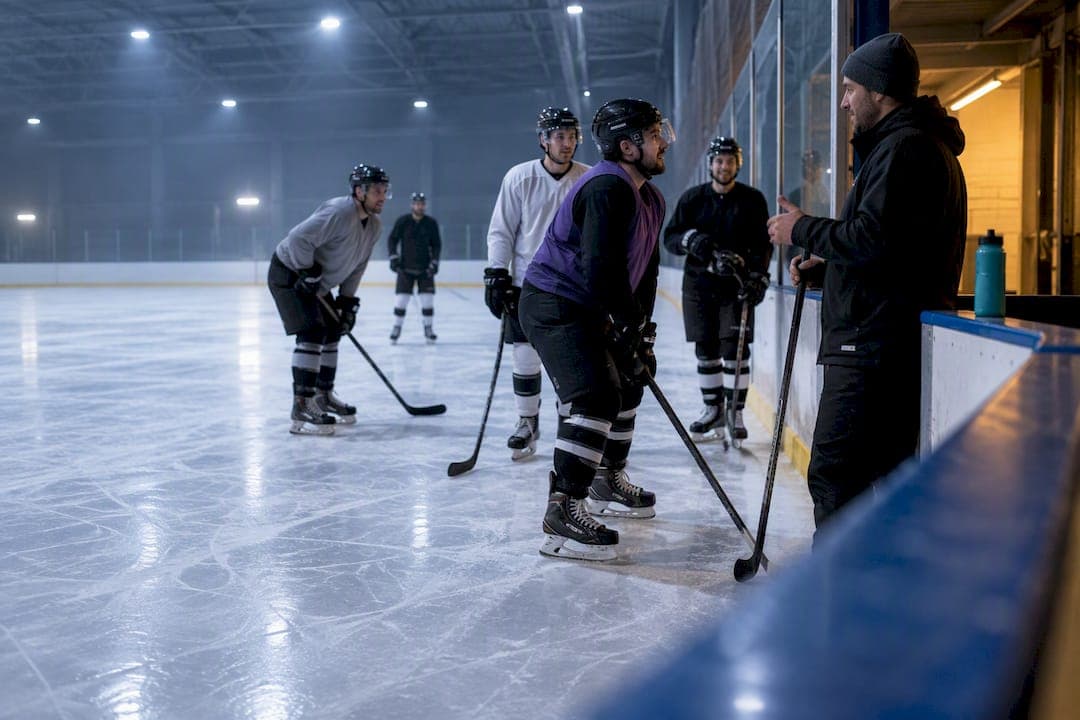
Running pickup hockey comes down to eight moves done in order: book the ice, pick a format and set of rules, price the session per skater, recruit a full roster plus alternates, collect payment before puck drop, confirm RSVPs with reminders, manage lines and goalies during play, and hold everyone to a basic safety and equipment standard. Tools like an ice scheduler, RSVP reminders, and a dedicated organizer app such as Roster can carry most of that load once the group grows past a handful of regulars.
TL;DR:
- Booking ice time during off-peak hours at municipal rinks or community centers typically costs less and is easier to reserve regularly.
- A full sheet supports 16 to 20 players in a 5-on-5 format, while smaller rinks are suitable for 3-on-3 or 4-on-4 games with fewer skaters.
- Expect per-player costs to include ice and facility fees divided by expected attendance, plus a 10% buffer for no-shows, with deposits discouraging cancellations.
- Self-rated skill levels and line rotation strategies help maintain balanced, inclusive games that are enjoyable for players of different abilities.
- Using a dedicated app like Roster can significantly reduce administrative workload by managing RSVPs, payments, and waitlist promotion for recurring groups.
Table of Contents
- Find and book ice time
- Decide the format and rules
- Budgeting and collecting money
- Recruit players and manage the roster
- Communicate and run the game
- Safety, equipment, and etiquette
- Make it recurring and retain players
- Handling weather and cancellation policies for outdoor pickup hockey
- Facilitating skill-level balance and inclusivity among players
- Tips for warming up and stretching to prevent injuries
- Author's perspective: tradeoffs and real-world tips from organizing pickup sports
- How Roster removes the admin work of running pickup hockey
- Sources
- FAQ
Find and book ice time
Start with municipal rinks, private arenas, YMCA branches, and community centers. Off-peak hours, usually late morning or after 9 PM on weekdays, cost less than weekend prime time and are easier to book regularly.
When you call or email an ice scheduler, ask about the hourly rate, minimum booking length, deposit and cancellation policy, whether staff or a referee is required, and dressing-room access. Some facilities publish this upfront: New England Sports Center lists private-rental hours and rates directly on its booking page, while Edwardsville YMCA shows a sample adult hockey rental structure with a competitive hourly rate and a moderate deposit. Booking platforms generally walk you through the same steps: pick a time, confirm the slot, and pay a deposit to hold it, a workflow described in general terms by guides on reserving a sports facility online.
Private rental gives you the full sheet and control over who plays, which matters once you are collecting money from strangers. Open or drop-in sessions cost less per skater but mix in random players and offer no control over format or safety rules.
- Call at least two rinks before committing, since rates and minimums vary block to block.
- Ask if multi-week blocks get a discounted rate compared with single bookings.
- Confirm whether the deposit is refundable if you cancel with notice.
Pro Tip: Lock in a recurring weekly slot even if attendance is uncertain at first. Rinks prioritize returning bookings when better time slots open up.
Decide the format and rules
Format depends on how many skaters show up and how much ice you have. A full sheet supports 5-on-5 with two goalies and four to six alternates, roughly 16 to 20 players. A half sheet or smaller rink works well for 4-on-4 or 3-on-3, which needs far fewer bodies, often just 10 to 12 skaters total, and keeps shifts short and game flow constant.
- 5-on-5: full ice, 16 to 20 players including goalies and subs.
- 4-on-4: full or three-quarter ice, 12 to 16 players.
- 3-on-3: half ice or small rink, 8 to 12 players, great for low turnout nights.
Rotate lines on a set interval, whether by whistle or a visible clock, so nobody camps on the bench or burns out on the ice. Decide your goalie policy before the first face-off: a guaranteed goalie for each side is ideal, a rotating goalie policy works when volunteers are scarce, and an open net with a mandatory low, slow-wrist-shot rule is a fallback when nobody wants to strap on pads.
Post a short rule sheet before puck drop covering checking tolerance (most pickup groups ban body checking outright), stick height, a zero-tolerance fighting policy, and how substitutes rotate in. The Adult Hockey League Rulebook is a useful reference for setting minimum roster counts and forfeiture rules if you want a more formal structure.
Budgeting and collecting money
Per-player cost is simple math: add the hourly ice rate to any facility fee, divide by the number of skaters you expect, and add a small buffer for no-shows.
- Add ice cost plus facility fees for the full booked hour.
- Divide by expected skaters, not the total roster, since some will always miss.
- Add roughly 10% to cover last-minute drops without leaving the group short.
A refundable deposit collected a few days ahead discourages no-shows better than an honor-system RSVP. Peer-to-peer apps like Venmo work well for small groups and put the money directly in the organizer's hands, cash at the rink avoids app fees but is easy to lose track of, and manager-collected pooled funds work for larger recurring groups but require someone willing to chase stragglers.
Whichever method you pick, publish the cost breakdown every time and share a quick summary after the game. According to guidance from Edwardsville YMCA, a transparent per-player cost breakdown reduces disputes and builds trust in the organizer over time.
Pro Tip: Send the cost breakdown in the same message as the RSVP link, not as a separate follow-up. Fewer messages means fewer players who miss the payment step entirely.
Recruit players and manage the roster
Fill your roster through channels where hockey players already gather: rink bulletin boards, local Facebook or Discord groups, coworkers, and friends of current regulars. Word of mouth from a trusted regular usually brings in better-fitting players than a public post.
Your invite message should answer six questions at once: who is playing, when and where, what it costs, what skill level fits, what gear is required, and how to RSVP. The game invite message guide breaks down the elements that reliably fill rosters, including an explicit skill-level indicator and a clear RSVP deadline.
- State the skill level plainly (beginner, intermediate, competitive), so new players self-select correctly.
- Set a firm RSVP deadline set a suitable time before the game.
- List required gear so nobody shows up in sneakers.
Keep a waitlist for once the roster fills, and promote alternates in the order they signed up, not by favoritism. Notify the next person on the list as soon as a spot opens, with a short deadline to confirm before you move to the next name. A no-show reduction approach that combines a reminder the night before, a small deposit, and a quick replacement pull from the waitlist keeps most sessions at full strength.
Communicate and run the game
Run a short pre-game check before puck drop: confirm who actually showed, check that both goalies are present or activate the open-net fallback, and glance over gear for anything obviously missing, like a helmet without a chin strap.
- Take attendance against the confirmed RSVP list, not the original invite list.
- Split into two balanced lines, alternating skill and position so no line is stacked.
- Set shift length, commonly less than a minute, and assign someone to call changes.
- Slot late arrivals and alternates into the rotation at the next natural break, not mid-shift.
Conflicts happen even in friendly games. A quick verbal warning usually settles a hard hit or a heated exchange. If it escalates, stop play, have both players sit out a shift, and restate the rule they crossed before resuming. Best-practice guidance from BenchApp points to a single communication hub, one RSVP link instead of a scattered group chat, as the single biggest factor in cutting last-minute confusion during game-day logistics.
Pro Tip: Assign one non-playing or early-arriving regular to run the bench clock. Shift timing falls apart fast when the organizer is also trying to play.
Safety, equipment, and etiquette
Adult pickup hockey should hold to the same baseline gear as any organized adult league: a helmet with a secured chin strap, shin guards, hockey pants, elbow pads, gloves, a protective cup, skates, and a stick. The Adult Hockey League Rulebook lists this equipment as a minimum standard, and organizers who enforce it before puck drop avoid most avoidable injuries.
- Require a helmet with chin strap and a protective cup at minimum, no exceptions.
- Recommend a full cage or half shield plus a mouthguard, especially for mixed-skill games.
- Ask new players to confirm their gear list in the RSVP reply, not at the rink door.
- Report dangerous plays, hard checks, or high sticks to the organizer immediately rather than letting it slide.
A rulebook-level equipment standard exists for a reason: the Adult Hockey League Rulebook treats full protective gear as a baseline requirement for adult play, not an optional upgrade.
Mixed-skill and coed games work best when everyone agrees upfront to dial back the physical play and prioritize passing over contact. A player who consistently ignores that agreement is a bigger threat to the group's longevity than a bad night on the scoreboard.
Make it recurring and retain players
Weekly cadence works for groups with a dedicated rink slot and an organizer with time to manage it every week. Biweekly suits smaller groups or organizers juggling other responsibilities, though it makes momentum harder to build.
Culture keeps a pickup group alive longer than any single game does. Send a short onboarding message to new players covering expectations (skill level, contact tolerance, gear), and consider a simple sign or reminder at the rink that the session is open to all skill levels. A quick recap message after each game, thanking a standout play or welcoming a new face, does more for retention than any highlight reel.
- Rotate small organizing tasks, like collecting payment or sending reminders, among a few regulars to avoid burnout.
- Recognize consistent attendees with something small, like calling next game's line assignments in their favor.
- Split into a separate time slot or skill tier once the group consistently exceeds available ice.
Guidance on running an inclusive pickup game points to clear expectations and visible inclusivity signals as the two biggest levers for keeping a mixed group together over time.
Pro Tip: Track attendance loosely for a month before deciding whether to add a second weekly slot. Guessing at demand usually leads to an undercooked second session.
Handling weather and cancellation policies for outdoor pickup hockey
Outdoor pickup hockey depends on ice conditions that indoor rinks never have to think about. Decide your cancellation threshold before the season starts: a minimum ice thickness, a temperature cutoff, or visible surface water are all reasonable triggers, and announcing the standard in advance prevents arguments on game day.
Build a simple weather check into your pre-game routine. Whoever lives closest to the rink checks conditions two to three hours before the scheduled time and sends a go or no-go message to the group. Waiting until people are already driving to the rink creates frustration and erodes trust in the organizer.
Set a refund or credit policy for weather cancellations before you collect the first payment. Many organizers roll a canceled session's payment forward to the next game rather than issuing refunds, which keeps the group's finances simple. Whatever you choose, state it in the same message where you first ask for payment so nobody feels blindsided later.
Have a backup plan for borderline calls. A shortened session, a smaller-format game on a cleared patch of ice, or a move to an indoor rink for that week keeps the group together instead of losing a night entirely. Groups that cancel without warning or explanation lose regulars faster than groups that cancel too conservatively but communicate clearly every time.

Facilitating skill-level balance and inclusivity among players
Skill imbalance is the fastest way to lose new players. Someone who gets run over in their first game rarely comes back for a second one, and a group that skews too competitive quietly stops attracting anyone outside its existing circle.
Ask new players to self-rate their skill level honestly when they RSVP, using simple categories like beginner, intermediate, and competitive, and use that information when splitting lines. Mixing one or two stronger skaters onto each line, rather than stacking all the strongest players together, keeps games close and enjoyable for everyone on the ice.
Set a shared expectation before puck drop that stronger players dial back the physical edge in a mixed-skill or coed session, and that everyone gets equal shifts regardless of ability. A pickup group that runs like a tryout stops being pickup hockey.
Watch for patterns over a few sessions rather than reacting to a single bad night. A player who consistently dominates play at the expense of others may fit better in a separate, more competitive time slot once the group is large enough to support one. Community discussion among adult players on threads like r/hockeyplayers frequently points to line rotation and honest self-rating as the two most effective tools for keeping mixed-skill games fun instead of lopsided.
Tips for warming up and stretching to prevent injuries
Cold muscles and stiff joints are a common source of pulled groins and strained hamstrings in pickup hockey, especially for adults who play once a week rather than daily. A few minutes of preparation before puck drop lowers that risk considerably.
Start with light cardio off the ice, even just a few minutes of jogging or jumping jacks in the locker room, to raise your heart rate and warm up muscle tissue before you put on gear. Follow that with dynamic stretches rather than static ones: leg swings, walking lunges, and hip circles prepare joints for movement better than holding a stretch in place.

Once on the ice, take the first few minutes at a controlled pace. Skate wide, easy loops, take a few soft shots, and let your first shift run a touch shorter than usual. Groin and hip flexor injuries are especially common in hockey because of the sport's lateral movement and quick stops, so a few extra minutes spent loosening the hips before full-speed play is worth the delay.
Encourage the same habit group-wide, not just for yourself. A five-minute shared warm-up before the first puck drop, even something informal like passing in a small circle, sets a tone that the group takes injury prevention seriously without turning pickup hockey into a training camp.
Author's perspective: tradeoffs and real-world tips from organizing pickup sports
The organizers who last longest are the ones who keep rules simple and invites clear. Overcomplicating a rule sheet or debating format every week burns goodwill faster than any bad call on the ice.
Invest extra structure only once a group outgrows casual management: a second time slot, a formal waitlist, or a stricter payment policy. Below that size, simplicity wins.
The three most common organizer mistakes are over-communicating in a group chat that buries the important message, leaving payment terms vague until someone disputes a charge, and running without a waitlist so a canceled spot goes unfilled. Fix all three with one clear invite message and one place to RSVP.
— Daniel
How Roster removes the admin work of running pickup hockey
Everything covered above, chasing RSVPs, tracking who paid, managing a waitlist, and keeping a scattered group chat from burying the important message, is exactly what Roster is built to handle. Instead of juggling a spreadsheet and three group threads, an organizer shares one signup link, and Roster fills open spots in real time, promotes the next alternate automatically when someone drops, and tracks Venmo payments between players and the manager without manual follow-up.
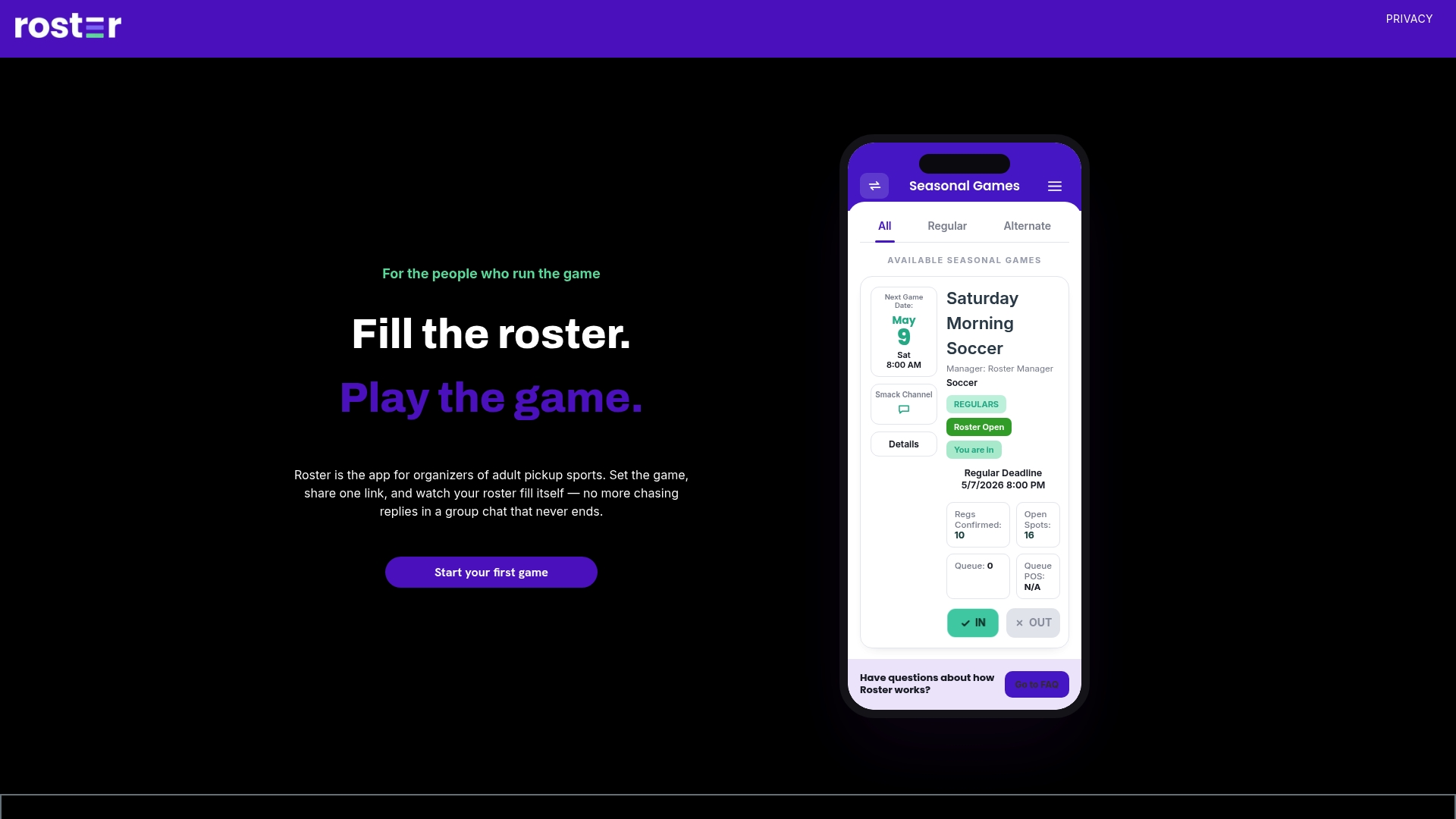
It makes the most sense once a group grows larger or runs on a recurring weekly schedule, since that is when manual tracking starts eating real time. For a casual one-off game among five friends, a text thread is still fine. For a standing weekly session with a waitlist and rotating alternates, Roster turns that admin work into a single link. Check the Roster landing page to see how the signup and payment tracking works for your next session.
Sources
FAQ
What is the 3-on-3 rule in hockey?
There is no single universal 3-on-3 rulebook for pickup hockey, since groups set their own variations. Most commonly it refers to a small-ice format with three skaters per side and no offside or icing calls, run to keep the game fast and accessible for smaller groups, as described in the format section above.
What is the etiquette of pickup hockey?
Pickup etiquette centers on respecting the mixed-skill nature of the game: dial back physical contact, share ice time, and report dangerous plays to the organizer rather than escalating on the ice. Groups that hold to a clear rule sheet and enforce it consistently, as outlined in the Adult Hockey League Rulebook, tend to stay welcoming to new players longest.
Where do you put your weakest player in hockey?
The common approach is to spread weaker players across different lines rather than grouping them together, which keeps each line competitive and shifts feeling fair. Organizers who ask new players to self-rate honestly at RSVP time can plan this balance before the game even starts.
How do I organize a recurring pickup hockey group?
Start with a fixed weekly or biweekly time slot, a simple invite message covering cost, skill level, and RSVP deadline, and a waitlist for when the roster fills. Tools like Roster can automate the RSVP link, waitlist promotion, and payment tracking once the group grows large enough that manual tracking becomes a burden.