

A team code of conduct is a short, shared agreement that spells out expected behaviors, observable norms, and what happens when someone crosses a line. To start yours: run a short workshop with your team, pick a handful of specific norms together, and have everyone sign off before the first practice or meeting.
Three immediate moves to get you going:
-
Schedule the workshop. Block 30–60 minutes with players, coaches, and (for youth sports) a parent rep. Participatory drafting produces stronger buy-in than a document handed down from the top.
-
Pick 4–6 norms. Fewer is better. Each norm should describe a visible behavior, not a vague value. “Arrive five minutes before practice starts” beats “be punctual.”
-
Decide sign-off. Will everyone sign a physical sheet, a digital form, or both? Settle this before the session so you leave with a completed document.
Pro Tip: Download the one-page printable template in Section 9 of this article, bring it to your workshop, and fill it in together. You’ll leave with a finished document.
Key Takeaways
A team code of conduct works when members write it together, sign it, and revisit it every season — not when it is handed down and filed away.
| Point | Details |
|---|---|
| Start with a workshop | Run a 30–60 minute session with all roles present; collaborative drafting produces stronger compliance. |
| Write observable behaviors | Replace vague values with specific, visible actions so the code is actually enforceable. |
| Build in graduated consequences | Use “if/then” steps (verbal reminder, written warning, suspension) so enforcement is proportionate and predictable. |
| Treat it as a living document | Review at the start of every season and after any significant incident to keep norms relevant. |
| Rostersports for ongoing visibility | Use Rostersports to post the code, collect acknowledgments, and send automated reminders across the season. |
Table of Contents
-
What is a team code of conduct, and why does every team need one?
-
Ready-to-adapt templates and examples for sports and workplace teams
-
Should sports teams use separate codes for athletes, coaches, and parents?
-
Common mistakes teams make when drafting and enforcing a code
-
Rostersports keeps your team code visible and your roster organized
What is a team code of conduct, and why does every team need one?
A team code of conduct is a concise, written agreement that defines how members will treat each other, handle conflict, and show up for the group. It is shorter and more personal than a formal HR policy. Where a workplace behavior policy might run twenty pages with legal citations, a team code typically fits on one page and uses plain language the whole group helped write.
The University of Michigan CRLT Engineering team contract guide frames it well: a good team contract states the team’s purpose, each member’s responsibilities, and the norms that govern how people work together, and it requires consensus and signatures from everyone involved. That last part matters. A code that nobody signed is a document nobody owns.
Concrete benefits teams report:
-
Faster conflict resolution because the standard is already agreed upon
-
Stronger psychological safety, since members know what to expect from each other
-
Clearer decisions during high-pressure moments (a game, a deadline, a difficult conversation)
Where codes of conduct show up:
-
Youth sports leagues (athlete and parent codes)
-
Adult pickup leagues and recreational teams
-
Project teams and cross-functional workplace groups
-
Competitive robotics and academic teams
The common thread is any group that needs consistent behavior across different personalities, roles, and stakes.
What should every team code of conduct include?
The University of Michigan CRLT guide recommends separating task-related standards from group dynamics norms, and writing “if/then” consequences so rules are actually enforceable. Below is a checklist of the core sections, each with a sample line you can copy directly.
| Section | What it covers | Sample language |
|---|---|---|
| Values statement | The team’s shared purpose in one sentence | “We compete to improve, support each other, and represent our community well.” |
| Scope | Who is bound by this code | “This code applies to all players, coaches, and parent volunteers during practices, games, and team travel.” |
| Expected behaviors (task) | Attendance, punctuality, task ownership | “Members arrive five minutes before scheduled start times and notify the group at least two hours in advance if they cannot attend.” |
| Expected behaviors (group) | Communication, respect, conflict | “Disagreements are raised directly with the person involved first, then with the coach if unresolved within 24 hours.” |
| Meeting norms | How the group runs sessions | “One person speaks at a time. Phones stay face-down during team meetings.” |
| Reporting process | Who to contact, how | “Report concerns to the team manager in writing. Reports are kept confidential to the extent possible.” |
| Consequences/escalation | Proportionate steps | “First breach: verbal reminder. Second breach: written warning. Third breach: temporary suspension from play.” |
| Review cadence | When the code gets revisited | “The team reviews this code at the start of each season and after any significant incident.” |
Additional elements worth including:
-
A signature block with date and printed name
-
An optional emergency contact line for youth teams
-
A short note on how to request a code revision
Pro Tip: Write every norm as something you could observe or hear. “Respect teammates” is invisible. “Address teammates by name and avoid sarcasm during feedback” is something a coach can actually see and address.
How do you create a team code of conduct in one workshop?
The Lucid Meetings ground rules guide recommends three steps: brainstorm norms, define observable evidence of each norm, and reach formal consensus with signatures. Here is how to run that as a single 45–60 minute session.
Pre-work (before the meeting):
-
Invite all relevant roles: players or team members, the coach or team lead, a parent rep for youth teams, and an admin if one exists.
-
Send a one-question prompt 24 hours ahead: “What’s one behavior that would make this team better to be part of?”
-
Print or share the one-page template from Section 9 so everyone arrives with the same frame.
Workshop agenda:
-
Open (5 minutes). State the purpose: “We’re writing our own rules together so everyone knows what to expect.” Emphasize that this is a shared agreement, not a top-down policy.
-
Brainstorm (10–15 minutes). Each person names two or three behaviors they want to see more of. Write every suggestion on a whiteboard or shared doc without editing.
-
Cluster and prioritize (10 minutes). Group similar ideas. Vote on the top 4–6 norms. Majority rules, but flag any norm that generates strong objection for a separate discussion.
-
Make them observable (10 minutes). For each selected norm, ask: “What would we see or hear if someone was living this norm?” Rewrite vague ideals into concrete behaviors.
-
Draft consequences (10 minutes). For each norm, agree on a proportionate “if/then” consequence. Keep it simple: verbal reminder, written warning, escalation.
-
Sign off (5 minutes). Everyone signs the document before leaving. If a two-session format works better for your group, use session one for steps 1–4 and session two for 5–6.
Decision and sign-off notes:
-
For youth teams, have parents sign a separate or parallel code at the same meeting.
-
For workplace teams, route the final draft through HR or legal for a quick review before circulation.
-
Store the signed document somewhere the whole team can access it, not just the coach’s inbox.
Ready-to-adapt templates and examples for sports and workplace teams
Three short snippets follow, each written for a different role. Adapt the language to your team’s age group, competition level, or organizational context.
Athlete/player snippet
This language works for adult recreational leagues and competitive youth programs alike. For younger athletes (under 12), simplify further: “I will be on time, listen to my coach, and cheer for my teammates.”
Coach/staff snippet
The RECF Library’s adult behavior guidelines recommend that adults in youth programs stay behind the scenes and actively encourage student-led problem solving rather than stepping in to provide answers. That principle translates directly into coach clauses like this one.
Parent/adult participant snippet
Adapting each snippet:
-
Youth recreational: Remove competitive-outcome language; add safety-first and fun-first clauses.
-
Adult pickup leagues: Shift the focus from parental involvement to peer respect and game etiquette.
-
Workplace teams: Replace “playing time” with “project responsibilities” and “officials” with “team leads or reviewers.”
The AIHR code of conduct template library and Rippling’s code of conduct examples both offer additional cross-sector phrasing worth reviewing before you finalize your own language.
| Template type | Primary focus | Enforcement style | Typical signatories |
|---|---|---|---|
| Athlete/player | On-field behavior, attendance, team support | Coach-led, playing-time consequences | Players, coach |
| Coach/staff | Role modeling, communication, player welfare | Admin or league-led | Coaching staff, athletic director |
| Parent/adult | Sideline conduct, communication with staff | League or club-led, removal from events | Parents, guardians |
How to communicate, enforce, and monitor your conduct code
A signed document is only the starting point. The City of Saint Paul’s workplace conduct policy is a useful reference for prohibited activities, reporting channels, and escalation language that teams can adapt at any scale.
Communication checklist:
-
Share the signed code with all members within 48 hours of the workshop
-
Read the key norms aloud at the first practice or team meeting of the season
-
Include the code in onboarding materials for any new member who joins mid-season
-
Post a one-page summary in the locker room, team channel, or shared drive
Investigation flow when a report comes in:
-
Member submits a concern (written, verbal, or through a designated form) to the team manager or coach.
-
The receiver documents the report with date, names, and a brief description.
-
Both parties are heard separately before any decision is made.
-
The manager applies the agreed consequence from the code or escalates to a league administrator or HR if the breach is serious.
-
The outcome is documented and filed. The reporting member receives a brief acknowledgment.
Monitoring and review:
| Monitoring tool | Frequency | What to track |
|---|---|---|
| Pulse survey (3–5 questions) | Mid-season and end of season | Whether members feel the code is followed and fairly enforced |
| Incident log | Ongoing | Date, nature, and resolution of each reported breach |
| Code review meeting | Start of each season or after a significant incident | Whether norms still reflect the team’s actual needs |

The Lucid Meetings guide recommends treating the code as a living document: integrate it into onboarding, revisit it regularly, and update it after incidents so it stays relevant rather than becoming a forgotten file.
Should sports teams use separate codes for athletes, coaches, and parents?
Short answer: usually yes, at least for youth programs. A single unified code can work for small adult recreational teams where roles are fluid. But when you have distinct groups with different levels of authority and different failure modes, separate codes give you clearer enforcement.
Why separate codes help:
-
Coaches and parents need different boundaries than athletes. A clause about “accepting coaching feedback” makes no sense in a parent code.
-
Enforcement differs by role. A player breach might mean reduced playing time; a parent breach might mean removal from the sideline.
-
Age-appropriate language matters. A 10-year-old athlete and a 40-year-old parent volunteer need different framing even when the underlying value is the same.
Sample coach clauses:
-
“I will not publicly criticize officials, opposing coaches, or my own players during or after games.”
-
“I will allow athletes to work through problems before stepping in with solutions.”
-
“I will communicate lineup and playing-time decisions to players before games, not during.”
Sample parent clauses:
-
“I will refrain from coaching my child or other players from the sideline during practice or games.”
-
“I will respect officials’ calls and model the sportsmanship I expect from my child.”
-
“I will direct concerns about team decisions to the coach privately, at least 24 hours after a game.”
The RECF Library guidelines make the case for adult codes being at least as rigorous as athlete codes, with explicit boundaries around adult involvement and clear consequences for interference with student-led work.
Integration options:
-
Cross-reference the codes (“The parent code supplements the team code of conduct dated [date]”).
-
Use a shared signature page where all parties sign their respective codes at the same event.
-
Attach role-specific codes as appendices to a single master document.
Common mistakes teams make when drafting and enforcing a code
Most codes fail not because the values were wrong but because of how the document was built or used afterward.
Mistake: Vague, aspirational language Fix: Replace “be respectful” with “address teammates by name and avoid sarcasm during feedback sessions.” Observable behavior is enforceable; a vague ideal is not.
Mistake: Top-down imposition Fix: Run the workshop described in Section 4. When members write the rules, they enforce them on each other without waiting for a coach to step in.
Mistake: One-time drafting, never revisited Fix: Schedule a code review at the start of every season and after any significant incident. A code that was written two years ago and never touched is a code nobody trusts.
Mistake: Vague or disproportionate consequences Fix: Use “if/then” language with proportionate steps. The FTC Team Duct Tape code of conduct shows how a competitive youth team handles this: written apologies for minor breaches, probationary periods for repeated violations, and temporary restrictions from team activities for serious ones. That graduated structure is easy to adapt for any team.
Mistake: No onboarding tie-in Fix: Every new member who joins mid-season should receive the code, read it, and sign it before their first practice. A code that only existing members know about is a code that creates inconsistency.
Mistake: Treating the code as a legal document Fix: Plain language builds culture; legalese builds resentment. The Project Include guide to writing codes of conduct recommends role-based clauses in plain language, framing the code as a culture-building tool rather than a list of prohibitions.
Pro Tip: Run a 10-minute role-play at your next team meeting. Present a realistic scenario (a player argues with a ref, a parent yells from the sideline) and ask the group how the code applies. Teams that practice enforcement are far less likely to freeze when a real situation arises.

A one-page printable team code of conduct template
Copy the text below into a document, fill in the bracketed fields, and print. It fits on a single page at standard margins.
[TEAM NAME] Code of Conduct Season: [Year] | Effective date: [Date]
Our purpose We are here to [compete / improve / have fun / represent our community — choose one or write your own].
Who this covers This code applies to all [players / members / coaches / parent volunteers] during practices, games, events, and team travel.
Our norms
-
We arrive on time and notify the group at least [X hours] in advance if we cannot attend.
-
We communicate directly and respectfully. No sarcasm, personal attacks, or public criticism of teammates or officials.
-
We accept feedback without argument and raise concerns privately with the coach or manager.
-
We follow all safety guidelines and report unsafe conditions immediately.
-
We support teammates in wins and losses equally.
-
We keep team communications and conflicts within the team.
Reporting Concerns go to [Name / Role] in writing or in person. Reports are handled confidentially to the extent possible.
Consequences First breach: verbal reminder from [coach / manager]. Second breach: written warning, documented and filed. Third breach: [reduced playing time / suspension from one event / removal from the team] at the discretion of [coach / league administrator].
Review This code is reviewed at the start of each season and after any significant incident.
Signatures
Optional: Emergency contact: _______________________ Phone: _______________________
Customization tips:
-
For youth teams, add a parent signature line below each athlete’s line.
-
For workplace teams, route the final draft through HR before distribution.
-
For adult pickup leagues, simplify to 4 norms and remove the emergency contact field.
The AIHR template library has additional section options if your team needs more formal language for scope or disciplinary procedures.
What actually works when you run this process
Most teams I have seen struggle with the same thing: they write a solid code, distribute it, and then never mention it again until something goes wrong. By then, the document feels like evidence rather than a shared agreement.
Two things make a real difference. First, read the code aloud at the first meeting of every season, not just the year it was written. That five-minute ritual signals that the norms are still active. Second, when a new member joins mid-season, have a veteran teammate walk them through the code rather than just emailing the PDF. Peer-to-peer onboarding builds accountability in a way that a document alone never will.
One thing I would do differently: involve the quieter voices earlier. In most workshops, two or three people dominate the brainstorm. The norms that emerge reflect their priorities. A simple fix is to collect written responses before the session and read them aloud anonymously, so every perspective enters the room before anyone starts talking.
The code is not the goal. The goal is a team that holds itself accountable. The code is just the clearest, fastest way to get there.
Roster Sports keeps your team code visible and your roster organized
Once your code is written and signed, the harder job is keeping it active across a full season of changing rosters, new signups, and group chats that move fast.
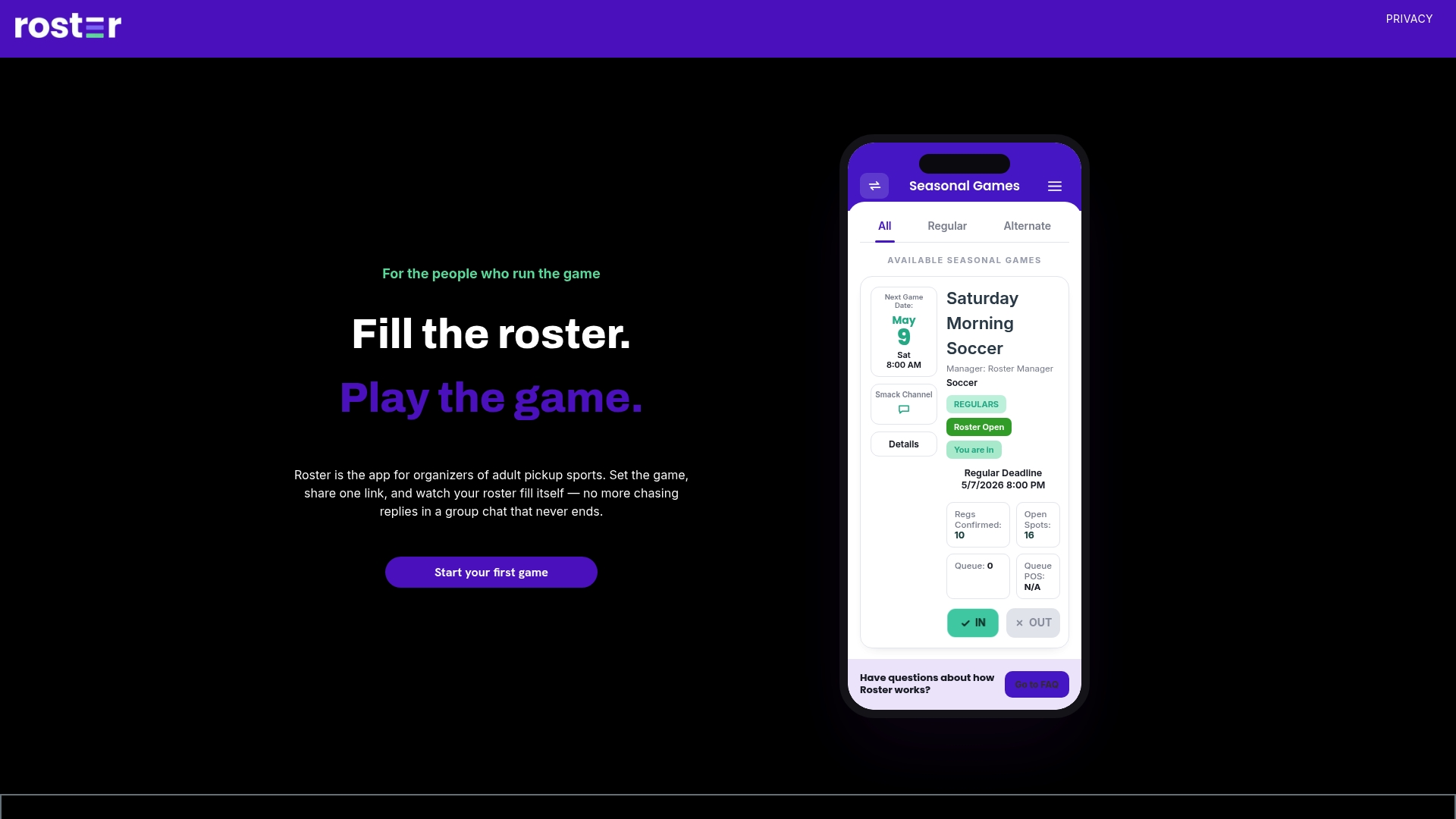
Roster Sports is built for adult pickup sports organizers who want less administrative friction and more time on the field. The app automates real-time player signups, manages waitlists when someone drops out, and handles group communication in one place instead of scattered threads. That same infrastructure is exactly what you need to keep your conduct norms visible: post the code as a pinned announcement, collect acknowledgments through the app, and send automated reminders at the start of each season without chasing anyone down manually.
If you are coordinating a recurring pickup league or a seasonal team, get started with Roster Sports and see how much time you get back when roster management runs itself.
Sources
-
Team Contract and Code of Conduct (University of Michigan CRLT Engineering)
-
Using ground rules to improve engagement and run excellent team meetings — Lucid Meetings blog
-
Free Code of Conduct Template and Guide (With Examples) — AIHR