

Count a player as paid only when the transaction shows up in your payment app's confirmed balance or transaction history and matches the roster entry by name, date, and amount. A screenshot, a text saying "just sent it," or a promise to pay later doesn't count. If your pay timing rule says fees are due before play, don't move a name from "pending" to "confirmed" until you've actually reconciled that transaction against your roster.
TL;DR:
- Confirm transactions manually in the payment app before marking them as paid, ensuring the amount, username, and timestamp match your roster entries.
- Use a weekly reconciliation schedule and a centralized ledger to prevent payment disputes and catch missing payments before game day.
- Prefer processing channels that generate automatic receipts, such as card payments via Stripe or Square, over fast but disputable methods like Venmo or Zelle personal accounts.
- Beware of fake payment confirmations and scams by verifying payments directly within the app, especially when overpayment or refund requests appear or when urgent claims are made.
- Integrate payment verification with roster management through automated systems to reduce manual effort, avoid miscommunication, and ensure a quick, reliable payment and attendance process.
Table of Contents
- How to Verify Player Payments in Under a Minute
- Building a Repeatable Payment Verification Process
- Which Payment Method Should You Actually Use?
- How Do You Spot a Fake Payment Confirmation?
- Handling Payment Reversals and No-Show Fees
- What Running Pickup Games Actually Teaches You About Payments
- Let Roster Handle Payment Verification For You
- Sources
How to Verify Player Payments in Under a Minute
You don't need a finance background to confirm player payments correctly, just a consistent habit. Here's the fast version you can run before every game:
- Open the payment app yourself and confirm the transaction is actually visible in your balance or transaction history, not just in a notification banner.
- Check that the payer's username, the exact dollar amount, and the timestamp all line up with what's on your roster.
- Grab the transaction ID or receipt number and log it against that player's name.
- For cash or check, hand over a signed receipt on the spot and write it down immediately, before you forget who paid what.
- If a payment is missing or shows as pending, apply your pay-before-play rule rather than assuming it'll clear in time.
Pro Tip: Keep a simple spreadsheet column called "verified" that only gets checked once you've personally seen the transaction post, not when someone tells you they sent it.
This is the kind of check that takes ten seconds per player when you've got a system, and ten minutes of arguing over Venmo screenshots when you don't.
Building a Repeatable Payment Verification Process
A one-off check works for one game. A recreational league running twelve weeks a season needs a workflow, or you'll spend every Tuesday night chasing down who actually paid.
Start with these four building blocks:
- Pick a payment timing rule and publish it. Decide whether fees are due at booking, before the first whistle, or on an invoice schedule, and put that rule in the same message where you share the game link. Ambiguity here is what creates disputes later.
- Centralize your records in one ledger. Every payment, regardless of channel, gets logged with the player's name, the method used, the amount, a transaction ID, and a timestamp. Scattered notes across three group chats guarantee you'll lose track of someone.
- Verify peer-to-peer payments inside the actual app before confirming anyone. This is the rule that matters most. Venmo's own help center warns users never to treat a screenshot or forwarded message as proof of payment and instructs account holders to confirm funds directly in the app instead.
- Reconcile on a set schedule, not whenever you remember. Daily works for weekly pickup games; weekly works for season-long leagues. Either way, a roster spot only flips to "confirmed" after that reconciliation pass, never before.
Where this breaks down most often is the assumption that a fast "confirmation" message from a player means the money moved. It doesn't. Fake payment confirmations are a well-documented pattern, and the only reliable defense is checking the app yourself rather than trusting what someone tells you they sent.
The last building block is the one most organizers skip because it sounds like extra work, but it actually removes work: automate the connection between signup and payment. When registration and payment happen in the same step, a paid registration effectively reconciles itself at checkout, which means you stop manually matching names to transactions altogether.
A weekly reconciliation habit doesn't need to be complicated. Assign one person, even if that's just you, to export the app's statement, compare it line by line against the roster ledger, flag anything that doesn't match, and follow up within a few business days. Clubs that build this into a regular routine catch missing payments before game day instead of during warmups.
The teams that struggle with payment chaos almost always share one trait: they're checking payments the night before a game instead of running reconciliation on a schedule. Build the habit once and the chaos mostly disappears.
Which Payment Method Should You Actually Use?
Every collection method comes with a different tradeoff between speed and paper trail, and picking the wrong one for your group size is where most reconciliation headaches start.
Venmo and Zelle move fast and most players already have them installed, which is why pickup organizers default to them. The catch is that running collections through a personal account creates real exposure: funds can get frozen, disputed, or reversed with no business protections behind them. If you're collecting dues regularly, a dedicated business profile is worth the small setup effort.
Cards through a processor like Stripe or Square generate an automatic receipt and drop straight into a statement you can reconcile against your bank record, which is why coaches who switch off cash and Venmo tend to cut their admin time noticeably. Cash and check still have a place, especially for last-minute walk-ons, but only if you log the payment immediately with a signed receipt naming who accepted it.
Whatever channel you use, track the same fields every time:
- Payer name and player reference on the roster
- Amount and payment channel
- Transaction ID or receipt number
- Date and time
- Admin who recorded it
| Payment channel | Speed | Recordkeeping | Best for |
|---|---|---|---|
| Venmo/Zelle (personal account) | Fast | Weak, disputable | Casual one-off games |
| Venmo/Zelle (business profile) | Fast | Solid, in-app history | Regular pickup groups |
| Card via processor | Fast | Automatic receipts | Recurring leagues |
| Cash/check | Instant | Manual, needs a signed receipt | Walk-ons, last-minute players |
Run reconciliation weekly: export your app or processor statement, match every line to the roster ledger, and flag mismatches for follow-up within a few days rather than letting them pile up until the season ends.
How Do You Spot a Fake Payment Confirmation?
Screenshots lie, and forwarded texts lie even more easily. Treat both as worthless until you've confirmed the transaction inside the actual app yourself.
Scammers targeting group collections tend to follow a pattern: they'll overpay slightly and then ask for a partial refund, or they'll create urgency by claiming they're about to lose their spot and need instant confirmation before the payment even clears. Both are red flags worth pausing on.
A few defenses cut this risk down significantly:
- Never mark a player confirmed based on a screenshot, forwarded email, or text message alone.
- Treat overpayment requests and refund pressure as warning signs, not generosity.
- Use a dedicated collection account with two-factor authentication, and limit who on your team can mark a payment as received.
- If something looks off, preserve every message and transaction detail, report it to the payment provider, and suspend that player's confirmed status until it's cleared.
Pro Tip: If a "player" asks you to refund part of a payment before it's even fully processed, stop and verify in the app first. This is one of the more common patterns behind Venmo scams targeting group payments.
Handling Payment Reversals and No-Show Fees
Reversals happen, and having a rule ready beats improvising one mid-dispute. A workable standard: payment must clear and post in the app or processor before a spot counts as confirmed, and any reversal within seven days automatically reverts that confirmation.
When a reversal hits, walk through the same steps every time:
- Un-confirm the roster spot immediately.
- Notify the player and give a short window to resolve it.
- Release the spot to the waitlist if it isn't cured in time.
- Keep every receipt and message on file in case the dispute escalates to a chargeback.
No-show fees only work if you enforce them the same way every week. Letting one friend skip the fee while charging everyone else guarantees resentment and inconsistent compliance. A clear, automated no-show policy paired with an active alternates list keeps games full even when people back out last minute.
What Running Pickup Games Actually Teaches You About Payments
The biggest mistake organizers make isn't picking the wrong payment app. It's treating payment tracking and roster management as two separate jobs. They aren't. Every reconciliation headache I've seen traces back to a spreadsheet that doesn't talk to the sign-up sheet.
Binding the two together, so a paid registration automatically fills a roster spot, removes most of the manual matching that eats an organizer's Tuesday nights. A single shared link and dashboard also kills the group-chat guessing game where three people ask "did you pay?" in three different threads. Less manual reconciliation means fewer arguments at kickoff.
— Daniel
Let Roster Handle Payment Verification For You
This app takes the manual matching out of payment verification by tying each player's payment directly to their roster spot the moment they sign up, instead of leaving you to cross-reference a Venmo history against a group chat after the fact.
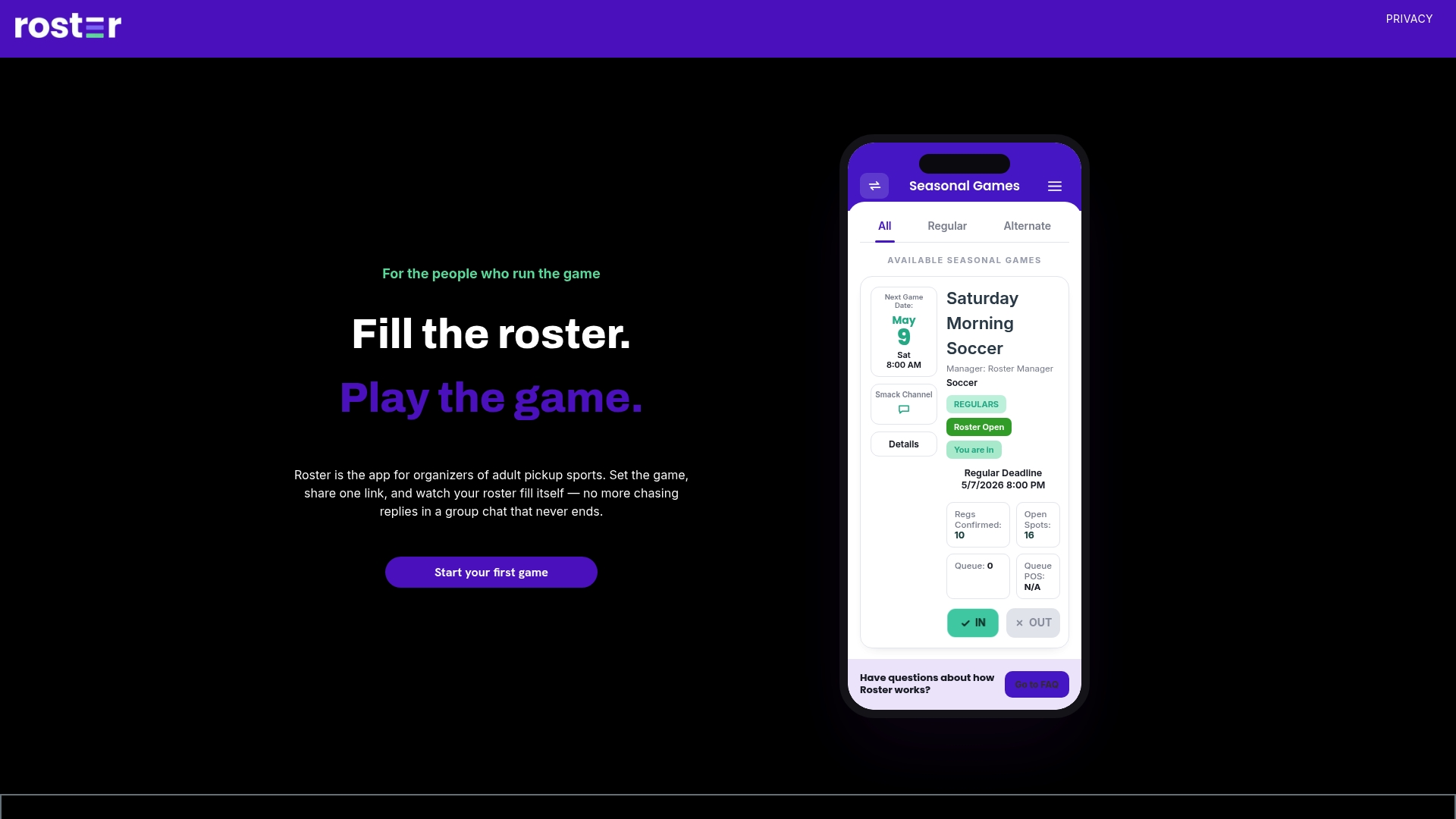
The app automates confirmation and waitlist movement so a paid signup fills a spot instantly and an unpaid one doesn't hold a place someone else could use. Payment records, including card receipts processed through the platform, stay attached to each roster entry, so you can quickly check who has paid recently. For organizers running weekly pickup games or full seasons, that's the difference between spending game day managing a spreadsheet and spending it actually playing.
If you're tired of chasing payment confirmations across multiple apps, consider checking out game management features that link roster and payment systems for you.
Sources
- Common Venmo Business Account Scams
- Common scams on Venmo
- How to Manage Club Finances Safely with Payment Apps | WDSportz
- How to Collect Youth Sports Payments | Centro
- Coachbusinesspro