

Running a weekly pickup soccer game typically costs a modest to moderate amount per session, depending mainly on field surface, lighting, and whether you need permits or insurance. A season on municipal turf with lights can add up to several thousand dollars once you factor in field rental, equipment, and payment-processing fees. Before you set a price per player, pull your city's written fee schedule, estimate how many players you can reliably field, and build your budget around venue choice, permits and insurance, and payment or admin fees.
TL;DR:
- Field rental costs vary significantly by surface type, with turf at $85 per hour and non-prepped grass at $44 per hour, based on local rates.
- Permits, insurance, and possible lighting or staff fees can add substantial upfront costs that should be included in your budget before setting player prices.
- Using peer-to-peer apps like Venmo incurs transaction fees of 1.9% plus $0.10 per payment if you operate a business profile, affecting your net income.
- Automating RSVPs, waitlists, and payment tracking with tools like Roster reduces admin time and helps avoid revenue loss from no-shows or last-minute cancellations.
- Booking a local referee depends on your game size and standards, but for casual pickup games, officiating is often optional and can be split among players if needed.
Table of Contents
- 1. Line-Item Costs Every Organizer Should Budget For
- 2. Three Budget Templates You Can Copy
- 3. How to Collect Player Payments Without Losing Money to Fees
- 4. What to Track for Taxes and Clean Recordkeeping
- 5. How Roster Cuts Admin Time and Cost Friction
- 6. Do You Need to Pay for Referees or Officials?
- 7. Are Uniforms or Team Identification Worth the Cost?
- 8. Budgeting for Safety Measures and Health Protocols
- 9. What Transportation and Parking Add to the Real Cost
- 10. Three Rules That Cut Both Cost and Uncertainty
- Review Your Budget and Admin Setup With Roster
- FAQ
- Sources
1. Line-Item Costs Every Organizer Should Budget For
Your biggest line item is almost always the field itself, and the surface you pick changes the math fast. Turf fields rent at a premium over grass because they need less maintenance downtime, while non-prepped grass is cheapest but comes with the worst footing after rain. As an example, Bothell, Washington's field rates list adult turf at $85 per hour with a 2-hour minimum, prepped grass at $52 per hour with a 2-hour minimum, and non-prepped grass at $44 per hour. Rates like these vary by city, season, and whether you qualify for resident pricing, so treat any example as a starting point, not a national number.

Permits and insurance add a second layer of cost and paperwork. Many municipal field offices ask for a certificate of insurance naming the city as an additional insured, often with a minimum liability limit, before they will sign a field-use agreement. Some districts also charge application or processing fees separate from the hourly rental rate, and a few require deposits that are only refunded if you follow cancellation rules exactly.
Equipment is the smallest recurring cost but still deserves a line item. Most organizers buy their own cones, pinnies, and a basic first-aid kit, since parks departments rarely supply more than the field and goals. Balls wear out faster than people expect on turf, so budgeting for periodic replacement rather than a one-time purchase keeps your numbers honest.
A few other categories round out the picture:
- Lighting surcharges: evening games on lit fields often carry a separate per-hour fee on top of the base rental rate.
- Staff or vendor fees: some venues bill extra for on-site staff, extended hours, or specialty field prep.
- Admin and platform fees: scheduling or roster software may charge per-player or per-use fees that belong in your per-game math.
- Cancellation penalties: weather policies at many venues, as shown in district fee schedules like PVRPD's master fee document, can include nonrefundable tournament fees or penalties that turn a rainout into a real loss.
Knowing which of these apply to your venue before you announce a price keeps you from eating a surprise cost mid-season. For a deeper look at how rental structure affects your number, see what soccer field rental actually costs.
2. Three Budget Templates You Can Copy
Here are three common setups and how the math works out for each.
- Informal free pickup: one organizer brings a bag of cones, a couple of balls, and uses a free public field. Out-of-pocket cost might run $10 to $20 a session for replaced gear, split informally among regulars or absorbed by the organizer.
- Paid weekly turf game: using a municipal adult turf rate like Bothell's $85 per hour with a 2-hour minimum, a 2-hour booking costs $170 before any lighting surcharge. Split across 12 players, that is about $14.17 each; across 16 players, about $10.63 each. Add a lighting fee if you play after dark, and build in a few dollars per player as a buffer.
- Season permit, amortized: a resident season permit secured through a district office often costs less per hour than one-off bookings, but requires paying upfront for a block of dates. If a 10-game season permit totals an amount similar to hourly booking rates for turf time, making the per-game cost comparable, but you are now exposed to the full nonrefundable cost if several games get rained out. Setting aside 5 to 15% of your gross field cost as a contingency fund for cancellations keeps a rough season from wiping out your margin.
Run your own numbers against your city's actual fee schedule rather than these illustrations, since resident status, time of year, and lighting minimums all move the total. For more on structuring refunds and no-show rules so cancellations do not sink your budget, see a no-show fee policy that keeps pickup games full.
3. How to Collect Player Payments Without Losing Money to Fees
Most organizers collect player fees through peer-to-peer apps, and the fee structure you choose changes your real take-home per game. A Venmo business profile charges a seller transaction fee of 1.9% plus $0.10 per payment, separate from any fee a standard personal account might incur, and that fee lands on the business profile owner, not the player paying. Standard bank transfers from a Venmo business profile are free and take one to three business days, while instant transfers carry an added cost, according to Venmo's own fee page.
A few practical choices to settle before your first game:
- Who absorbs the processing fee: some organizers build it into the per-player price, others pass it through as a small surcharge, and either is fine as long as it is stated upfront.
- Payment channel: peer-to-peer apps are simplest for small groups, while a credit-card processor or ACH setup may suit larger recurring leagues despite slightly different fee structures.
- Instant versus standard transfer: instant transfers get you cash faster but cost more per transaction, so reserve them for situations where you actually need same-day access to funds.
- Transparency: post your fee policy wherever you post the price, so players are not surprised at checkout.
Pro Tip: Keep a simple spreadsheet row for every game that lists expected payments, actual payments received, and any refunds, so reconciliation against your field invoice takes minutes instead of hours.
For a closer look at tracking peer-to-peer payments against your field costs, see how to track Venmo payments from players.
4. What to Track for Taxes and Clean Recordkeeping
The IRS frames allowable deductions around expenses that are ordinary and necessary for your specific situation, and whether a given pickup soccer expense qualifies depends on your own facts rather than a blanket rule. What matters most for an organizer is keeping clean, separated records rather than assuming anything is automatically deductible.
Categories worth tracking per event or season:
- Field rental invoices and permit paperwork.
- Certificates of insurance and any signed field-use agreements.
- Equipment receipts, including replacement balls, cones, and first-aid supplies.
- App or platform invoices tied to scheduling or roster management.
- Payment logs showing what players paid and what processing fees were deducted.
A workable routine is a per-game ledger entry with the field invoice attached, reconciled monthly against your payment records. Holding a small contingency fund for cancellation refunds keeps a rained-out game from throwing off your books. None of this is a substitute for professional advice: once your pickup game involves real money moving through your hands each season, a tax professional can tell you what actually applies to your situation.
5. How Roster Cuts Admin Time and Cost Friction
A large share of wasted field money comes from paying for slots that go empty because no-shows and last-minute drops are not managed in real time. Roster automates RSVPs, fills open spots from a waitlist, and tracks alternates so a paid field hour is less likely to go half-used.
Specific ways this shows up in your budget:
- Automated waitlists reduce no-show gaps that would otherwise mean paying for players who never show.
- Centralized payment tracking that integrates with peer-to-peer Venmo payments makes reconciling what each player owes against your field invoice faster than chasing a group chat.
- Roster's own billing is a line item to include in your planning: managers are charged per-player fees billed automatically after games.
For operational templates and more detail on how this plays out across a season, Daniel and the rest of the Roster Sports blog cover specific examples worth reading before your next season starts.
6. Do You Need to Pay for Referees or Officials?
Most casual pickup soccer games run without a paid referee, with players self-officiating fouls and out-of-bounds calls. That keeps costs down but can also mean more disputes mid-game, especially as a group grows or mixes skill levels.
If you do want a referee, cost depends entirely on your local market and the official's certification level, and there is no standard national rate for informal pickup games the way there is for sanctioned league matches. Some organizers split a flat per-game referee fee evenly among players rather than folding it into the base field cost, which keeps the line item visible and easy to adjust if attendance drops. Others reserve paid officiating for games that have gotten large enough, or competitive enough, that self-officiating is causing real friction.
If you go this route, treat the referee fee the same way you treat field rental: get a clear rate in writing ahead of time, decide whether it is a flat fee or hourly, and build it into your per-player price rather than absorbing it as a surprise organizer cost. For most casual weekly games, this remains optional rather than a baseline expense, and plenty of long-running pickup groups never add it at all.
7. Are Uniforms or Team Identification Worth the Cost?
Pickup soccer rarely requires real uniforms, but some form of team identification makes a noticeable difference once you are juggling more than a dozen players split into two sides. The cheapest option is a set of reversible pinnies or scrimmage vests, which most organizers buy once and reuse for years rather than replacing every season.

If your group plays regularly enough to want something more permanent, a basic printed or numbered shirt is the next step up in cost, though this moves you from a one-time pickup-game expense into something closer to a recreational team budget. For most managers, a simple set of two-color pinnies covers the actual need, which is quick visual separation of teams, not branding or identity.
Treat pinnies as a durable equipment purchase rather than a per-season cost: buy a set that fits your typical group size, store them with your other gear, and only budget for replacement when they wear out or go missing. This keeps the cost closer to the smaller end of your overall budget rather than competing with field rental or permit fees for priority.
8. Budgeting for Safety Measures and Health Protocols
Basic safety costs for pickup soccer are modest and mostly one-time. A simple first-aid kit covering cuts, sprains, and minor injuries is the baseline most organizers already budget for alongside cones and balls, and it rarely needs more than occasional restocking.
Health-related protocols, including any precautions tied to contagious illness, are a different kind of cost: they depend on current local guidance and venue policy rather than a fixed organizer expense. Some venues set their own rules around capacity or hygiene that organizers are expected to follow as a condition of booking, and those rules can change by season or by municipality. Rather than budgeting a specific dollar figure for this category, check your venue's current policy when you book and build in flexibility to adjust your group size or format if local guidance shifts.
Where safety costs do show up reliably is in your insurance and permit paperwork, since many municipal field agreements already require coverage that protects players in case of injury. That cost sits with your permits and insurance line item rather than as a separate safety budget, and it is one more reason to request the full written fee schedule before you commit to a season.
9. What Transportation and Parking Add to the Real Cost
Field location affects your total cost in ways that do not show up on any invoice but still shape who shows up and how much the game effectively costs each player. A field with free, close parking effectively lowers the real cost of attending, while a venue that charges for parking or sits far from where your regulars live can shrink your turnout even if the rental rate itself is a bargain.
If your venue charges for parking, decide upfront whether that is the player's problem or something you factor into your pricing conversation, since it is rarely practical for an organizer to cover parking costs directly. For venues with no on-site parking fee but a tight lot, arriving early or coordinating carpools among regulars is a free fix that keeps the game full without changing your budget at all.
When comparing two venues at similar rental rates, factoring in typical travel time and parking cost for your actual player base often matters more than a few dollars of difference in the hourly field rate. A slightly pricier field that is easy to reach can fill up more reliably than a cheaper one that nobody wants to drive to.
10. Three Rules That Cut Both Cost and Uncertainty
Running pickup soccer on a tight budget comes down to removing guesswork before it costs you money. Get the written fee schedule and cancellation terms from your venue before you ever quote a per-player price, since verbal estimates rarely match what shows up on the actual invoice. Pick one payment policy, state it plainly, and stick to it so players always know what they owe and why.
The biggest lever most organizers overlook is automating the parts of the job that eat time without adding value: tracking RSVPs, chasing payments, and filling last-minute drops. The organizers who stay in this longest are the ones who treat admin time as a real cost, not a free byproduct of running a game they love.
— Daniel
Review Your Budget and Admin Setup With Roster
Once you have your field costs, permits, and payment policy mapped out, the remaining friction is almost always admin time: chasing RSVPs, tracking who paid, and scrambling to fill a spot when someone drops an hour before kickoff. Roster is built specifically for that part of the job, automating signups, waitlists, and peer-to-peer Venmo payment tracking so you spend less time managing logistics and more time actually playing.
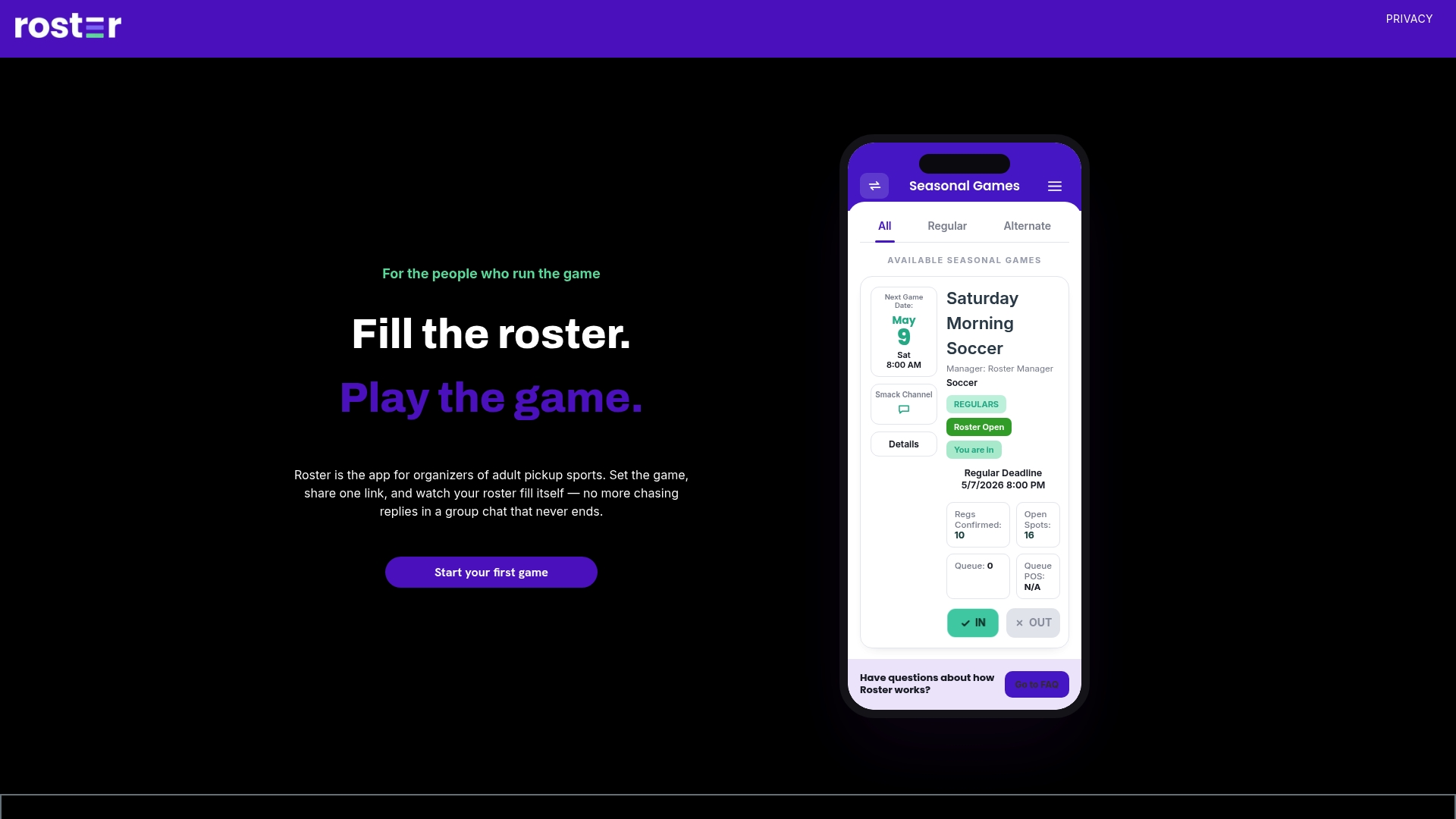
Our billing is straightforward and worth including in the budget you just built: managers are charged per-player fees billed automatically after scheduled games. If you are ready to see how it fits into your own season, visit the Roster landing page to review features and get started.
This article is general information, not a substitute for advice from a qualified financial advisor. Consult a qualified financial professional about your own circumstances before acting on anything here.
FAQ
How much does it cost to rent a soccer field for pickup games?
Field cost depends heavily on surface and location, with one municipal example showing adult turf at $85 per hour with a 2-hour minimum, prepped grass at $52 per hour, and non-prepped grass at $44 per hour. Check your own city's fee schedule, since rates and minimums vary widely by region and season.
Do I need insurance to book a field for pickup soccer?
Many municipal venues require a certificate of insurance naming the city as an additional insured before they will approve a field-use agreement. Requirements and minimum coverage limits vary by venue, so confirm the exact terms with your local parks or recreation office before booking.
What payment app fees should I expect when collecting player fees?
A Venmo business profile charges a seller transaction fee of 1.9% plus $0.10 per payment, with standard transfers free and instant transfers costing extra. Deciding whether you or your players absorb this fee is a policy choice worth stating clearly upfront.
Can I deduct pickup soccer organizing costs on my taxes?
Whether an expense qualifies as deductible depends on your specific facts, and the IRS frames deductions around expenses that are ordinary and necessary for your situation rather than a blanket rule for organizers. Keep separated records of field invoices, permits, and payment logs, and consult a tax professional if your pickup game involves meaningful recurring income or expenses.
How much does Roster cost to use as an organizer?
Roster charges managers per-player fees, billed automatically after scheduled games. There is no published price for features beyond this per-player model, so check the Roster site directly for the latest details.
Sources
- City of Bothell — Sportsfields / Field rates
- PVRPD District Master Fee Schedule (2026-2027)
- Venmo — Business profiles and fees
- IRS — Publication 334 and recordkeeping guidance