
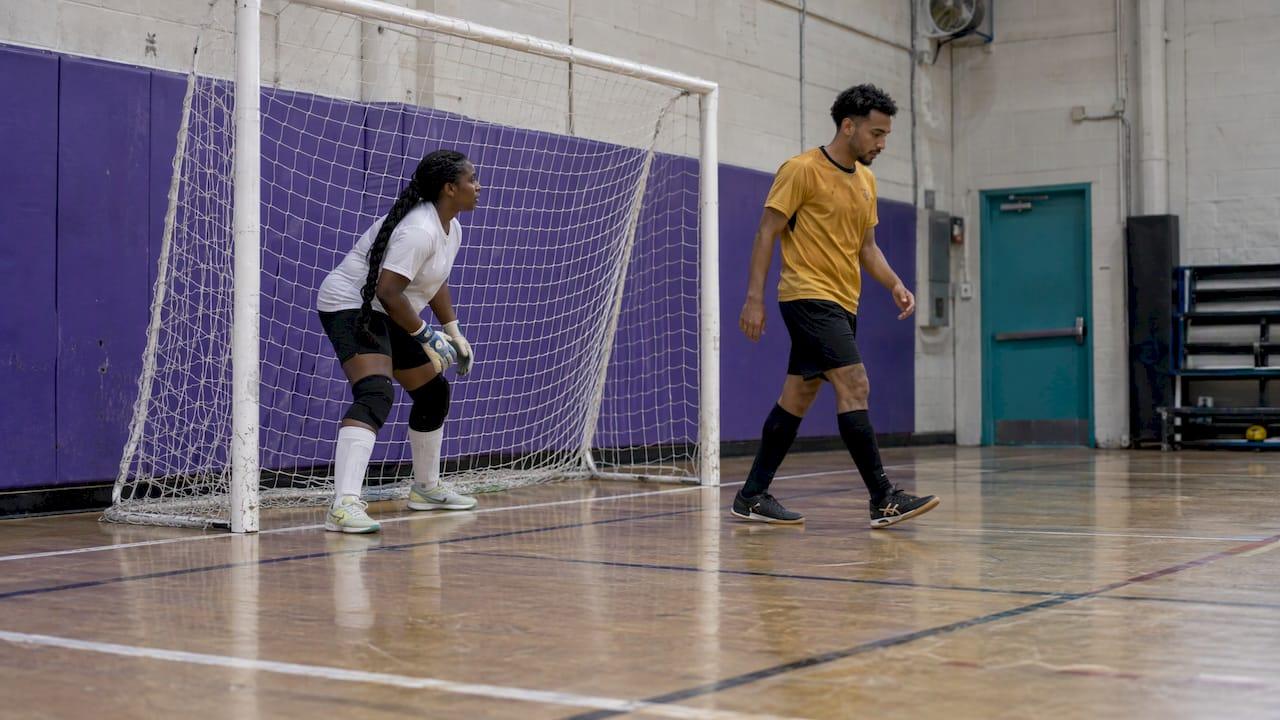
The best goalie rotation for a pickup game is one that is decided before anyone shows up, written where everyone can see it, and tied to a roster that is already full. Whether you run soccer, hockey or another sport with a net, the argument over who is in goal costs you more than the minutes spent playing there. Settle the method once, post the order with the game details, and the first ten minutes stop being a negotiation.
This guide covers how to choose a method, how to share the order, and what to do when people arrive late, leave early or flatly refuse to play goalie. We run Roster, an app for organizers of adult pickup sports, so we also show where the roster side of this problem gets easier when one link holds the signups.
TL;DR
- Pick one rotation method per game type and announce it in the signup message, not at kickoff.
- Volunteers first, then a fixed order, is the fairest default for casual groups: nobody is forced, nobody is stuck.
- Post the order in one place, and name a backup for each turn so a no-show does not stall the game.
- Keep a clear waitlist and alternates so a missing goalie can be replaced by someone who signed up for that purpose.
- Write down your rule for late arrivals and early departures once, and apply it the same way every week.
Table of Contents
- Why goalie rotation causes more friction than any other rule
- Five rotation methods and what each costs you
- Hockey and other net sports
- How to share the order so nobody has to ask
- Keep the game moving when plans change
- Late arrivals, early departures and players who refuse the net
- Count your keepers like any other slot
- Borrowing a rotation mindset from other sports
- Make it a routine, not a debate
- Put the goalie order on one roster
- Our perspective
- FAQ
- Sources
Why goalie rotation causes more friction than any other rule
Every pickup group has the same three people. One loves the net and would stay there all night. One will do it only if nobody else will. The rest quietly hope someone else volunteers. Without a rule, the game starts with an awkward silence, and the organizer, who is already handling the field, the bibs and the late texts, ends up assigning the position and absorbing the grumbling.
A rotation fixes this because it turns a personal request into a group norm. Nobody is singled out. It also protects the keeper. Goalies take a different kind of workload than field players: long stretches of standing, then bursts of diving, saving and distribution. Sharing it keeps the position fun for those who want it and bearable for those who do not.
The point of a rotation is not equal minutes down to the second. It is that everybody understands the rule and believes it is applied evenly.
Five rotation methods and what each costs you
There is no single correct system. Public pickup programs handle it differently, which is a useful signal that the right answer depends on your group.
1. Volunteers only
The Great Falls Reston Soccer Club's adult pickup league plays with or without goalies, depending on who volunteers for the position. That is the lightest approach: no schedule, no tracking.
It works when you have one or two people who genuinely like keeping. It breaks when they miss a week, because the game then runs with no keeper at all or someone is pressured into it. If you use volunteers only, decide in advance whether you play keeperless, use a rolling field-player goalie or shrink the goal.
2. Volunteers first, then a rotation
This is the method we recommend for most adult groups. Anyone who wants the net takes the first shift. If nobody does, or if the volunteer wants a break, the group rotates in a set order. Pickup Soccer NYC's game rules take this approach: goalkeepers take turns rotating unless a player specifically requests to stay in goal.
The benefit is that people who love the position are happy and people who do not are not trapped. The cost is that you need a visible order so the rotation is not just "whoever looks away last."
3. Fixed order by arrival or by signup
The first person to sign up takes the first shift, the second takes the next, and so on. It is easy to explain and hard to dispute, because the order comes from a record, not from your judgment.
The tradeoff is that signup order rewards the people who respond fastest, and they will end up in goal first every week. Reverse the order on alternate weeks to keep it balanced.
4. Timed shifts
Set a shift length, such as 15 or 20 minutes, and rotate when the clock hits it. This is the fairest on minutes and works well in short, high-energy games. It also adds friction: someone must watch the clock, and swapping gloves and positions mid-flow interrupts play. Tie the change to a natural stop instead of a hard whistle, such as a goal or a ball out of play.
5. Goals-conceded or score-based swaps
A keeper rotates out after conceding a set number of goals, or the player who scores swaps into goal. It is fun and self-correcting for loose, social games. It is less fair to the person who happens to play behind a weak defense, so use it only in groups that treat the game as a joke first.
| Method | Best for | Main risk |
|---|---|---|
| Volunteers only | Groups with a regular keeper | Nobody shows, game stalls |
| Volunteers, then rotation | Most adult pickup groups | Needs a posted order |
| Fixed signup order | Larger, steady rosters | Fast responders always go first |
| Timed shifts | Short, intense games | Clock-watching, interrupted play |
| Score-based swaps | Social, low-stakes games | Uneven for weaker defenses |
Hockey and other net sports
Hockey adds a practical wrinkle: goalie gear is expensive and takes time to put on, so rotating a full set between skaters is rarely realistic. Many pickup hockey groups treat goalies as a separate signup slot, so the question becomes how many goalies you need and how you cover a missing one, not how to rotate. If you run hockey, our guide to organizing pickup hockey walks through the signup structure, including how to handle slots that are hard to fill.

For soccer, futsal, lacrosse and similar games with shared equipment, the methods above apply directly.
How to share the order so nobody has to ask
A rotation that lives in your head is not a rotation. It is a series of requests. Here is how to publish it.
- Announce the method with the game details. Put one line in the signup message: "Goalie: volunteers first, then we rotate in signup order, 20 minutes each." Players who dislike the rule can decide not to come, and that is better than a fight at the field.
- Write the order down. List the names in the order of turns. If you use signup order, the list builds itself from your roster.
- Name a backup for each slot. If the person on the list is late, the next name steps up and the late player takes the next open turn.
- Repeat it in the group chat on game day. A morning reminder with the order and kickoff time prevents most confusion.
- Keep it the same for a full season. Changing the rule mid-season invites debate about every past decision.
Once the roster is set, the order is trivial to publish. In Roster, you set the game details and share one link, and the app tracks signups, regulars, alternates and the waitlist, so the list of who is actually playing is already accurate when you write the order. Group chat is built in, so the order and any change go to the people who are really on the roster instead of a thread with 40 half-interested members.
Keep the game moving when plans change
The goalie rotation is only as steady as the roster beneath it. A rotation built for 14 players collapses when 9 show up. Two practical rules from public pickup programs help.
First, plan around a maximum. Pickup Soccer NYC caps full-field play at 24 players, counting 12 per side including the goalkeeper, and brings in substitutions beyond that. Whatever your own number is, a cap tells you when rotating becomes about subs, not just the net.
Second, set a rule for waiting players. The same rules direct players waiting off the field to call for a substitution after a reasonable 5 to 10 minutes, with organizers facilitating the process. That gives you a model: a standard wait time, announced up front, applied to everyone.
If the game is short on bodies, our guide on how to find subs for soccer covers filling gaps quickly. And if you need a policy for what happens when a player gets hurt, including a keeper, see our notes on writing an injury substitution policy.
Substitution timing in a rotation
More structured adult leagues restrict when substitutes can enter. The Great Falls Reston over-35 rules allow unlimited substitutions at stoppages except corners and direct or indirect kicks, including penalty kicks, and substitutes need referee approval before entering. You probably do not have a referee, but the principle transfers: swap goalies at a stoppage, never in the middle of an attack and never right before a set piece. Say so in your rules and nobody will be caught off guard by a keeper leaving at a bad moment.
Late arrivals, early departures and players who refuse the net
This is where most organizers improvise, and where a written rule pays off most.
Late arrivals
Give late players the next open turn, not the one they missed. If the order is fixed, the late arrival joins the end of the list. The person who showed up on time should not lose their shift because someone else was stuck in traffic. Say this in your signup message, and say it kindly.
Early departures
Ask anyone who must leave early to take their goalie turn first, before they go. It is a fair trade: they get to play the position and the rest of the group does not inherit an uneven rotation. If they cannot, they skip their turn, and the order simply closes up.
Players who do not want to play goalie
Some people play adult pickup precisely because they do not want the pressure of the net. Respect that. A rotation that forces everyone is a rotation that loses players. Two workable options:
- Opt-out with a swap. A player who skips goalie covers another duty, such as bringing the ball bag, keeping time or taking the first sideline sub turn.
- Declared keepers. Ask in your signup message who is willing to keep. If you have enough willing players, the rest never face the question.
The Pickup Soccer NYC approach, rotation unless someone specifically asks to stay in goal, leaves room for the opposite request too: players who love the position can claim it and everyone else benefits.
When nobody wants it
If no one volunteers and the group will not rotate, play without a keeper, use smaller goals or make the position a rolling "sweeper keeper" who can use feet only outside the box. Decide this ahead of time, not at the whistle.
Count your keepers like any other slot
When you cannot rotate because there are too few willing keepers, the problem is your roster, not your rule. Treat the goalie as a position you need covered and plan alternates for it. An alternate who has already said yes to keeping is worth more than five who said yes to "playing."
That is the logic behind regulars and alternates: regulars hold a spot for the season, and alternates fill in game by game. Roster tracks both, along with the waitlist, so when a regular drops out, the open spot fills from people who have already opted in rather than from a frantic round of texts. For a wider look at running a game from first message to final whistle, read our five decisions for organizing pickup soccer.
Borrowing a rotation mindset from other sports
Organizers in other sports solve a similar problem: sharing a demanding position fairly over a season. If you want a framework for thinking about workload, turns and limits, this piece on how to plan rotations for a pitching staff shows how a coach builds a schedule around who has played what. The same habit of writing down turns and tracking them helps a pickup group keep its goalie order honest.
Make it a routine, not a debate
A short checklist you can paste into every game announcement:
- Method: volunteers first, then rotation in signup order.
- Shift length: one half, or 20 minutes, whichever your group prefers.
- Swaps happen at stoppages only.
- Late arrivals join the end of the order.
- Anyone leaving early takes their turn first.
- Backup goalie for each turn is the next name on the list.
Paste it once, adjust it once a season, and you have removed the most repeated argument in your group chat.
Put the goalie order on one roster
A rotation needs a trustworthy list of who is playing. Roster is built for adult pickup organizers: you set the game or season details, share one link, and players sign up in real time. Regulars and alternates are tracked, open spots fill automatically, dropouts create a waitlist, and the group chat lives inside the app. Payments between players and managers can be tracked through Venmo, so you are not chasing money either.
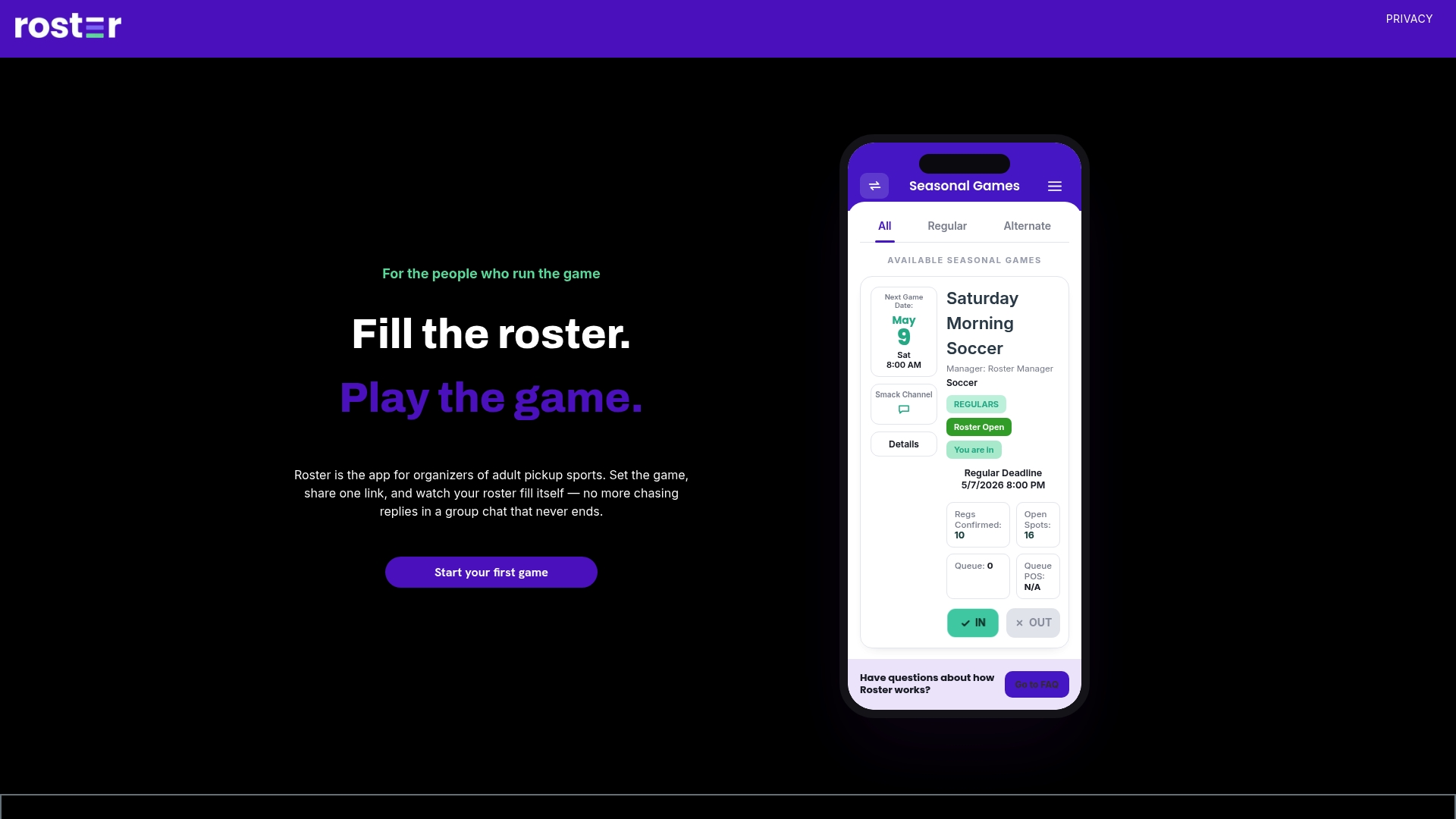
If you are tired of rebuilding the lineup from scattered texts every week, set up your next game at Roster and post your goalie order to a roster that is already confirmed.
Our perspective
Most goalie fights are really roster fights. When a game is short, the keeper slot is the first one nobody wants to fill, and the organizer ends up pleading in a group chat at 6 AM.
We built Roster for people who run adult pickup games and are tired of that. The idea is simple: set the game, share one link, and let the app handle who is in, who is an alternate and who is on the waitlist. Once you know exactly who is playing, a goalie rotation is easy. You write the rule, post the order, and get on with the game.
Our advice is to keep the rule boring. Volunteers first, then a posted order, swaps at stoppages. Boring rules are the ones people follow, and they free you to play instead of referee the chat.
Daniel
FAQ
How long should each goalie shift be in pickup?
A common starting point is 15 to 20 minutes or one half, depending on game length. Pick a unit that fits your game and keep it for the season. Change at a stoppage, not mid-attack.
What if nobody wants to play goalie?
Ask for declared keepers in your signup message so you know before kickoff. If none step up, rotate in a posted order, shrink the goals or play with a field-player keeper. Deciding this in advance keeps it from turning into an argument at the field.
Should the organizer always play goalie?
No. An organizer who is always in goal never gets to play the game they built. Put yourself in the same rotation as everyone else, and let a posted order take the pressure off you.
How do I share the goalie order with the group?
Post it with the game details and repeat it in the group chat on game day. Name a backup for each turn so a late arrival does not stall the game. With Roster, the signup link and group chat live in one place, so the order reaches the people actually on the roster.
Sources
- Pickup Soccer NYC: Game Rules
- Adult Soccer, Great Falls Reston Soccer Club
- How to Plan Pitcher Rotations for Youth Baseball, Pitch Training Baseball