
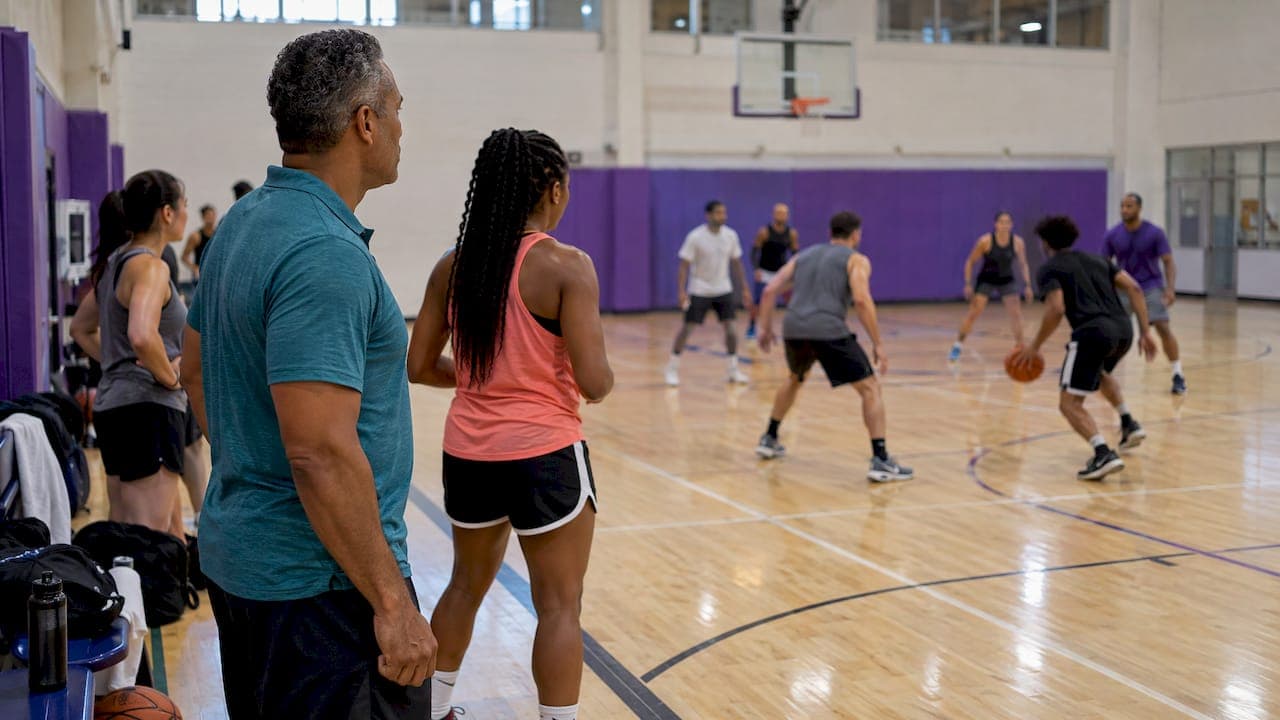
Set your roster limit by working backward from the format you play: count the players on the field or court at once, add a small bench for rotation, then stop signups at that number and put everyone else on a waitlist. For most adult pickup games that means a cap of two to five players above the starting lineup, enforced by one signup link instead of a group chat thread.
This guide covers how to pick the number, how to handle the people who don't fit, and how to keep a game from ending up overbooked with ten people standing around a half-court.
TL;DR
- Start with your format (3v3, 5v5, 7v7, 11v11), then add a bench sized to how much rest your players want, not to how many people replied "yes."
- Your real cap is set by your tightest constraint: court or field space, how long you have the venue, and how many people you can keep happy.
- Use one signup source of truth. A cap in a group chat is a suggestion; a cap in a signup list is a rule.
- Run a waitlist that moves automatically when someone drops, so open spots fill without you texting around.
- Tell people the cap, the cutoff and the cancellation rule in the same message, every time.
Table of Contents
- Why a roster limit matters in pickup games
- Start with the format, then add a bench
- Find your tightest constraint
- Regulars and alternates: two kinds of spots
- How to stop a game from becoming overbooked
- How signups, cancellations and waitlists should work
- How to communicate the limit clearly
- Adjusting the cap over time
- Perspective: a cap only works if it's enforced for you
- Put your roster limit on autopilot
- FAQ
- Sources
Why a roster limit matters in pickup games
Overbooking sounds like a good problem. In practice it is the fastest way to sour a regular game. Eighteen players show up for a 5v5 run, half sit for most of the night, and next week six of them don't come back. Underbooking is the opposite problem: you cancel at the last minute and your core group stops trusting the game.
A roster limit is how you make a promise to your players: if you're on the list, you will play, and you'll play enough to be glad you came. That is the idea behind one capacity guide, which frames the right number as the smallest group you can serve well rather than the largest number a venue can physically hold. For a pickup organizer, "serve well" mostly means playing time.
Start with the format, then add a bench
Your minimum and your maximum come from the game itself. Here are working numbers for common adult formats. Treat them as starting points you adjust after a few weeks of watching who actually plays.
| Format | On the field or court | Reasonable cap | Notes |
|---|---|---|---|
| 3v3 half-court basketball | 6 | 8 to 10 | Winners stay on, so a longer line is tolerable |
| 5v5 full-court basketball | 10 | 12 to 15 | Shorter runs mean more rest for a bigger bench |
| 5v5 or 6v6 indoor soccer | 10 to 12 | 14 to 16 | Rolling substitutions keep legs fresh |
| 7v7 soccer | 14 | 15 to 18 | See the league example below |
| 11v11 soccer | 22 | 24 to 26 | Allow for no-shows, because one missing player can sink a full field |
| Volleyball (6v6) | 12 | 14 to 16 | Rotate subs by side-out |
Those caps are our own rules of thumb, not a standard. If you want an outside benchmark, adult leagues publish theirs. One U.S. adult soccer club limits 7v7 team rosters to 15, with a minimum of 8, and allows unlimited substitutions within the game rules. A 15-player roster for a 7-player side is roughly double the starting lineup, which works for a team that plays every week but is generous for a pickup game where everyone wants equal minutes.
City recreation departments take a similar line. Long Beach's adult sports rules say teams should carry a full roster to cover injuries and absences, and leave the actual limit to each sport's own rules. The principle carries over: the cap exists so the game happens even when life gets in the way, not so as many people as possible can say they're in.

Find your tightest constraint
The format gives you a first number. Then check it against everything else that could break. The capacity guide mentioned above suggests setting the public cap by your tightest operational constraint, and asks you to picture what goes wrong if every confirmed person arrives on time. For a pickup game, run through these:

Space. How many courts or fields did you actually reserve? A single gym court supports one game. Two games need two courts, and the cap doubles only if you really have both.
Time. If you have the gym for 90 minutes and want everyone to play at least 60, do the math before you open signups. A sixty-minute minimum for 15 people on a 10-person game does not work. A planning document from an Australian croquet association walks through the same logic, calculating capacity from available playing minutes, game length, breaks and simultaneous games. When demand exceeds what the schedule can handle, it lists two options: limit participants or keep a waiting list. That's exactly the choice you face.
Your own attention. If you have to track every name by hand, 30 people is a lot. A cap you can't manage is not a cap.
Skill balance. If you play competitively, five extra beginners can change the quality of the run. Some organizers keep a core list of regulars and a separate pool of alternates for exactly this reason.
Facility rules. Some parks and rec centers have occupancy limits or require permits for larger groups. Check with the facility before you publish a number you can't honor.
A worked example
Say you run a Tuesday night 5v5 game in a rented gym for 90 minutes. You want each player to get most of the game, so you pick 12 as the cap: 10 on the court and 2 rotating. Experience tells you that around one in five "yes" replies fails to show on a given night, so you plan for that in your waitlist rather than your cap. You close signups at 12, keep a waitlist of about 4, and let the list refill any dropout. If all 12 show, you have a fast, fair game. If 10 show, you still have a game. If 13 show up because someone didn't cancel and then did anyway, you have a rule for that too (more on that below).
Regulars and alternates: two kinds of spots
Many pickup games work better with two tiers instead of a single list.
- Regulars hold a standing spot for the season. They get first call and expect to play each week.
- Alternates fill spots when a regular says they can't make it. They sign up per game and play when a spot opens.
This gives you a cap with a built-in safety valve. Your regular roster might be 10 for a 10-person game, with a pool of alternates who get notified when a regular drops. The game stays full, regulars keep their spot, and newer players get a way in without displacing anyone. If you're building a league from scratch, our guide to starting an adult rec league in one season covers how to size the first roster.
How to stop a game from becoming overbooked
Overbooking rarely happens because organizers set a bad number. It happens because the number lives in too many places. Someone replies "in" to a text, someone else reacts with a thumbs-up, a friend of a friend shows up. These habits cause most overbooked games:
- The cap lives in a chat. Messages scroll away, and no one counts. Move the count to a single list that stops accepting names at the limit.
- Guests are unlimited. A "bring a friend" culture quietly doubles your headcount. Set a clear rule, such as one guest per player and that guest takes a spot on the list. We wrote about this in capping guests per player in adult pickup games.
- Cancellations don't free spots. If someone drops by text and you forget to update the list, you either run short or turn away a person who could have played.
- No cutoff. Without a deadline, "I'm in" at 5:55 p.m. for a 6:00 p.m. game is a coin flip. Pick a cutoff and stick to it.
- Walk-ups are welcome by default. Decide ahead of time whether walk-ups play only if there's room, and say so.
How signups, cancellations and waitlists should work
The cleanest system follows a short sequence that every player can understand:
- Open signups with the date, time, location, format and cap in the first line.
- Fill the roster in the order people respond. First come, first served is the easiest rule to defend, unless you give regulars first access.
- Close at the cap. The next person goes to the waitlist, in order, and sees their position.
- Release spots on cancellation. When someone drops, the first person on the waitlist gets the spot and is notified immediately.
- Set a late-cancel rule. A player who drops within a few hours of game time should know that others may have been counting on them. Decide whether that matters in your group, and say so in advance.
- Lock the list at your cutoff. After that, changes go through you.
Automation is what makes this sustainable. Doing steps 3 and 4 by hand means reading messages, updating a list and texting the next person, sometimes several times a week. That's the job that burns organizers out; we cover it in eight steps to end sports organizer burnout.
What to do about no-shows
A cap protects you from too many people, but not from people who say yes and don't come. Two fixes help. First, a waitlist that is longer than you think you need, so late dropouts get replaced. Second, a visible, friendly norm: tell players to release their spot as soon as plans change. Our post on reducing no-shows in pickup games goes deeper, and promoting pickup games with an organizer checklist shows how to word the invite so expectations are clear from the start.
How to communicate the limit clearly
Players don't resent a cap. They resent surprises. Put the same four facts in every invite:
- The cap. "12 spots, then a waitlist."
- The cutoff. "Signups lock at 4 p.m. on game day."
- The cancel rule. "If you can't make it, release your spot in the app or link so the next person can play."
- The guest rule. "One guest per player, and guests count toward the 12."
Then repeat them. A reminder the day before, with the current count and waitlist size, does more to prevent confusion than any amount of after-the-fact apologizing. Keep game-day messages short: location, time, who's in, and where to check for changes.
When you have to say no, be matter-of-fact and kind. "The game is full, you're second on the waitlist, and we'll text you if a spot opens" is a better message than silence, and it keeps the person engaged for next time.
Adjusting the cap over time
Your first number is a guess. Keep notes for a month:
- How many people showed up compared with how many signed up?
- Did anyone sit for more than a third of the game?
- Did games start late because you were waiting for a last player?
- How often did the waitlist actually convert into players?
If you routinely have people sitting out, lower the cap or add a second game. If you routinely play short, raise the cap by one or two, or build a stronger alternate pool. Formats matter too: U.S. Soccer's game-format guidance notes that changing field size and player numbers changes the experience and how much each player gets to participate. It's written for youth soccer, but the principle holds for adults: fewer players per side means more touches for everyone.
If demand keeps outgrowing one game, the answer is usually a second session or a second team, not a bigger roster. Our walkthrough on multi-team scheduling explains how to manage several games without multiplying your admin. For basketball specifically, see how to run pickup basketball with one link.
Perspective: a cap only works if it's enforced for you
We built Roster after seeing the same pattern in game after game. The organizer picks a sensible number, posts it in a group chat, and by game day the number means nothing. Replies pile up, someone drops without telling anyone, and the organizer becomes a full-time bookkeeper for a hobby.
Our view is that a roster limit should be a setting, not a negotiation. You decide the game details once, share a single link, and the roster fills in real time. When the last spot goes, the next person lands on a waitlist. When someone drops, the waitlist moves, and you don't have to touch it.
We think this matters beyond convenience. People play pickup to see other people in person. Every hour an organizer spends chasing replies is an hour less spent on the game itself, and burned-out organizers are the main reason good games disappear. Making the cap automatic is our way of keeping those games alive.
Daniel
Put your roster limit on autopilot
Roster is a mobile app for adult pickup sports organizers. You set the game details, including your roster spots, then share one link. The app fills open spots in real time, keeps a waitlist, and manages regulars and alternates so a dropout doesn't turn into a round of texts. It also supports group chat and Venmo payment tracking between players and managers.
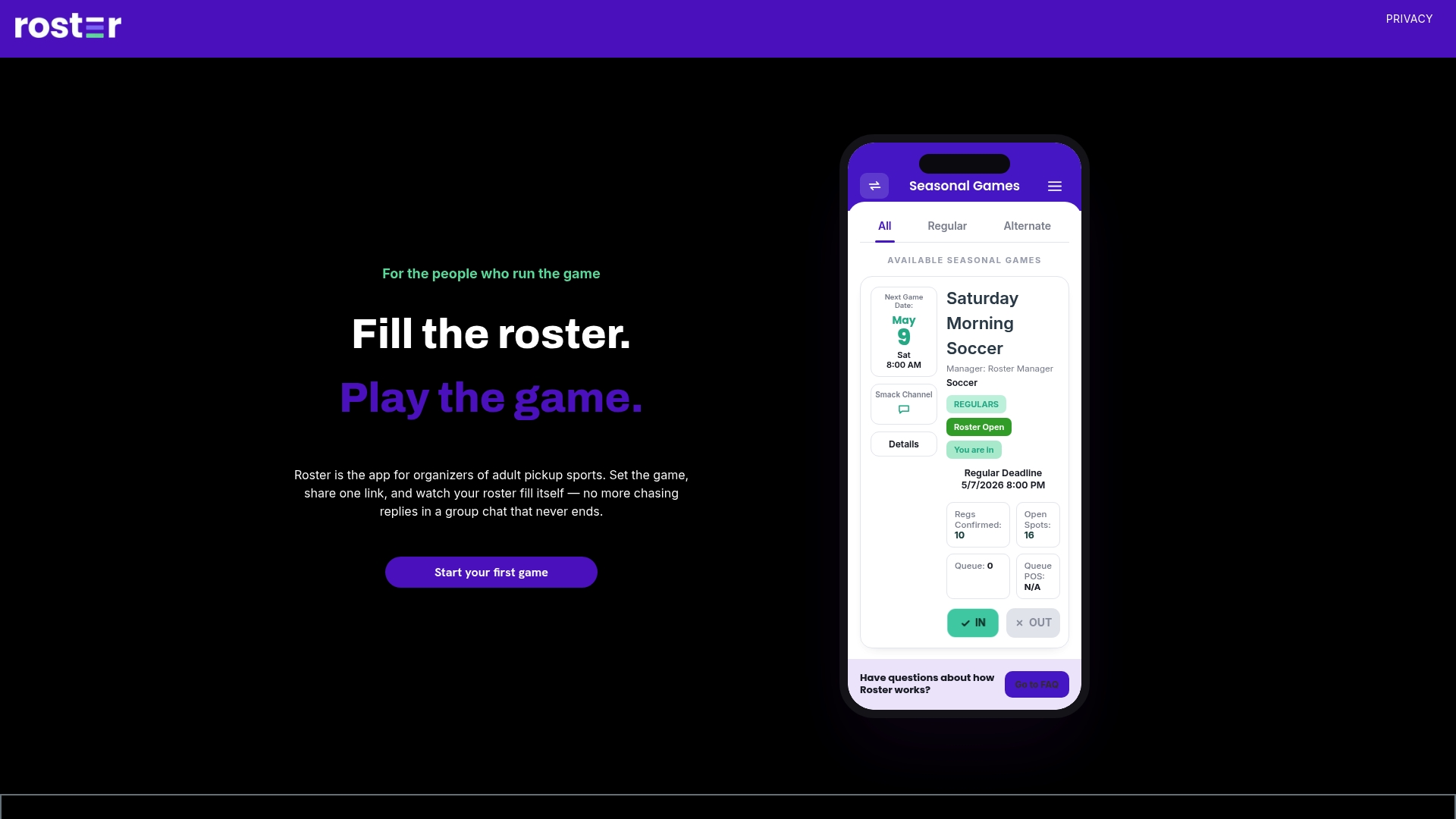
If your game keeps outgrowing your group chat, try Roster for your next game and let the link do the counting.
FAQ
How many players should I allow for a pickup game?
Take the number of players on the field or court at once and add two to five for rotation, depending on the sport and how much rest your players want. For 5v5 basketball that usually lands at 12 to 15. Then check the number against your venue time and space before you publish it.
What should I do when more people sign up than I have spots for?
Close the roster at the cap and move everyone else to a waitlist in order of signup. When someone cancels, offer the spot to the first person on the waitlist right away. Tell waitlisted players where they stand so they know whether to keep the evening open.
Should regulars get priority over newcomers?
In most standing games, yes. A small group of regulars with guaranteed spots gives the game a stable core, and a separate pool of alternates fills in when a regular can't play. It also gives new players a clear path in without bumping anyone.
How do I handle guests without blowing past the cap?
Make guests count toward the roster. A simple rule is one guest per player, and the guest takes a spot on the same list. If the game is full, the guest goes on the waitlist like anyone else.
How far in advance should signups lock?
Pick a cutoff that gives you time to react, such as a few hours before game time, and apply it consistently. After the lock, changes go through the organizer, so the final headcount is settled before anyone leaves for the gym.
Sources
- Adult Soccer, Great Falls Reston Soccer Club
- Supplemental adult sports rules, City of Long Beach
- How to Choose the Right Event Capacity, HereNow.events
- Setting your numbers, Croquet Victoria
- Game Formats, U.S. Soccer