
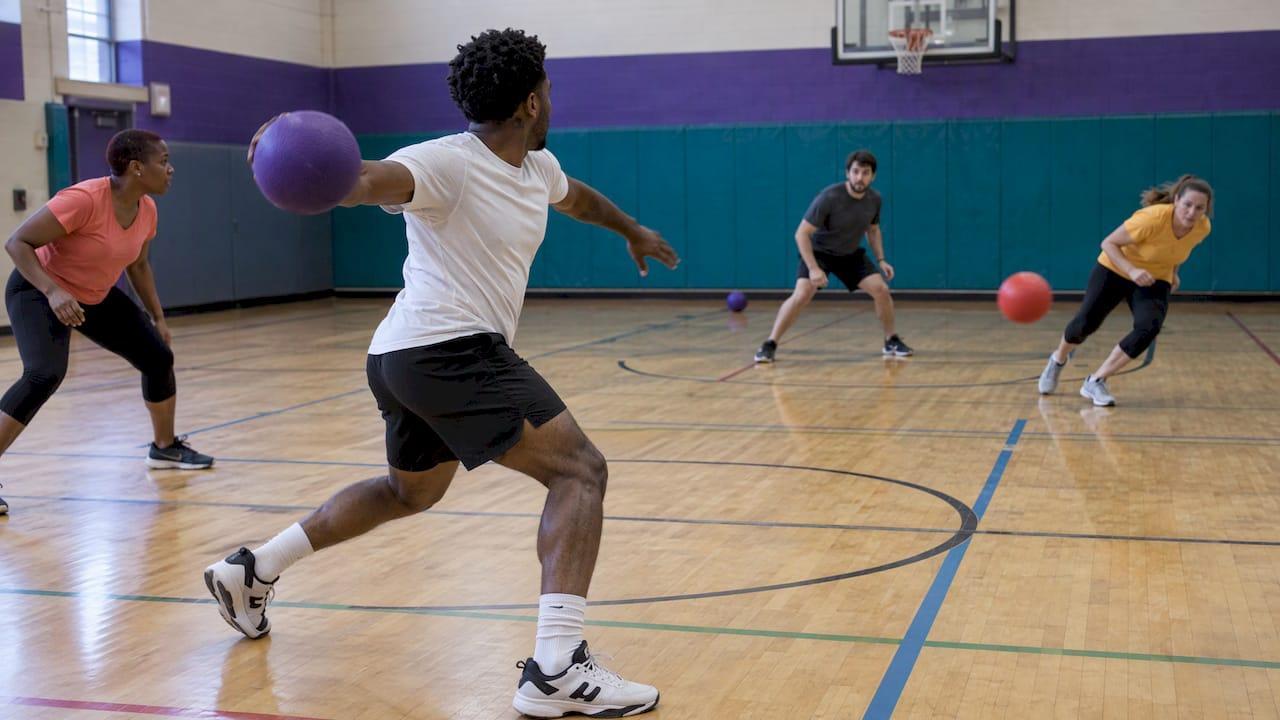
To organize pickup dodgeball, you need four things: a gym you can use at a regular time, enough foam balls, a player count that makes real games possible, and one place where people sign up. Everything else, from team splits to rules, is easy once those four are fixed. This guide walks through each step in the order you will face it, with numbers taken from official rulebooks so you are not guessing.
TL;DR
- Pick one recurring day, time and gym. A fixed slot gets players to show up from habit.
- Aim for 12 to 16 signups. Games can start with as few as 6, but you want a cushion for no-shows.
- Use soft foam balls of about 7 inches, six or seven per game, and explain the opening rush before the first throw.
- Set a start-time rule for late arrivals and make substitutions happen between rounds.
- Run signups from a single link with a waitlist, so open spots fill without a group chat.
Table of Contents
- Start with the time and place
- Decide how many players you need
- Set up the court and equipment
- Make the opening rush safe and clear
- Choose a game length and team format
- Handle late arrivals and substitutions
- Keep it welcoming and safe
- Our perspective on running pickup games
- Put signups on autopilot
- A simple first-night plan
- FAQ
- Sources
Start with the time and place
Dodgeball needs a flat, open floor with room to run and walls or space around the edges. A school gym, a community center or a rec center court usually works. Many adult programs use a volleyball court as the playing area. Cabot Parks & Recreation, for example, sets up its dodgeball on a volleyball court with the center line serving as the attack line.
When you contact a facility, ask these questions:
- Is the floor suitable for sneakers only, and is street footwear banned?
- Can you bring your own foam balls, or does the facility supply them?
- What are the rental rates for a one- or two-hour block, and is there a weekly discount?
- Is there a hard stop time, so you know when to start cleanup?
- Is there a liability waiver requirement for groups?
Pick one weekday evening and stick with it. Weeknights between 6 and 9 PM tend to work for people coming from work. Add 15 minutes before the first game for stretching and ball setup. A predictable slot beats a perfect slot.
Decide how many players you need
Dodgeball is forgiving on numbers, but not unlimited. Published rules show the range organizers work with.
| Source | Minimum to play | On court per team | Roster or suit-up limit |
|---|---|---|---|
| Town of Gilbert, AZ adult dodgeball | 6 present to start a game | Up to 8 | 8 to 15 on a roster |
| UC Berkeley intramurals | 2 to start | 6 | 12 can suit up |
| Cabot Parks & Recreation | Teams of 6 | 6 | Up to 2 substitutes, 8 maximum |
| NCDA 2025 Rulebook | 8 at the start of a point | Up to 12 | Not specified here |
For a casual pickup, the practical target is two teams of six, so 12 people on court, plus a few extras rotating in. That points to 14 to 16 signups. If 16 sign up and only 12 arrive, you still have a full game. If 14 sign up and 14 arrive, everyone gets a good amount of play.
A small turnout is not a cancellation. Six or eight players can run a three-on-three or four-on-four game on a smaller court, and the balls travel faster, which many people enjoy. Set your own floor, such as "we play with six," and tell people before they sign up.

Set up the court and equipment
You do not need regulation dimensions to run a good pickup, but it helps to know what the standards look like so you can scale down sensibly.
- Foam format: The World Dodgeball Federation's 2024 rules call for six polyurethane-coated foam balls about 17.8 cm (7 inches) across, on a court 18 meters by 9 meters (about 59 by 30 feet) with at least a meter of free space around it.
- Barriers: The same rules call for the court to be enclosed by barriers or netting, which is a reminder to keep walls, bleachers and equipment well away from the playing area.
- Attack line: In the foam format, the attack line sits 3 meters back from the center line, which gives a simple reference if your gym has existing court lines.
- Local adult programs: Gilbert, Arizona describes an in-bounds area of roughly 60 by 30 feet with a center line, and uses seven balls.
- College play: The NCDA plays on a 94 by 50 foot court with ten 8.5-inch rubber playground balls. That is the larger end of the scale, and it is more than most pickup groups need.
A basketball or volleyball court can stand in for all of this. Use the half-court or center line as your dividing line, and mark the attack line with cones or tape if the facility allows it.
Your kit list is short: foam balls (buy more than you think you need, since some will deflate or go missing), a mesh bag to carry them, two sets of pinnies or a way to tell teams apart, cones or tape, a first-aid kit, and a phone or small speaker for a timer.

Make the opening rush safe and clear
The opening rush is where most confusion and most collisions happen, so explain it before every session, especially if new people are there. Two published setups show the usual pattern.
In Gilbert's program, all seven balls go on the center line, equally spaced, with players behind their team's back line. During the rush, players can only collect the three balls to the right of the center ball. The center ball is not active during the rush.
The NCDA setup is different: two balls go along halfcourt and four sit on each team's neutral zone line, with balls placed to avoid tripping hazards on the running paths.
You can borrow either, or write a house version. Keep it to a few lines you can say in 30 seconds:
- Everyone starts behind the back line.
- Only the balls on your right are yours in the rush.
- A ball must be taken back behind the attack line before it is thrown.
- Throw at the body, not the head, and no throwing at someone who is not looking.
- A hit ball that is caught by the other side means the thrower is out and a teammate may come back in.
That last rule is common in organized play. Under UC Berkeley's intramural rules, a catch lets a player who is not in play come in, as long as the team has fewer than six on court. Eliminated players can also retrieve stray balls for their team. That keeps people involved and cuts down on standing around.
Choose a game length and team format
Pickup does not need a scoreboard. A simple approach is to play rounds until one side has no players left, reset, and go again. You get many short games instead of a few long ones, which is easier for newcomers.
If you want more structure, the NCDA plays two 25-minute halves with a 5-minute halftime, which can be shortened by agreement. That is too long for a casual evening, but it shows how you can build a timed format: for example, 10-minute games with a 2-minute reset.
Here are three options for splitting teams:
- Random draw: Pull names or count off. Fast and fair.
- Pinnie swap: Whoever arrives first wears one color, the next arrivals wear the other. Teams rebalance themselves as people come in.
- Rotate by round: After each game, reshuffle so everyone plays with and against everyone.
For co-ed groups, a ratio helps keep things even. Gilbert's co-ed play, for instance, needs three women and three men among the six players to start. Decide whether you want to use any ratio and tell people up front.
Handle late arrivals and substitutions
The biggest drag on a pickup game is waiting. Set a rule and apply it to everyone.
- Start time means start time. Pick a short grace period. UC Berkeley's intramurals award a forfeit if a team lacks the minimum 15 minutes after the scheduled start. For a pickup, 10 to 15 minutes before you start with what you have is a reasonable pattern.
- Late players join between games. Do not stop a round in progress. Whoever shows up goes to the sideline and enters at the next reset.
- Substitutions happen between rounds. Cabot's rules, for example, allow substitutes after each round.
Post these three rules in the signup message. People who know the rule before they arrive rarely argue about it.
The same logic applies to no-shows. Ask players to drop out as soon as they know they cannot make it, so the next person on the list can take the spot. Our pickup game checklist covers a four-phase routine for this, including what to say when someone cancels late.
Keep it welcoming and safe
Pickup dodgeball attracts a mix: people who played in school, people who haven't thrown a ball in 15 years, and a few competitive ones. A few habits keep everyone coming back.
- Run a quick intro. Introduce new players to the group, show them the rush, and say the headshot rule out loud.
- Offer intensity options. If the turnout is large enough, run one court at an easygoing pace and one with more competitive play, and let people choose.
- Use soft balls only. Foam, in the 7-inch range, is standard for recreational play.
- Keep the floor clear. Water bottles, bags and loose balls belong on the sideline, not behind the back line.
- Stop for injuries. If someone goes down, pause the game, check on them, and only restart once they are okay. If it is more than a minor bump, call for help from facility staff or emergency services.
- Check shoes and glasses. Closed-toe sneakers only, and suggest sports glasses or a strap for anyone who wears glasses.
If you want a refresher on structuring other sports the same way, we have written guides on organizing pickup volleyball, pickup basketball and pickup soccer. Much of the process carries over.
Our perspective on running pickup games
Most pickup groups do not fail because people stop liking the game. They fail because the organizer gets tired. Every week it is the same loop: post in the group chat, scroll for replies, lose track of who said maybe, find out at 6 PM that four people dropped, and scramble to fill the gap.
We built Roster around the idea that the organizer should set the game once and share one link. People sign up there, spots fill in real time, and when someone drops out the waitlist moves up. You stop counting messages and start counting players.
Dodgeball is a good example of why this matters. The game works best with a healthy number of people on both sides, and the margin is thin: too few and the games drag, too many and half the group stands around. A clear roster with regulars and alternates gives you control over that balance without a dozen texts.
We also care about what happens after the signup. The point of all this is to get people in the same gym, throwing balls and laughing, and a little less time looking at a screen. If the logistics take care of themselves, you can show up, set out the balls, and play.
Daniel
Put signups on autopilot
Once you have a time, a place and a few rules, the remaining work is chasing replies. That is the part Roster handles. You enter the game details, share a single link, and players claim spots. Regulars and alternates are tracked separately, open spots fill as people drop, and anyone beyond capacity lands on a waitlist.
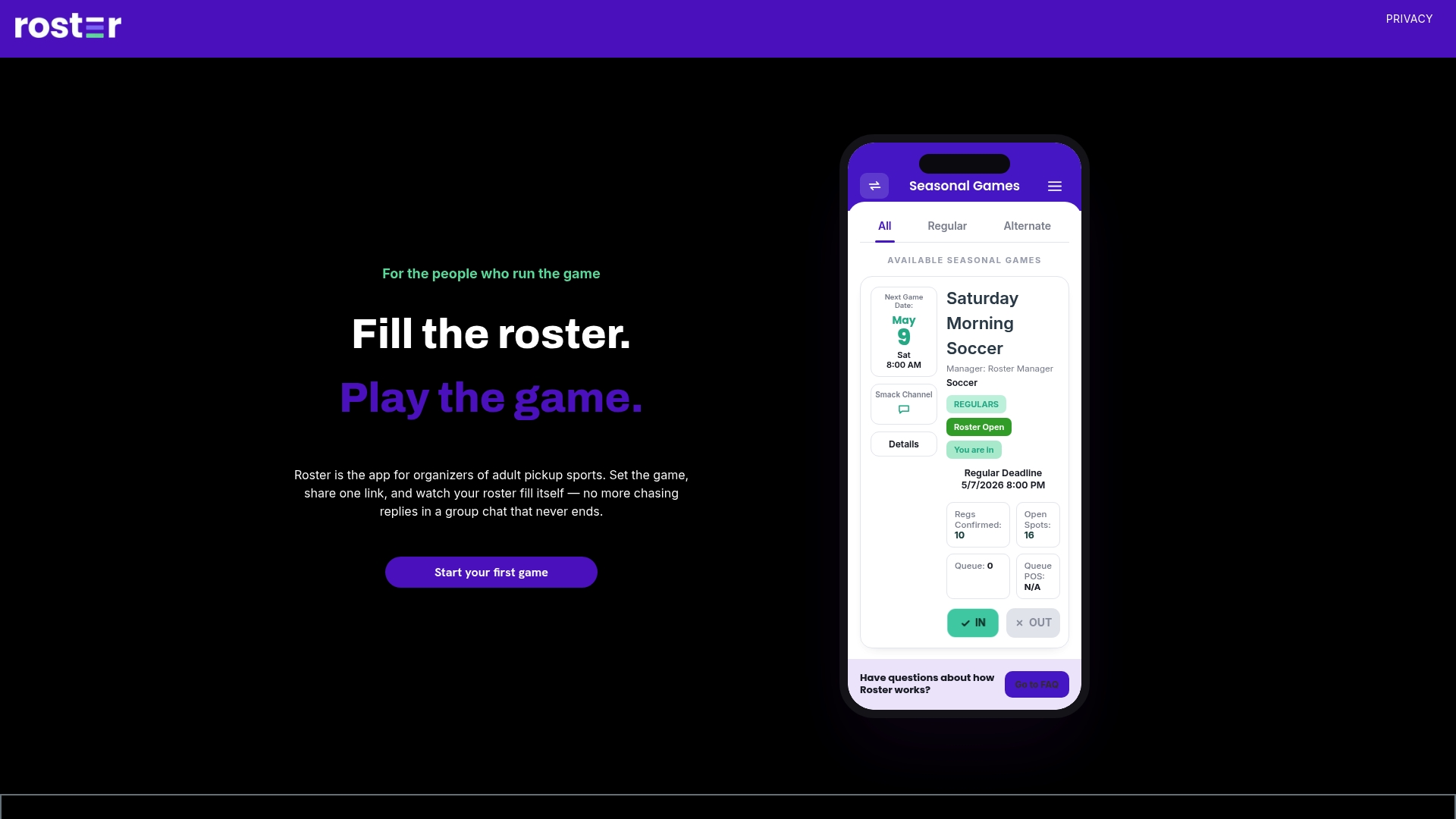
If you run a weekly dodgeball night, you can set the roster size you want, whether that is 12 on court plus a few rotating, and let the app keep the list current. Try it at Roster and keep your group chat for jokes instead of headcounts.
A simple first-night plan
Here is a schedule you can copy for a two-hour gym block:
| Time | What happens |
|---|---|
| 0:00 to 0:15 | Setup: lines, balls, pinnies, sign-in |
| 0:15 to 0:25 | Welcome, rules, opening rush walkthrough |
| 0:25 to 1:45 | Rounds of 8 to 10 minutes, reshuffle teams between rounds |
| 1:45 to 2:00 | Final round, cleanup, announce next session |
After the first night, ask people what worked. Did they want longer games? A different ratio? A second court? Small changes made from real feedback do more than any rulebook.
To keep the group going, send a reminder the day before, post the same link every week, and invite each regular to bring a friend. Growth in pickup is mostly word of mouth, and a low-friction signup makes it easy to say yes.
FAQ
How many people do you need for pickup dodgeball?
You can start with as few as six, which is the minimum Gilbert, Arizona requires to start an adult game. Twelve to sixteen is the comfortable range for two full teams with rotation. Plan for a few no-shows and keep a waitlist.
What kind of balls should you use?
Use soft foam balls around 7 inches. The World Dodgeball Federation's foam format specifies polyurethane-coated foam balls of about 17.8 cm. Bring six or seven per game plus spares.
How big does the court need to be?
A volleyball or small basketball court works. Gilbert's program uses an in-bounds area of about 60 by 30 feet, and the WDBF foam court is 18 by 9 meters. Keep extra space around the edges clear of bags and furniture.
What do you do when players show up late?
Have them wait on the sideline and join at the start of the next round, never mid-round. Set one grace period for starting the first game and apply it to everyone. Put the rule in your signup message so it is no surprise.
How do you keep teams balanced?
Reshuffle between rounds using a random draw or pinnie colors. If you run co-ed games, decide on a ratio in advance, as some organized programs require an even split to start. Rotating teams keeps things social and fair.
Sources
- Town of Gilbert, Adult Dodgeball
- NCDA 2025 Rulebook
- Cabot Parks & Recreation Dodgeball Rules
- WDBF Dodgeball Rules 2024
- UC Berkeley Recreation & Wellbeing, Dodgeball Rules