
A player skill rating is a number that places someone on a scale of ability, and for pickup pickleball there are two kinds: a self-assigned skill level (such as 3.5) and a results-based rating (such as DUPR) calculated from verified matches. If you run open play, use the skill level to describe who a game is for, use a results-based rating when you want an objective check, and keep the signup process simple enough that the right mix of players actually shows up.
This guide explains what each rating measures, how players find theirs, and how to turn the numbers into fair games without a group chat full of "what level is this?" messages.
TL;DR
- A skill level (2.0 to 5.5) is a self-assessed description of what a player can do. A rating like DUPR (2.0 to 8.0) is calculated from verified match results.
- USA Pickleball names DUPR its official exclusive rating system for its own events, but a casual pickup game does not need an official rating to work.
- Put a level range in every game listing, give players a short self-assessment to take, and keep one shared signup link so mismatched players are easy to spot before game day.
- Fair games depend on two things: matching ability and filling every spot. Roster handles the second part with one link, real-time roster filling and waitlists.
Table of Contents
- What a player skill rating actually measures
- The skill level scale, in plain terms
- How DUPR ratings work
- How a player finds their level
- Why ratings matter when you run games
- A worked example
- The logistics problem ratings do not solve
- Roster for pickup organizers
- Our perspective
- Common mistakes with skill ratings
- FAQ
- Sources
What a player skill rating actually measures
Two different ideas get called "rating," and mixing them up causes most arguments at the courts.
Skill level describes what a player knows and can do: consistency, shot selection, strategy. USA Pickleball established its skill level scale in 2005 and distinguishes it from ratings and rankings, which are based on match results. A player can use a skill level without any official rating.
A rating is a single number that estimates current playing ability. USA Pickleball describes it as based on verified match results processed by a rating provider's algorithm, so it moves as results come in.
For an organizer, the difference is practical. A skill level is what you print on the game listing ("3.0 to 3.5 open play"). A rating is what you check when someone's self-description and their play do not line up.

The skill level scale, in plain terms
USA Pickleball groups its levels into four named tiers, each covering two half-point levels, per its skill level guide:
| Level | Tier | What it looks like |
|---|---|---|
| 2.0 and 2.5 | Kitchen Cruisers | Fundamental skills with guidance, but not yet consistent or confident |
| 3.0 and 3.5 | Dinkers | Solid strokes and basic strategy |
| 4.0 and 4.5 | Smashers | Comfortable with the soft and hard game, sees the whole court, anticipates play |
| 5.0 and 5.5 | Aces | Skilled in all facets, executes advanced shots consistently under pressure |
Most open-play groups only need three buckets: new players, developing players and strong recreational players. Two or three clearly labeled sessions beat one mixed session where half the court is frustrated.
How DUPR ratings work
DUPR is the results-based system most players have heard of. Per USA Pickleball, DUPR is the official exclusive rating system across all USA Pickleball-owned events, and its scale runs from 2.0 for beginners to 8.0 for professionals.
DUPR's own explanation splits that scale into four tiers: 2.000 to 2.999 Novice, 3.000 to 3.999 Intermediate, 4.000 to 4.999 Advanced and 5.000 to 8.000 Professional. New players start as NR (not rated) until results are processed.
How the number moves matters if you plan to use it:
- It compares how a player performs with the expected result based on everyone's ratings. Beating expectations can raise a rating, meeting them changes it very little, and falling short can lower it. It is not just wins and losses.
- Match type, match count and recency also count: club and tournament results carry more weight than recreational ones, more matches make a rating more stable, and recent matches influence it more.
To get one, a player creates a free DUPR profile and plays verified matches, such as tournaments, leagues or club sessions that submit results. They log results in the app and opponents confirm them. After the first several verified results, an initial rating is published.
Skill levels and DUPR numbers are not identical
People often convert 3.5 straight to 3.5. The two systems are built differently, so treat any conversion as a rough guide. A player who calls themselves a 3.5 and shows up with a DUPR somewhere in the 3.0 range is not lying; the systems simply measure different things. For a pickup group, a band is safer than a hard cutoff: "3.0 to 3.5" rather than "exactly 3.5."
How a player finds their level
Most of your regulars will never enter a tournament, so the self-assessment is the tool that matters most.
USA Pickleball offers a 12-question Player Skill Level Self Assessment that takes about 3 to 5 minutes and is meant to help players understand their strengths, find areas to improve and match up with players at their level. Send it to new signups before their first game.
The PPA Tour notes that players entering their first tournament can self-rate, and that both a self-rating and an official rating are accepted. The same logic works for pickup: self-rating is the entry point, and results confirm it over time.
Give players this guidance when they rate themselves:
- Read the written definitions for each level before choosing a number.
- Choose the level where you do most things reliably, not where your best shots live. A big drive does not make up for an unreliable soft game.
- If you are torn between two levels, pick the lower one for your first few sessions. It is easier to move up than to leave a game where everyone is waiting on you.
- Re-rate after a few months. Skill changes, and a level chosen on day one gets stale.
Why ratings matter when you run games
A mismatched court produces the problems organizers hear about afterward: advanced players drifting away because rallies are short, newer players feeling hunted, and one-sided games that nobody enjoys. Matching by level is the simplest fix.
Tournament organizers lean on ratings heavily. Seeding guides tell directors to lock ratings shortly before an event and place the strongest teams so that they meet weaker ones early in a bracket. Pickup is looser, but the principle carries over: use a number to set expectations, then let people play.
Here is a practical setup that works for most groups.
1. Name the level in the game itself
Write the range in the title or details of the game: "Tuesday night open play, 3.0 to 3.5." People self-select before they sign up, which removes a round of messages. Our guide to pre-session decisions for pickup pickleball walks through the other choices to make before posting a session, such as format and court count.
2. Offer different sessions rather than policing one
If your signups are spread across 2.5 to 4.5, a single session will disappoint someone. Two sessions with a tighter band each, or one session with a clearly labeled "all levels, social" format, set honest expectations. Our inclusive pickup games guide covers how to keep mixed-ability groups welcoming.
3. Balance the courts or teams, not just the list
Once players are in, rotate partners so strong players are spread across courts. See how organizers balance teams by skill quickly before a session starts.
4. Handle the mismatch privately
If a player consistently plays far above or below the group, a short, friendly message works better than a public correction: "We think you'd have more fun in the 3.5 to 4.0 session." A rating from verified matches gives you a neutral reference instead of an opinion.
5. Ask for feedback
A two-minute survey tells you whether the levels feel right. Questions that work are in our player feedback survey guide.
A worked example
Say you run Thursday night open play with four courts, which holds 16 players at a time. You post it as "3.0 to 3.5."
Twenty-two people sign up. Fourteen are in your range. Five self-rated 2.5, and three are 4.0 and up. If everyone plays, the 4.0s will dominate and the 2.5s will be stretched. With a level range in the listing, you can make three moves before game day: invite the 2.5s to a beginner-friendly session, point the 4.0s to a higher-level group, and open the freed spots to the waitlist of 3.0 to 3.5 players. The game that runs has 16 players in the right band, and nobody had to be told in the parking lot that they were in the wrong place.
That last move depends on knowing exactly who is in, who is out and who is next, which is where logistics take over from ratings.

The logistics problem ratings do not solve
A perfect level range does not help if only 11 people appear, or if 19 appear for 16 spots. The unglamorous part of organizing is tracking replies across a group chat, chasing maybes and finding a replacement when someone cancels two hours before.
The more specific your game is, the more this matters. A tight band like "3.0 to 3.5" has a smaller pool of eligible players, so every dropout is harder to replace. A shared signup link with a live roster and a waitlist keeps the pool visible. Our pickup game checklist lays out the prep, the scripts for self-calling and ways to cut no-shows.
Roster for pickup organizers
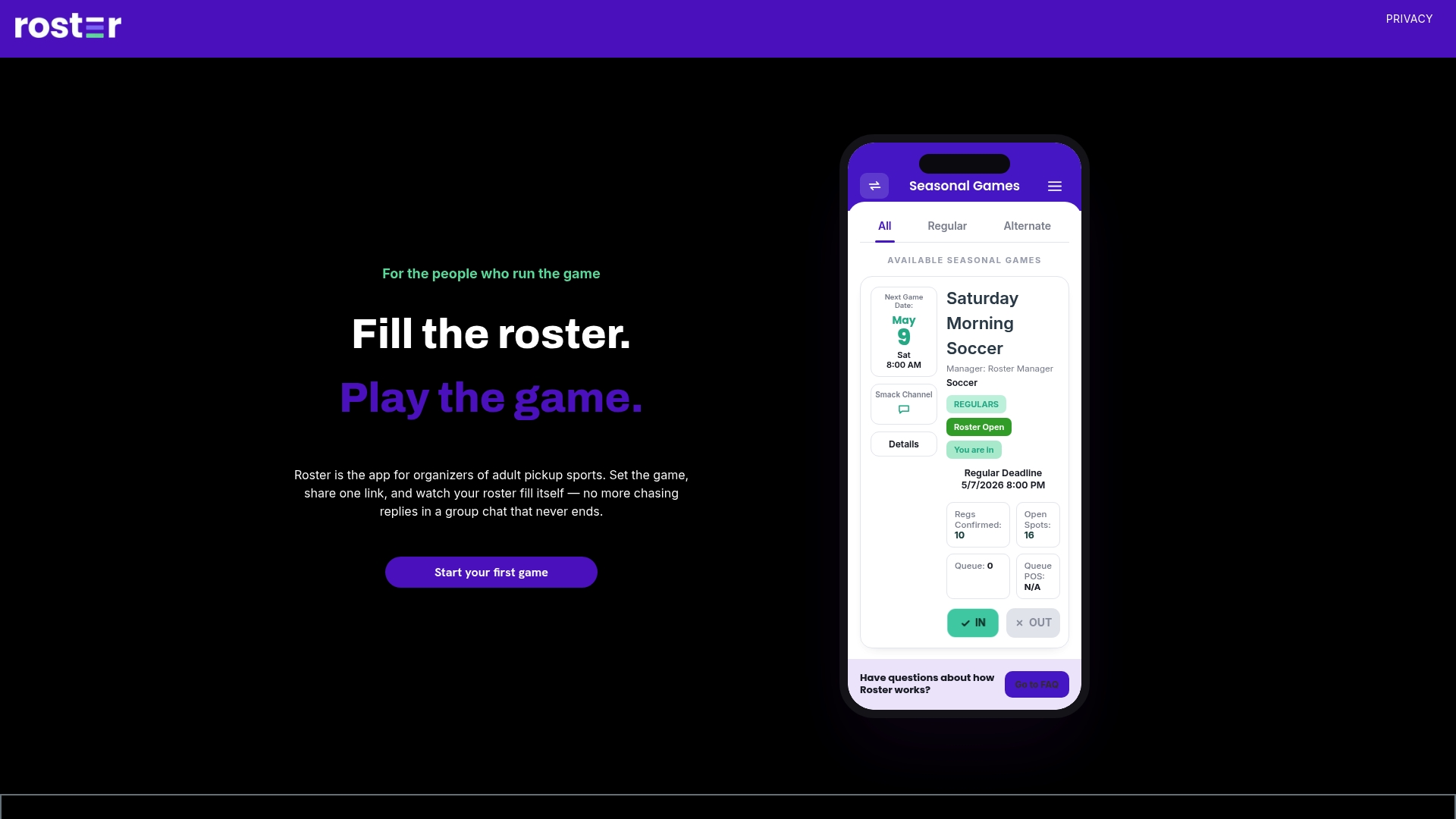
Roster is a mobile app for adult pickup sports organizers. You set the game details, including the level range you want, and share a single link. Players sign up through that link, Roster tracks roster spots and waitlists, fills open spots in real time when someone drops, and supports regulars and alternates. There is also group chat in the app and peer-to-peer Venmo payment tracking between players and managers.
For a skill-banded game, that means the people who see the level on the listing are the people who claim the spots, and a cancellation moves the next person on the waitlist in rather than starting a new round of texts.
You can see how it works at Roster.
Our perspective
Most organizers we talk to start by worrying about the wrong thing. They agonize over whether a player is a 3.0 or a 3.5, then spend their evenings in a group chat figuring out who is actually coming.
Ratings are a useful shared language. They tell a newcomer whether a game is for them and give you a neutral way to talk about fit. But a number on a listing only works if the roster behind it is accurate and full.
That is why we built Roster around the part organizers dread: you set the game, share one link, and the app tracks signups, regulars, alternates and the waitlist while you focus on running a good session. Put the level in the game details, let people choose themselves in, and keep the roster moving. The goal is more time on the court and less time on your phone.
Daniel
Common mistakes with skill ratings
- Treating the number as a verdict. A rating is an estimate. Use ranges, and let play confirm it.
- Using one number for everything. DUPR can show different singles and doubles ratings, so check the one that matches the format you run.
- Demanding an official rating for casual play. USA Pickleball says players can use skill levels without an official rating, so a self-assessment is enough for most pickup groups.
- Letting levels go stale. Ask regulars to re-rate periodically, and revisit the bands as your group improves.
- Ignoring the welcome. Players who feel judged by a rating rarely return. Frame levels as a way to find a good game, not as a ranking.
FAQ
What is a good pickleball skill rating?
There is no single good number, because a rating just describes where you are. On USA Pickleball's skill level scale, 3.0 to 3.5 players are called Dinkers, with solid strokes and basic strategy. On the DUPR scale, 3.000 to 3.999 is the Intermediate tier. Aim for games where your level sits in the middle of the group.
Do I need a DUPR rating to play pickup pickleball?
No. DUPR is free to join and is the official exclusive rating system for USA Pickleball-owned events, but casual open play works fine with a self-assessed level. USA Pickleball notes that skill levels let players develop and enjoy matches without needing an official rating. A rating helps most when you enter tournaments or want an objective check.
How long does it take to get a DUPR rating?
You create a free profile, play verified matches and have opponents confirm the results. After the first several verified results, an initial rating is published, then it updates as more results are processed. The pace depends on how often you play matches that submit results.
How do I rate myself honestly?
Take the 12-question USA Pickleball self-assessment, which takes about 3 to 5 minutes. Then compare your result with the written level definitions. Choose the level where you perform reliably most of the time, and pick the lower of two close levels at first.
How should I label a mixed-ability pickup game?
Set a band of one or two levels, such as 3.0 to 3.5, and say it in the game title. If your group spans a wider range, split it into two sessions or label one "all levels, social." Players then choose the right game before they sign up.
Sources
- Pickleball Player Rating, USA Pickleball
- Determining Pickleball Skill Levels for Every Player, USA Pickleball
- How the DUPR Rating System Works, DUPR
- Pickleball Ratings Explained: How Skill Levels Are Calculated, DUPR
- How to Find Your Pickleball Rating, PPA Tour