

A coed ratio policy is a short written rule that says how many players of each gender must be on your roster and on the field, and what happens when a game falls short. For most adult pickup games, the workable version has four parts: an on-field cap for the majority gender, a minimum for the minority gender, a minimum number of players to start, and a plain fallback for no-shows. Below are real numbers from U.S. leagues, so you can borrow a ratio that fits your sport instead of inventing one.
TL;DR
- Pick two numbers per sport: a cap on one gender on the field and a floor for the other. Leagues commonly land at 4 to 6 on the cap side and 2 to 4 on the floor side, depending on team size.
- Add a minimum-to-start rule and a grace period, so a missing player means a short-handed game, not a cancelled one.
- Decide in writing what happens when one gender is short: play with fewer fielders, borrow a sub, or forfeit.
- Make the policy inclusive: count nonbinary players, let people skip disclosing, and say so in the rules.
- Put the policy in the game description and share it where you collect sign-ups, so everyone reads it before they join.
Table of Contents
- What a coed ratio policy actually covers
- Ratios real U.S. leagues use
- Set your roster so the ratio is reachable
- What to do when attendance misses the ratio
- Write the policy so it includes everyone
- How to tell players the rules
- Perspective: the ratio is only as good as your roster
- Run your coed game with Roster
- A sample policy you can adapt
- FAQ
- Sources
What a coed ratio policy actually covers
In an organized league the policy often runs a page or more. In a pickup group it can fit in five lines. Either way it answers the same questions:
- On-field ratio: the most players of one gender allowed on the field at once, or the fewest of the other.
- Roster ratio: how many of each gender you need signed up so the on-field ratio is actually reachable.
- Start minimum: the fewest players, and the fewest of each gender, needed to play at all.
- Shortfall rule: what you do when attendance misses the ratio.
- Inclusion language: how players who are nonbinary or prefer not to say fit in.
The point of all this is fairness on the field and fewer arguments on the sideline. A written number settles a dispute before it starts. That matters most in soccer, where one or two strong players can dominate play unless the rules shape the game.
Ratios real U.S. leagues use
The fastest way to write a sensible policy is to see what others have settled on. The table below pulls figures from published league and parks department rules.
| League | Sport and format | On-field ratio | Minimum to start |
|---|---|---|---|
| El Segundo Recreation & Parks | 7v7 soccer | Max 4 men, at least 2 women on the field | 5 players, at least 2 women |
| Claremore Soccer Club | 7v7 soccer | Max 3 male field players, not counting the keeper | 5 players within 10 minutes |
| Northern Virginia Adult Soccer | 11v11 soccer | 6/5: max 6 of either gender | 7 players, at least 2 of each gender |
| Port Orange | Soccer, 8 on the field | A team of 8 fields at least 2 women | 6 players (5 men, at least 1 woman) |
| SPAR | 10v10 kickball | Max 6 males, at least 4 females | 8 players, at least 2 women |
| FXA Sports | Kickball | At least 4 females with 10 in the field | 6 in the field, at least 2 females |
| City of Gilbert, AZ | Dodgeball | Max 4 male players, +/- one ratio | 6 players (3 female, 3 male) |
| Pump Soccer League | 5-player basketball | Max 3 majority gender, min 2 minority | Roster of 5 to 12 |
A few patterns stand out.
The minority floor is usually 2 to 4. Even in a 7v7 game, leagues want at least two women on the field at all times. In larger formats like 10v10 kickball, the floor rises to four.
Caps are often expressed as a maximum for men. El Segundo, Claremore and SPAR all cap men and leave women uncapped. That keeps the rule simple: women can always fill extra spots.
The true half-and-half format is rare in big games. NVASA's 11v11 division uses a 6/5 split, meaning a maximum of six players of either gender on the field at one time. NVASA argues that the tighter ratio gets women more touches and keeps strong male players from overshadowing them. That is the league's own view, but it shows the tradeoff: the closer you get to even, the harder attendance becomes.

Matching the ratio to your sport
Start from the number of players on the field, then work backward.
- 5v5 or 6v6 (basketball, volleyball, small-sided soccer): the Pump Soccer League's mixed-gender rules use a max of 3 majority and min of 2 minority in 5-player basketball, and 4 and 2 in 6-player volleyball. Copy that shape for small games.
- 7v7 to 8v8 soccer: cap men at 3 or 4, floor women at 2.
- 10v10 or larger (kickball, softball, 11v11 soccer): floor of 4 minority players is common. Bath County's adult co-ed softball rules, for example, require at least 4 female players on the field at all times, and drop one fielder for each missing female player, as their 2025 rulebook sets out.
That last idea is worth stealing. Instead of canceling when a gender is short, the team plays with one fewer fielder per missing player. It keeps the ratio intact and keeps the game going.
Set your roster so the ratio is reachable
An on-field ratio only works if the roster supports it. If your game needs two women on the field and you have three signed up, one absence breaks the policy. Leagues handle this with roster floors. SPAR's kickball rules call for at least four females on a 10-player roster. B-Town Kickball asks for 13 registered players with at least 5 of each gender, according to its 2025 rules. WideWorld Indoor Soccer's 2025 rulebook recommends co-ed teams carry at least three women, against a requirement of two on the field.
The rule of thumb: carry at least one more minority-gender player on the roster than your on-field floor. Two on the field means three on the roster. If you want help picking roster sizes, our guide to setting roster limits for your pickup game walks through the math, and the one on capping guests per player covers a common way ratios get thrown off: a regular brings three friends who all happen to be the same gender.
Alternates matter here too. Keep a short list of reliable players of each gender who can fill in on short notice. A waitlist split by the spots you need to fill is the most practical way to protect the ratio week to week.

What to do when attendance misses the ratio
This is the section players read closest, because it is where rules turn into disputes. Decide these in advance.
Set a minimum to start and a grace period
Port Orange's soccer rules require six total players, including at least one woman, to start or finish a game, and give a 10-minute grace period for the first game time. Claremore's rule is five players within 10 minutes of the scheduled start, or the game is forfeited and not rescheduled. For a casual group, you probably don't need forfeits. A start minimum plus a short grace period is enough.
Choose a fallback and write it down
There are three common ways to handle a gender shortfall:
| Fallback | How it works | Example |
|---|---|---|
| Play short | Remove one fielder per missing minority player | Bath County softball |
| Borrow a sub | Allow a pickup player of the needed gender, in limited numbers | FXA allows up to four pick-up players (two of each gender), only when the team can't field a full 10 |
| Forfeit unless agreed | Team forfeits unless both captains agree to play | El Segundo: forfeit unless both managers agree |
WideWorld adds a useful wrinkle. If only one woman is present at game time, she cannot be replaced by a man. If two are present and both teams agree beforehand, the team may play with one on the field and one female sub.
For a pickup group, "play short" or "both sides agree" works best. Forfeits make sense when you run a league with standings, not when you are trying to keep Thursday night alive.
Consider scoring instead of strict caps
Some groups keep the rules loose and adjust scoring. Claremore's 7v7 rules award goals scored by women two points and men's goals one point, alongside the cap on male field players. It is an option if you want to nudge play toward inclusion without turning away players.
Write the policy so it includes everyone
A binary man/woman ratio leaves nonbinary players unsure where they fit. You can fix that in one or two sentences.
The Pump Soccer League's April 2022 policy uses a majority/minority system rather than fixed men/women labels. It counts nonbinary players among gender minorities and invites transgender players to take a gender-minority spot or play as the gender they identify with. Anyone uncomfortable disclosing can select "prefer not to say." The league sets majority and minority from the previous year's demographics, so the labels follow the actual makeup of the group.
B-Town Kickball takes a different route: nonbinary players count toward the majority gender represented in the field, as chosen by the team or captain, for ratio accounting.
Both approaches work. Pick one, say it in the policy, and don't ask anyone to explain themselves. Practical tips:
- Use "majority gender" and "minority gender" or "at least X players who are women or nonbinary" instead of only "men" and "women."
- Offer a "prefer not to say" option on sign-up.
- Keep gender information visible only to the organizer, not the whole group.
If your group plays through a school, park or league, or hosts a tournament, check the rules that apply to you. USA Pickleball's gender guidelines advise operators to understand their state's laws and follow them where they apply, to set eligibility rules clearly and in writing before entry, and to consider an open category for all players. The same logic carries to any recreational group. For a campus program, look at how UW Whitewater's intramural handbook treats it: co-rec rosters must follow approved ratios, other ratios are treated as illegal, and a penalty or forfeit may follow. It also says the ratio does not apply when someone wants to join a league of the other gender because their own isn't offered or didn't fill.
If you want to see how a full rulebook organizes approved ratios, exceptions and penalties in one place, this sports tournament rulebook example shows a clear layout you can adapt for your own group.
How to tell players the rules
A policy nobody reads doesn't help. Players tend to accept a ratio when they see it before they commit and hear about changes early.
- Put the policy where people sign up. Put the ratio in the game description, not in a message buried in a group chat from three weeks ago.
- Keep it to five lines. Ratio, roster floor, start minimum, grace period, fallback.
- Explain the why in one sentence. "We use a ratio so everyone touches the ball" gets less pushback than a bare rule.
- Announce changes once, in one place. When you adjust the ratio or the roster, say it where players already look.
- Remind on game day. A short note about who is in and which spots are open prevents surprises.
- Revisit after a few sessions. If the ratio keeps forcing short-handed games, the number is probably too tight. Our three-session pilot is a practical way to test a format before locking it in.
On gender-balanced soccer in particular, it also helps to understand how compatibility and team balance affect who sticks around. This piece on compatible players for a team looks at how to spot players who fit a squad, a useful angle when you are recruiting for the minority-gender spots your ratio needs.
Perspective: the ratio is only as good as your roster
We talk to organizers all the time, and the same thing happens. They write a thoughtful ratio, then spend every week chasing replies to make it work. The rule was never the hard part. Filling the right spots on a game day was.
That is why we built Roster around a single shared link. You set the game details, including your ratio in the description, and players sign up in one place. Regulars and alternates are tracked, open spots fill in real time, and dropouts go to a waitlist, so you aren't rebuilding the lineup from a pile of texts the night before.
Our view is simple: organizers should spend their energy on the game, not the logistics. A clear policy plus a roster that updates itself means you can keep the game fair and still show up to play.
Daniel
Run your coed game with Roster
If your ratio policy is written, the next job is keeping the roster full. Roster is a mobile app for adult pickup organizers. You set the game details, share one link, and the app manages sign-ups for regulars and alternates, tracks roster spots and waitlists, and keeps game chat in one place.
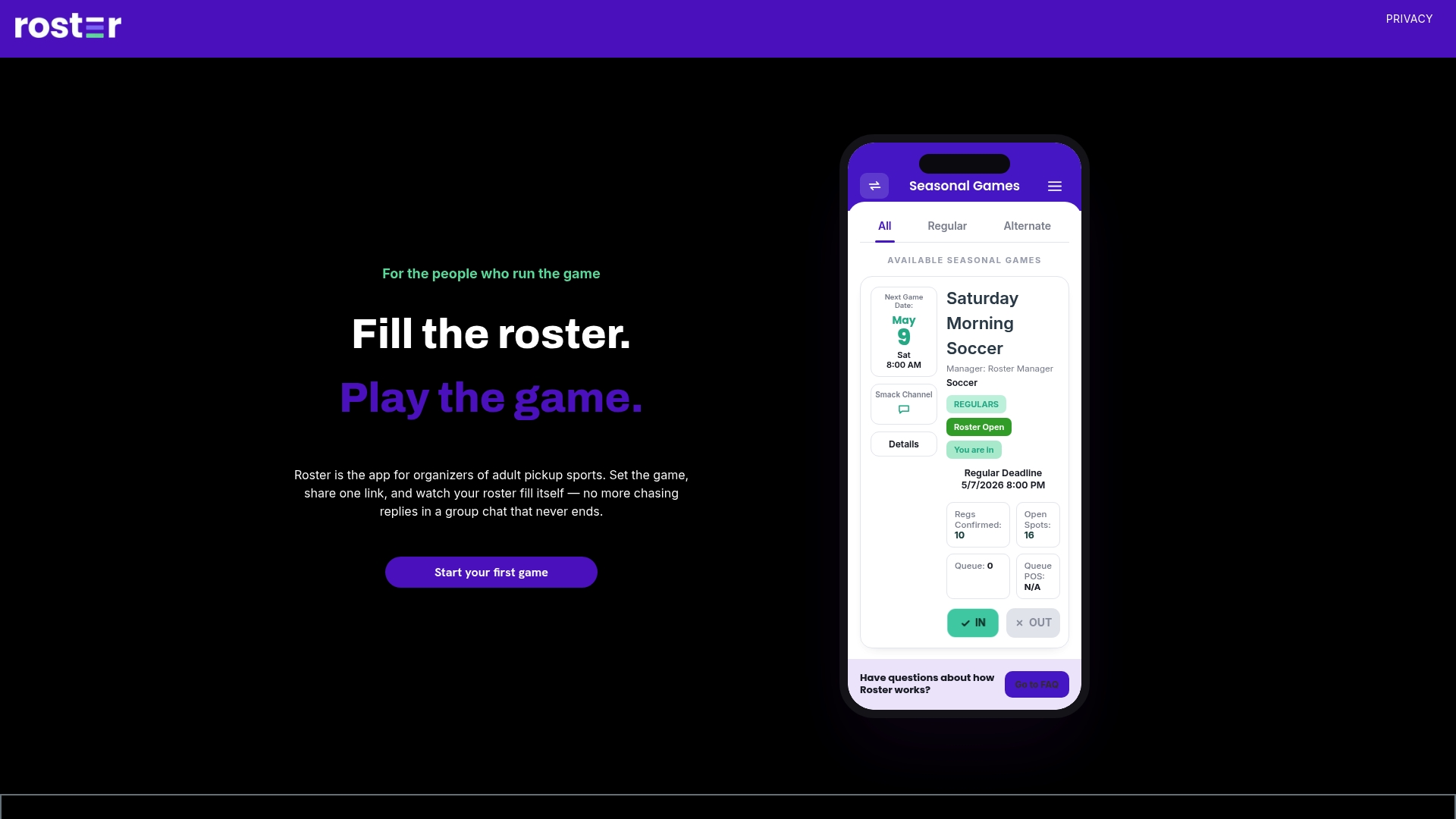
That means fewer RSVP threads and fewer last-minute scrambles to find the player your ratio needs. See how Roster works or get the app and set up your next game.
A sample policy you can adapt
Here is a template for a 7v7 coed soccer game. Swap the numbers for your sport using the table above.
- On-field ratio: at most 4 players of one gender, at least 3 of the other, keeper included in the count.
- Roster: 12 players, with at least 5 in each gender group, plus a waitlist.
- To start: 5 players present, with at least 2 in the minority gender group.
- Grace period: 10 minutes after the scheduled start.
- If short: play with one fewer fielder per missing minority-gender player, or borrow a sub if both sides agree.
- Inclusion: nonbinary players may count toward either group, chosen at sign-up. "Prefer not to say" is always an option.
Treat it as a starting point. After a few games, adjust based on how often you ran short and how the group felt about it.
FAQ
What is a good coed ratio for pickup soccer?
For 7v7, a cap of three or four men with at least two women on the field is common, as in the El Segundo and Claremore rules. For 11v11, NVASA uses a 6/5 split. Choose the number your roster can sustain every week.
What happens if a team doesn't have enough women to meet the ratio?
Leagues handle it three ways: play with fewer fielders, borrow limited pickup subs, or forfeit unless both sides agree. Bath County drops one fielder per missing woman. Pick one and put it in writing.
How do I include nonbinary players in a coed ratio?
Use majority and minority language, or count nonbinary players toward a group chosen at sign-up. The Pump Soccer League counts nonbinary players among gender minorities, and anyone can choose "prefer not to say."
How many players should be on a coed roster?
Leagues range widely: 5 to 12 in Pump basketball, 8 to 15 in Gilbert's adult co-ed rules, and 10 to 20 in FXA kickball. Aim for your on-field number plus a few alternates, with at least one extra minority-gender player.
Sources
- Northern Virginia Adult Soccer
- PSL Gender Rules for Game Play
- Bath County adult co-ed softball rules
- City of Gilbert adult dodgeball rules
- El Segundo Coed 7v7 Soccer
- UW Whitewater Approved Co-Rec Ratios
- FXA Sports Co-ed Kickball Rules
- Port Orange Co-Ed Soccer Rules
- WideWorld Indoor Soccer Rule Book
- Claremore Soccer Club adult soccer
- B-Town Kickball rules
- USA Pickleball Gender Guidelines
- Sports tournament rulebook example
- Compatible players for a team