

Use WhatsApp when your team is small, phone-first, and values privacy by default. Use Discord when you need structured channels, defined roles, and always-on voice for a larger or more active group. Neither platform, though, was built to track RSVPs, fill open roster spots, or chase payments, which is where a growing number of team leaders reach for a dedicated tool instead.
TL;DR:
- WhatsApp is ideal for small, phone-first teams prioritizing privacy with end-to-end encryption, but it struggles with scalable structure and detailed moderation.
- Discord offers scalable channels, roles, and persistent voice rooms, making it better suited for larger, more active communities that require organized discussions.
- Both platforms have fixed limits on file sharing and call quality in their free tiers, prompting upgrades once media sharing or high-quality audio become frequent needs.
- Security differs: WhatsApp encrypts message content but not metadata, while Discord's lack of end-to-end encryption exposes message content to the platform.
- For logistics like RSVPs and payments, dedicated tools like Roster automate these processes far more effectively than chat apps can manage alone.
Table of Contents
- Main features and what they mean for teams
- What actually drives the decision: scale, privacy, and control
- Matching the platform to your team type
- Admin and security decisions team managers can't skip
- How cost and paid tiers affect long-term use
- Getting new members through the door without losing them
- When chat apps stop being enough for organizers
- Where structure should win over convenience
- Let Roster handle the logistics chat apps weren't built for
- Where these figures and features come from
- Sources
- FAQ
Main features and what they mean for teams
WhatsApp and Discord solve communication differently because they were built for different problems. WhatsApp groups live inside your phone's contact list: you add people by phone number, and the group behaves like an extension of a personal chat. Discord organizes people into servers made of channels, so a single community can split into text, voice, and topic-specific spaces without creating separate group chats.
That structural difference shapes almost everything else. Voice on WhatsApp means a scheduled or ad hoc group call with a participant cap; voice on Discord means a channel members can drop into and out of at any time, which team-tool roundups highlight as a standout capability for teams that coordinate verbally and often. Discord also offers forum channels, a format Discord's own product team built specifically to keep topic-based discussions from getting buried in a single feed.
- Chat model: WhatsApp groups are phone-number based and flat; Discord servers use channels and categories for structure.
- Voice and video: WhatsApp offers scheduled group calls; Discord offers persistent voice channels members join anytime.
- Organization: Discord supports forum channels and announcement channels; WhatsApp relies on a single scrolling thread per group.
- File sharing: both compress media automatically, and upload ceilings vary by platform and account tier.
- Search and history: both keep searchable message history, but Discord's channel separation makes older topic-specific messages easier to relocate.
For a team leader, the practical question is not which app has more features. It is whether your group needs the simplicity of one thread or the structure of many.
What actually drives the decision: scale, privacy, and control
Feature lists only matter once you map them to how your team actually behaves. Four dimensions tend to decide the outcome: size, privacy tolerance, moderation needs, and how much automation you want layered on top.
Scale is the clearest signal. A group of ten friends organizing a weekly run rarely needs channels or roles. A community of 200 volunteers, or a public event group that keeps growing, benefits from Discord's separation of announcements, logistics, and casual chat. WhatsApp Communities has closed some of that gap: WhatsApp added event tools, member tags, and announcement controls and supports communities of up to 1,024 members, but it still functions as a set of linked groups rather than a fully role-based structure.

Privacy works in the opposite direction of feature richness. WhatsApp provides end-to-end encryption by default for chats and calls, according to its own help center, which protects message content even though metadata sharing with Meta remains a separate concern. Discord does not offer end-to-end encryption for standard server messages, relying instead on transport-level encryption and server-side storage, so message content is visible to Discord's systems in a way it isn't on WhatsApp.
Moderation tips the scale back toward Discord. Its role and permission system lets an admin decide exactly who can post where, pin messages, manage members, or run moderation bots, none of which WhatsApp offers beyond basic admin controls in a group.
- Scale: WhatsApp suits groups under roughly 100 active members; Discord's channel structure holds up better as communities grow into the hundreds.
- Privacy: WhatsApp encrypts message content by default; Discord does not encrypt standard messages end to end.
- Moderation: Discord's roles, permissions, and bot ecosystem give admins granular control; WhatsApp's admin tools are basic by comparison.
- Integrations: Discord connects more readily to bots and workflow tools; WhatsApp integrations are narrower and mostly business-tier.
- Notifications: both allow muting and custom alerts, but Discord's per-channel settings make it easier to quiet noisy sub-groups without leaving the server.
None of this makes one platform universally better. It makes them suited to different jobs.
Matching the platform to your team type
- Small, mobile-first teams and parent or volunteer groups do best on WhatsApp: everyone already has it installed, encryption is on by default, and there's no account to create.
- Pickup sports and casual volunteer rosters often start in a WhatsApp or Discord group, but chat-only coordination breaks down fast once RSVPs, no-shows, and fill-ins pile up.
- Distributed product or marketing teams sometimes adopt Discord for its voice channels and async threads, using it alongside or instead of more formal project tools.
- Large public communities and event organizers lean on Discord because channels, roles, and voice rooms scale to hundreds of members without turning into one unreadable thread.
- Hybrid setups work well when a team keeps chat for social conversation but hands scheduling, sign-ups, and payment tracking to a purpose-built roster management tool, rather than trying to make a chat app do a database's job.
The pattern across all five: chat apps are good at conversation and weak at logistics that require structure, memory, and follow-through.
Admin and security decisions team managers can't skip
Whichever platform you choose, a few settings determine whether your group stays usable as it grows. Discord's account and server caps documentation lays out limits on channels, roles, and members per server, information worth reading before you build out a structure you'll need to redo later.
Roles and permissions matter most on Discord, where an admin can restrict who posts in announcement channels, who can invite new members, and who can manage voice rooms. WhatsApp's controls are simpler: group admins can restrict who sends messages or edits group info, but there's no equivalent to Discord's audit log for tracking moderation actions.
Encryption is the other major fork. WhatsApp's default end-to-end encryption protects what people say; it does not hide metadata such as who is in a group or when messages are sent, which Meta can still access. Discord's lack of end-to-end encryption means message content itself is visible to the platform, a tradeoff worth naming explicitly to members handling sensitive coordination.
- Set roles early: define admin, moderator, and member permissions before invites go out, not after a problem occurs.
- Limit bot access: third-party Discord bots can read message history and metadata, so only add ones from trusted sources.
- Turn on WhatsApp's group settings: restrict who can add members or change group info to reduce spam and impersonation.
- Document your privacy tradeoff: tell members plainly whether their messages are end-to-end encrypted or not.
Pro Tip: Write your moderation rules into a pinned message or channel description on day one. Rules added after a conflict always look reactive, even when they're reasonable.
How cost and paid tiers affect long-term use
Both platforms are free to join, but growth tends to surface limits that only a paid tier resolves. Discord's Nitro and Nitro Basic documentation shows how upgrades raise file upload size and improve audio and video quality, features that matter once a community starts sharing large clips or running high-quality voice sessions regularly. Server boosts, funded by members or the admin, unlock similar perks at the server level rather than the individual level.
WhatsApp doesn't run a comparable subscription model for personal use. Its main limits, like the size cap on Communities, are structural rather than something you can pay to remove.
- Free tier limits: both platforms cap file size and call quality until you upgrade or boost.
- Discord's paid path: Nitro and server boosts raise upload limits and audio quality for active communities.
- WhatsApp's paid path: limits are mostly fixed, with WhatsApp Business offering separate tools rather than higher personal caps.
- Budgeting rule: if your group regularly shares large video files or leans on voice quality, plan for Discord boosts rather than assuming the free tier will hold.
For most small teams, the free tier of either platform is enough. The moment you're managing dozens of active members and frequent media sharing, budget for the upgrade before members start complaining about failed uploads.
Getting new members through the door without losing them
The best-organized server or group is useless if half your members can't figure out how to join it. Community-management writeups note that Discord's verification steps cut down on spam but raise the initial friction for less technical members, while WhatsApp's join process is nearly frictionless because most people already have the app open.
- Send a plain-language invite before launch explaining what the group is for and what members need to do to join.
- Walk new members through the first five minutes inside the app, pointing them to the one or two channels or topics that matter most.
- Keep a simplified "starter" space for less technical members rather than dropping them into a fully built-out server with a dozen channels.
Pro Tip: If more than a few members ask the same "how do I find X" question in the first week, that's a sign to simplify your structure, not to write a longer FAQ.
When chat apps stop being enough for organizers
Group chats handle conversation well. They handle logistics badly. An organizer running a weekly pickup game knows the pattern: someone asks who's in, three people respond, two more message privately, and by game day the headcount is still a guess. Add a no-show or a last-minute replacement, and the thread becomes unreadable within minutes.

Automating that process is a different kind of problem than messaging. Real-time roster fills, automatic waitlists when a spot opens, and payment tracking between players and organizers aren't things a chat thread was designed to do, no matter how well the group is moderated. That's the gap Roster was built to close: a single shared link replaces the RSVP thread, and open spots fill automatically instead of requiring the organizer to track responses by hand.
The decision rule is simple. If your group's main activity is conversation, a chat app is the right tool. If your group's main activity is recurring games or shifts with changing headcounts, chat becomes a bottleneck the moment attendance starts fluctuating week to week.
Where structure should win over convenience
My honest read after comparing both platforms: most teams over-invest in choosing the "right" chat app and under-invest in deciding what chat is actually for. WhatsApp and Discord are both good at conversation. Neither is a scheduling tool, and treating either one like a database for who's playing this week is how RSVP threads spiral out of control.
The rule I'd give any team leader: keep chat for chat, and move logistics to a tool built for logistics the moment tracking spots and payments by hand starts eating more time than the activity itself deserves.
— Daniel
Let Roster handle the logistics chat apps weren't built for
Once you've picked WhatsApp or Discord for conversation, Roster picks up the part that neither platform does well. Set your game details once, share a single link, and Roster fills open spots in real time while automatically building a waitlist for dropouts, no more scrolling through a thread to count heads.
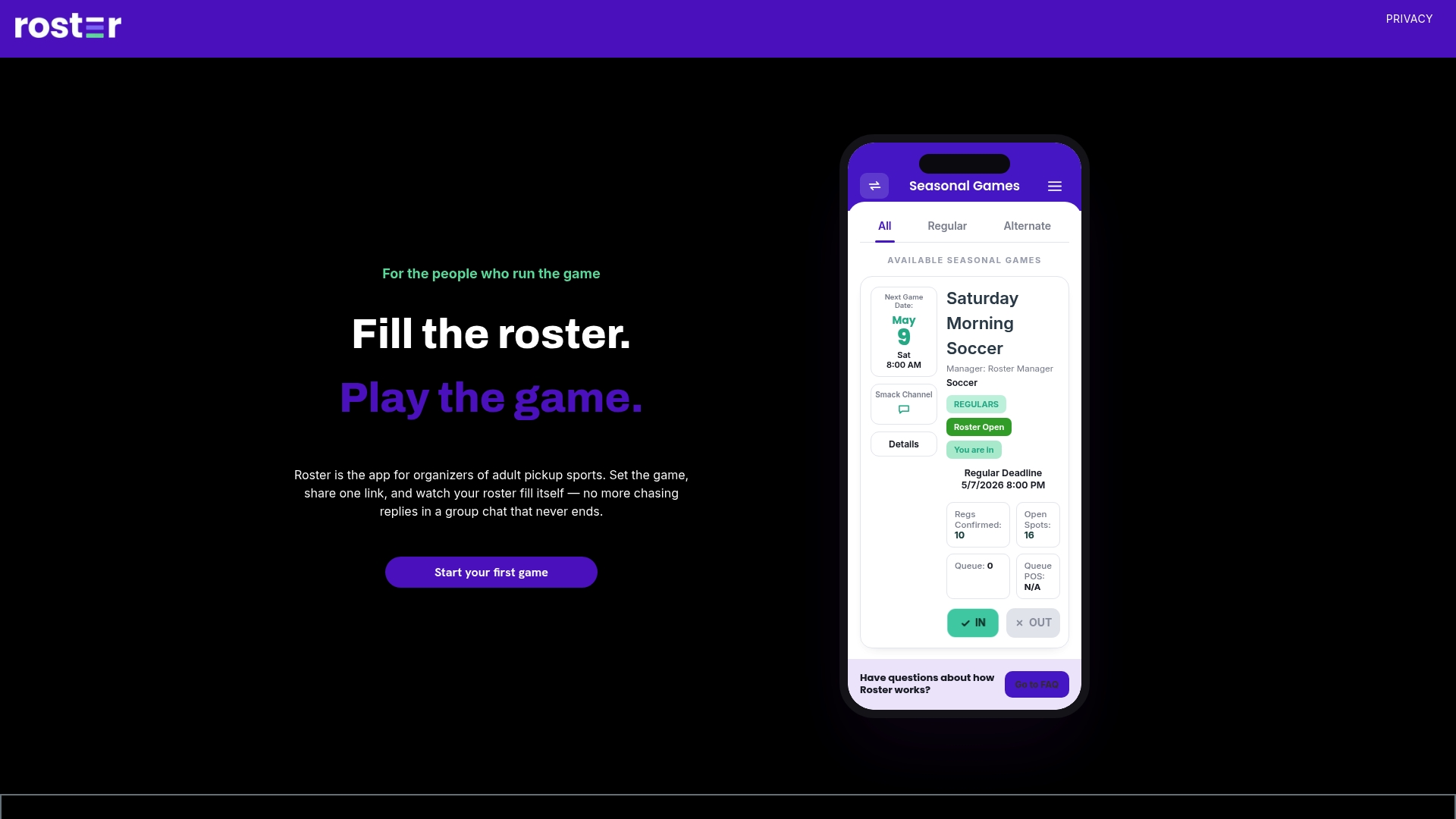
It's designed for pickup sports organizers and volunteer leads who want to avoid chasing RSVPs and payments across pickup sports teams. If that's your week, every week, see how Roster's game management tools work and give your next game a link instead of a headcount spreadsheet.
Where these figures and features come from
- Discord support, on server and account caps.
- Vecosys comparison, on onboarding friction and community size.
- LeapXpert roundup, on platform fit by team type.
Sources
- Discord support: Account caps, server caps, and more
- WhatsApp Communities vs Discord for Beginners (Vecosys)
- Best communication software comparison — LeapXpert
FAQ
Why do people use Discord instead of WhatsApp?
People choose Discord when they need structured channels, defined roles, and voice rooms members can join anytime rather than scheduled calls. It suits larger or more active communities better than a single scrolling WhatsApp thread.
Which is better for my team, a dedicated chat platform or Discord?
The right choice depends on what your team actually needs: structured tools built for project coordination handle formal workflows better, while Discord fits looser, voice-heavy, or community-style teams. Neither is a universal answer; match the platform to how your group communicates day to day.
Why are people moving away from Discord?
Some communities move away from Discord because its lack of end-to-end encryption on standard messages raises privacy concerns, and its channel-based structure can feel like too much overhead for a small group. Others find the join and verification process adds friction for non-technical members, as community-management guides point out.
Why are people moving away from WhatsApp?
Some teams outgrow WhatsApp once a group needs role-based moderation, multiple discussion topics, or voice channels that stay open around the clock, features WhatsApp's flat group model doesn't offer. Concerns about metadata sharing with Meta also push privacy-conscious groups to reconsider, even though WhatsApp's message content stays end-to-end encrypted by default.
Can Roster replace WhatsApp or Discord entirely?
Roster isn't a chat replacement: it's built specifically to automate scheduling, roster fills, waitlists, and payment tracking for pickup sports organizers. Many teams keep WhatsApp or Discord for conversation and use Roster for the logistics chat wasn't designed to handle.