

A dropout deadline is the last moment a player can cancel their spot in your pickup game without it counting against them. For most organizers, the best cutoff is the point after which you can no longer realistically find a replacement. Pick that time, say it once in plain words, and make sure a waitlist is ready to catch every spot that opens before it.
This guide is for the person running the game: the soccer, basketball, volleyball or softball organizer who is tired of last-minute texts. (If you searched "dropout deadline" looking for a college course withdrawal date, your school's registrar page is the place to go. Everything below is about adult pickup sports.)
TL;DR
- A dropout deadline is the cutoff after which a player's cancellation is treated as late. Set it by how long it takes you to refill a spot, not by a number you copied from somewhere else.
- Short games with a deep waitlist can run a tight cutoff. Games that need exact numbers, like 11v11 or a booked indoor court, need a longer one.
- Publish the rule where players sign up, and state the consequence for a late cancel or a no-show before anyone joins.
- Before the cutoff, drops should be easy and free. After it, the player's job is to help find a replacement.
- Guidance from a US government adaptive sports program supports clear, visible cancellation policies as a way to cut no-shows.
Table of Contents
- What a dropout deadline means for a pickup game
- How far before the game should players be able to drop out?
- Separate "early drop" from "late drop"
- What to do when a player cancels after the deadline or doesn't show
- What the evidence says about cancellation rules
- Use a waitlist so a dropout is not a crisis
- Perspective: why we built Roster around the dropout
- How to communicate the cutoff so players actually follow it
- Keep it welcoming and accessible
- A simple template you can copy
- Run your dropout deadline with Roster
- FAQ
- Sources
What a dropout deadline means for a pickup game
In a pickup game, a dropout deadline is a simple agreement: until this time, you can leave the roster with no questions asked. After it, leaving has a cost, whether that is a fee, a warning, or just a request that you find your own sub.
That cost does not have to be money. Many groups never charge anyone. What matters is that the line exists, that everyone knows where it is, and that it is the same for everybody, including you.
A deadline does three jobs:
- It protects the game. If the game needs ten players to run, an unannounced dropout an hour before kickoff can cancel it for everyone.
- It protects your time. Without a cutoff, every cancellation becomes a private negotiation, and you are the one running it.
- It gives the waitlist something to work with. Players waiting for a spot will only stay interested if there is a realistic chance to get in. A clear cutoff tells them when the roster is final.
How far before the game should players be able to drop out?
There is no universal number, and no official body sets one for casual adult games. Treat any "always 24 hours" rule you read with suspicion. The right cutoff comes from one question: how long does it take to refill a spot?
Start with these three factors.
1. How fast your waitlist responds
If you have a pool of regulars who check their phones and say yes within minutes, a cutoff of a few hours can work. If your waitlist is slow or small, you need more runway. Measure it: look at the last few times someone dropped and note how long it took to get a replacement confirmed.
2. How exact your numbers have to be
Some games survive one person short. A pickup basketball run with twelve players is fine at eleven. Others fall apart: a 5v5 game with no subs, a volleyball group that needs six per side, or a league night where you have already paid a field fee for a set number of people.
3. What you have paid for in advance
When you have booked a field, a gym or a court by the hour, a short roster costs you real money, and you should set the cutoff earlier. If you are using a free public park, you have more flexibility.

A practical way to choose
Use this rough framework, then adjust after a few weeks of real games:
| Game type | Typical need | Suggested cutoff approach |
|---|---|---|
| Drop-in game at a free park, flexible numbers | Roughly right numbers | A few hours before kickoff, with a waitlist |
| Weekly game with a paid field or gym | Full roster to split the cost | The day before, so you have the evening and morning to refill |
| Full-sided or league-style game | Exact numbers, no subs | Longer lead time, such as two days, with named alternates |
| Season-long team with set regulars | Same group every week | A cutoff each week for regulars to confirm or release their spot |
These are starting points drawn from how organizers commonly run things, not rules. The test is simple: if a typical dropout at your cutoff time leaves you scrambling, move the cutoff earlier. If you almost never use the last few hours for replacements, you can move it later and make life easier for your players.
Separate "early drop" from "late drop"
The best policies have two zones, not one.
- Before the deadline: the player can leave freely. Thank them for the notice. This should feel like a non-event, because you want people to tell you early.
- After the deadline: the player is asked to help fill the spot, or a late-cancel consequence applies.
This matters because the worst outcome of a strict policy is that people stay quiet. A player who feels trapped will simply not show up. If dropping early is painless, you get notice, and notice is what lets a waitlist work. We cover the mechanics in our guide to cancelling a pickup game without losing half your roster.
What to do when a player cancels after the deadline or doesn't show
Decide the response before it happens. Making it up on the spot is what turns a minor annoyance into an argument in the group chat.
Late cancellation
A late cancel is better than a no-show, because you at least know. Reasonable responses, from lightest to firmest:
- Ask the player to offer the spot to a friend or a waitlisted player.
- Move them to the back of the line for the next game that fills up.
- Apply whatever fee or credit rule you have announced.
No-show
A no-show with no message is the one that costs the game. Many organizers handle it in steps: a friendly check-in the first time, then a firmer rule if it repeats. If your group uses a fee, apply it the same way every time and to everyone. Our piece on a no-show fee policy that keeps pickup games full walks through how to word it, and how to reduce sports no-shows in pickup games covers the habits that prevent them in the first place.
Emergencies
People get injured, kids get sick, work runs late. Build in room for judgment: you can waive a consequence once for a real emergency without breaking the rule. Say so in the policy ("organizer's discretion") so that a waiver reads as fairness, not favoritism.
What the evidence says about cancellation rules
Casual adult sports have little formal research, but there is useful guidance from a related field. The US Department of Veterans Affairs adaptive sports program published lessons on no-shows. It found that an initial registration fee, even a nominal one, may increase commitment to attend. The same document says a signed financial agreement or cancellation policy may reduce no-shows and last-minute cancellations, and that such policies can include financial penalties for late cancels.
It also says policies like these should be advertised, accessible and user-friendly. That is the part worth borrowing even if you never charge anyone: a rule only works if players can find it and understand it in ten seconds. That program serves a specific population, so treat it as a useful principle, not a rulebook for your Tuesday night game.
If you do bring in any waiver or written agreement, see our guide on what organizers need in a pickup game waiver and how to collect signatures.
Use a waitlist so a dropout is not a crisis
A waitlist is what makes a deadline humane. Without one, every dropout is a hole. With one, a dropout is an opening for someone who wanted in.
Here is how to make a waitlist actually work:
- Keep it ordered. First on the list gets the first open spot. This is the fairest rule, and it ends arguments about who you "picked."
- Offer spots automatically or with one message. The faster the offer goes out, the more likely it gets accepted before the cutoff.
- Set a short response window. If the first person on the list does not answer, move to the next so the spot does not sit empty.
- Tell waitlisted players where they stand. People will wait if they can see the chance is real.
- Keep a pool of alternates. Players who have said "I'll come if you're short" are the most reliable fix on game day.
If you handle this by hand, it eats your evening. Our walkthrough on filling dropouts in five minutes with one message shows a message format that keeps the replacement process short.
Perspective: why we built Roster around the dropout
We built Roster after watching organizers do the same thing every week: post the game, chase replies through a group chat, then scramble when someone bailed.
Our view is that the dropout is not the problem. The silence around the dropout is. When a player can leave in one tap and the next person on the waitlist is offered the spot right away, the cutoff stops being a rule you enforce and becomes a system that runs itself.
That is how Roster is designed. You set the game details and share one link. Players sign up, open spots are filled in real time, and if someone drops, a waitlist is there to take the spot. You spend less time counting replies and more time actually playing.
We also think games are better when people meet in person instead of living in a thread. Good logistics are what make that possible.
Daniel
How to communicate the cutoff so players actually follow it
A good rule that nobody has read is no rule. Treat communication as part of the policy.
Put it where players sign up
The signup page or link is the best place for the rule, because people see it at the moment they commit. Add the deadline to the game description itself, not only in a pinned message that scrolls away in a chat.
Write it in one short block
A clear version fits in four lines:
- Game: Thursday, 7:00 pm, Riverside Field
- Drop out free until: Wednesday, 7:00 pm
- After that: find a replacement from the waitlist, or the late-cancel rule applies
- Spots open up? The next person on the waitlist is offered the spot automatically
Use the exact day and time, not "a day or so before." Vague deadlines are the ones people argue about.
Announce roster changes in one place
When the roster changes, say it once, in the same place every time. If updates are scattered across texts, a chat and a comment thread, players stop trusting any of them. This is the main reason groups drift toward chaos: the information is everywhere, so nobody has the real version.
Remind before the cutoff, not after
A short reminder a few hours before the deadline ("Last call to drop without penalty") prevents more late cancels than any penalty does. It also gives the waitlist a final push.
Be consistent, starting with yourself
Players watch how you apply the rule. If you waive it for friends and enforce it for newcomers, the policy collapses. Apply it the same way to everyone, and follow it yourself when you need to bail.
Keep it welcoming and accessible
Pickup sports are supposed to be fun. A policy that feels like a penalty system will push away exactly the casual players you want.
- Start light. Begin with a clear deadline and a waitlist, and add consequences only if late cancels keep happening.
- Make leaving easy before the cutoff. The smoother the early exit, the more notice you get.
- Think about who a fee affects. If you use fees, keep them modest and explain what they cover, so the rule reads as shared fairness.
- Allow substitutions. Letting a player send a friend in their place after the deadline is often the friendliest solution for everyone.
- Review each season. If the same cutoff keeps leaving you short, adjust it. A policy is something you tune.
A simple template you can copy
Adapt this wording to your own game:
Dropout deadline: You can leave this game for free until [day and time]. After that, please find a replacement or message the organizer right away. If you no-show without notice, [your consequence, e.g., you go to the back of the waitlist for the next game]. Emergencies are handled case by case.
Keep the tone friendly and short. Then use the same text every week so players know it by heart.
Run your dropout deadline with Roster
If you are tired of managing cutoffs and replacements by hand, Roster is a mobile app built for organizers of adult pickup sports. You set the game details, share a single link, and players sign up in one place. Regulars and alternates are tracked, open spots fill in real time, and a waitlist catches dropouts so you are not chasing people through a group chat. Roster also includes payment tracking between players and managers if your group uses fees.
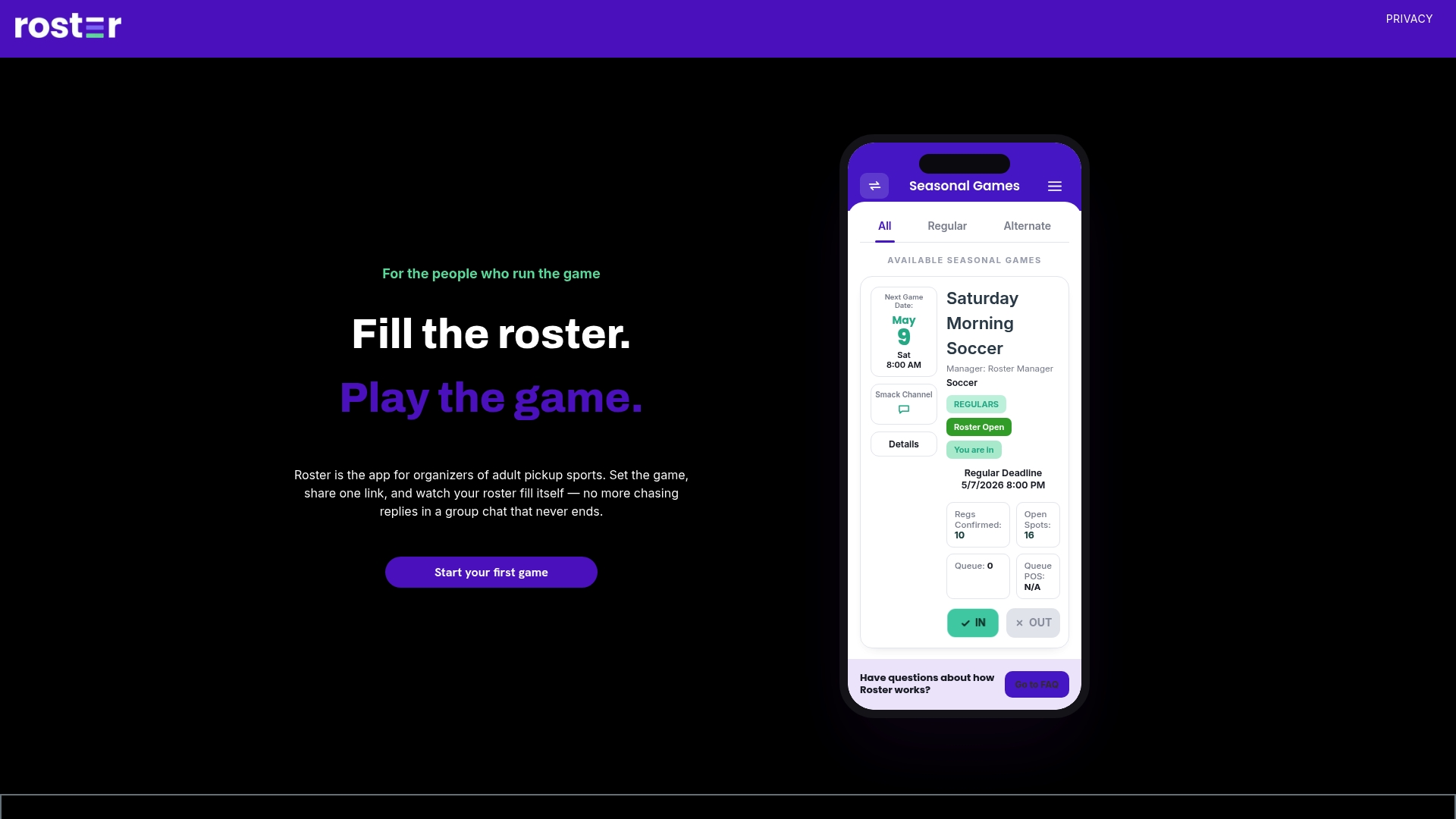
See how it works at Roster.
FAQ
What is a dropout deadline in a pickup game?
It is the last time a player can cancel their spot without a consequence. Before it, they can leave freely. After it, a late-cancel rule applies, or the player helps find a replacement.
How long before a pickup game should the cutoff be?
It depends on how fast you can refill a spot. A free park with a responsive waitlist can use a cutoff of a few hours. A paid field or a game that needs exact numbers calls for a day or more. Check how long your last few replacements took and set the cutoff just beyond that.
Should I charge players who cancel late?
You don't have to. Many groups start with a clear deadline and a waitlist, then add a consequence only if late cancels continue. US Department of Veterans Affairs adaptive sports guidance suggests that a clear cancellation policy, including penalties, may reduce late cancellations. Whatever you choose, announce it before players join and apply it equally.
What should I do if someone doesn't show up?
Reach out first, since the reason may be genuine. If it repeats, apply the rule you announced, such as moving them down the waitlist or applying a fee. Consistency matters more than severity.
How do I tell players about the deadline?
Put it in the game description on the signup page, write the exact day and time, and send one reminder before the cutoff. Keep roster updates in one place so players know where to look.