

The fastest way to find subs for soccer is to build the pool before you need it: a standing list of vetted regulars and alternates, a clear cutoff, and one link where anyone can claim an open spot. When you are already short, work the list in order, then ask your league or a free-agent pool, and set the ground rules (ID, waiver, fee) before the sub steps on the field.
This guide is for adult pickup and rec-league organizers, not for coaches tracking youth playing time. It covers where subs come from, how to vet them, what league rules to check, what to charge, and what to do at 11 AM when the 7 PM game has nine players.
TL;DR
- Keep a ranked pool of alternates all season. Scrambling for strangers on game day is the expensive way to do it.
- Publish an RSVP cutoff and fill dropouts from the waitlist in the order people joined it.
- Check league rules before you recruit: many leagues require subs to be rostered, declared, or cleared, and some forfeit the game if you skip that step.
- If you charge subs, write the fee down once. One league caps its $10 sub fee at two appearances before the player must join the roster.
- Roster handles signups, waitlists and alternates from one shared link, so spots refill without you texting forty people.
Table of Contents
- Where subs actually come from
- Vet a sub in five minutes
- Check the rules before you recruit
- What to charge a sub, and how to say it
- The last-minute playbook
- Stop the shortage before it starts
- Our perspective: a sub list is part of the game, not a patch
- Fill spots without the group chat
- FAQ
- Sources
Where subs actually come from
Organizers who rarely scramble tend to draw on four sources, roughly in this order.
1. Your own alternates list. Anyone who has played with your group and said "call me if you're short" belongs on a named list, ranked by how reliably they show up. This is the cheapest and safest source because you already know their level and their manners.
2. Friends of regulars. A regular vouching for a friend is the best vetting shortcut there is. If the friend flakes, the regular hears about it too, which keeps everyone honest.
3. League free-agent pools. Organized leagues often run them. Santa Monica Adult Sports lets people without teams join a free-agent list, and team managers contact those players when they need extras. Chicago Fire Adult Soccer offers free-agent registration and staff help finding free agents before the season starts. If you play in a league, ask the office before you post anywhere else.
4. Open community groups. Local pickup groups on social platforms and Meetup-style pages work in a pinch. One U.S. pickup group on Meetup publishes its location, format, skill expectations, conduct rules, equipment, payment, arrival deadline and the consequences for no-shows and late arrivals. Copy that approach for your own invite so strangers know what they are signing up for.
Vet a sub in five minutes
A sub who is too good, too rough or too unreliable costs you more than an empty spot. You do not need an interview. You need five answers before you say yes.
- Level. Ask where they have played recently and how competitive the game is. Match it against your group's stated level, not your hope.
- Contact details. A real name, a working phone number and, in organized leagues, whatever the league requires. playNOLA's sub policy asks substitutes to check in before the game, provide contact details, sign the waiver and pay the fee.
- Identity. One adult-league policy has substitutes show a player card or government-issued ID to the referee, with their name, team and division recorded. That is a Canadian league's rule, so adapt it only where your own league allows.
- Expectations. Tell them the arrival time, the cleat and shin guard rules, and what happens if they cancel late.
- A reference. Who in the group has played with them? If nobody, treat the first game as a trial.
If you want a formal gate rather than an open invite, a manual approval step helps. Our guide on vetting pickup game signups walks through six steps for approving people before they take a spot.
Check the rules before you recruit
This is where casual organizers get burned. In a pickup game anyone can play. In a league, the wrong sub can cost you a result. The rules vary a lot, so read your own league's document first. Here is how a handful of U.S. programs handle it.
| Program | What it says about subs and rosters |
|---|---|
| Chicago Fire Adult Soccer | Players must be on the official roster before Game 2. Rosters freeze after Week 2. Playoff eligibility is limited to listed players. Using unrostered or unregistered players can bring a warning, then a forfeit. |
| Santa Monica Adult Sports | Free-agent list for players without teams. A forfeit is declared if an unrostered player participates. |
| Roseville adult co-rec | Rosters due before the first game, additions allowed through the third game, no playing for more than one team, and changes frozen after the third game (2026 rules). |
| San Antonio FC adult league | The player who cannot play is responsible for finding a replacement, and the replacement must be officially rostered and cleared by league staff (2025 rules). |
| playNOLA | Opposing captain must approve, the sub is declared before the game, and subs are generally barred from playoffs unless the opponent consents. |
| KEVA Sports indoor | A short team may borrow from other rosters only through the league process. The match counts as a forfeit and is played as a friendly, with the referee told and the sub on the score sheet (2022 rules). |
The pattern is consistent. Leagues want to know who is on the field, they want it settled early, and they protect playoffs from ringers. If you run a private pickup group, borrow the useful part: decide who counts as a regular, who counts as an alternate, and say so in writing.
One more point if your group includes minors or you coach across age groups. US Club Soccer's safety policy requires background screening for adult participants who are authorized to have regular contact with or authority over minor athletes. That applies to club activity under its jurisdiction, not to a regular adults-only pickup game, but it is worth knowing if your organization straddles both.
What to charge a sub, and how to say it
There is no national standard for sub fees, so the honest answer is to look at how organized programs structure them, then pick a rule you can explain in one sentence.
The clearest published example is playNOLA. It charges a $10 cash fee per substitute appearance. A sub can pay it twice, and after that must pay the remaining league fee to become rostered. In its example, a $70 league fee leaves $50 owed after two sub fees. The logic is neat: a sub is a tryout with a price, and the third game is a commitment.
Whatever you choose, three habits keep it painless:
- Write the fee in the invite. Nobody should learn the price at the field.
- Decide what the fee covers. Field rental, a ref, balls, or just your costs. People pay more readily when they know where it goes.
- Cap it or convert it. A rule like "after two games, join the roster" turns frequent subs into regulars and stabilizes your numbers.
A note on how this works with Roster: managers pay Roster based on rostered participation, and players pay only the manager, never the app. Roster tracks peer-to-peer Venmo payments between players and the manager, so you can see who has paid without chasing anyone. Fees to the app are billed to the manager's card on file seven days after scheduled games.
The last-minute playbook
It is game day and you are short. Work this sequence and stop when you are full.
- Check the waitlist first. If you keep one, the next name is already waiting. Fill in listed order, because skipping people is how a waitlist loses trust. The Pleasanton pickup group is a good model: a final RSVP deadline, an ordered waitlist, a check of who is present at kickoff, and stated penalties for late changes and no-shows.
- Message your alternates, once. Send one message with the time, place, level and the one-line fee rule. Say first come, first served, and name a response deadline of 60 to 90 minutes. Our post on game invite message elements covers what to include so people can say yes without asking questions.
- Ask the regulars who can't make it to find their own replacement. San Antonio FC's league does this formally. In a pickup group, it shifts the work off you and usually produces someone the group already trusts.
- Call the league if you have one. Chicago Fire Adult Soccer says to contact the league by noon on game day, and staff will try to find substitutes, including on-site if a team arrives short. The same policy says a team that cannot field enough players within 10 minutes forfeits, with no fine in that situation. Verify your own league's cutoff rather than assuming it is the same.
- Post to an open group as a last resort. Use the same invite template, and approve people manually if you do not know them.
- Decide your minimum. If you cannot reach it, call the game early and tell everyone. A cancellation at 3 PM beats an empty field at 7 PM.
Stop the shortage before it starts
Most last-minute scrambles are the same problem repeating: late dropouts and silent no-shows. Three fixes cover most of it.
Set a hard RSVP cutoff. Pick a time, say it every week and stick to it. Our no-show checklist lays out six steps for tightening RSVPs.
Keep the waitlist ordered and visible. When people can see they are fourth in line, they stop asking you if there is room.
Enforce the consequences you wrote down. The consistent groups apply their stated penalties for late changes and no-shows every time, to everyone. The first exception becomes the rule.

If you are still building the group, the five decisions in how to organize pickup soccer and the plan for finding field time and filling rosters cover the groundwork that makes subs easier to find later.
Our perspective: a sub list is part of the game, not a patch
We built Roster for organizers who run adult pickup games and are tired of being the unpaid dispatcher. Here is what we think about subs.
The problem is rarely a lack of people. It is that the information lives in a group chat, buried between memes and "who's in?" replies. The organizer becomes a human spreadsheet, and the person who could have filled the spot never saw the message.
So we treat regulars and alternates as two different roles from the start. Regulars hold a spot for the season. Alternates are first in line when a spot opens, and the app fills it in real time and keeps a waitlist for dropouts. You set the game details once, share one link, and the roster manages itself.
We also think games should get people off their screens. The goal is less texting and more showing up. If your tools keep you glued to your phone, they are not doing their job.
— Daniel
Fill spots without the group chat
Roster is a mobile app for adult pickup organizers. You set the game, share one link, and players sign up as regulars or alternates. Open spots fill automatically, dropouts go to a waitlist, and Venmo payments between players and you are tracked in one place. Group chat is built in, so the conversation stays attached to the game.
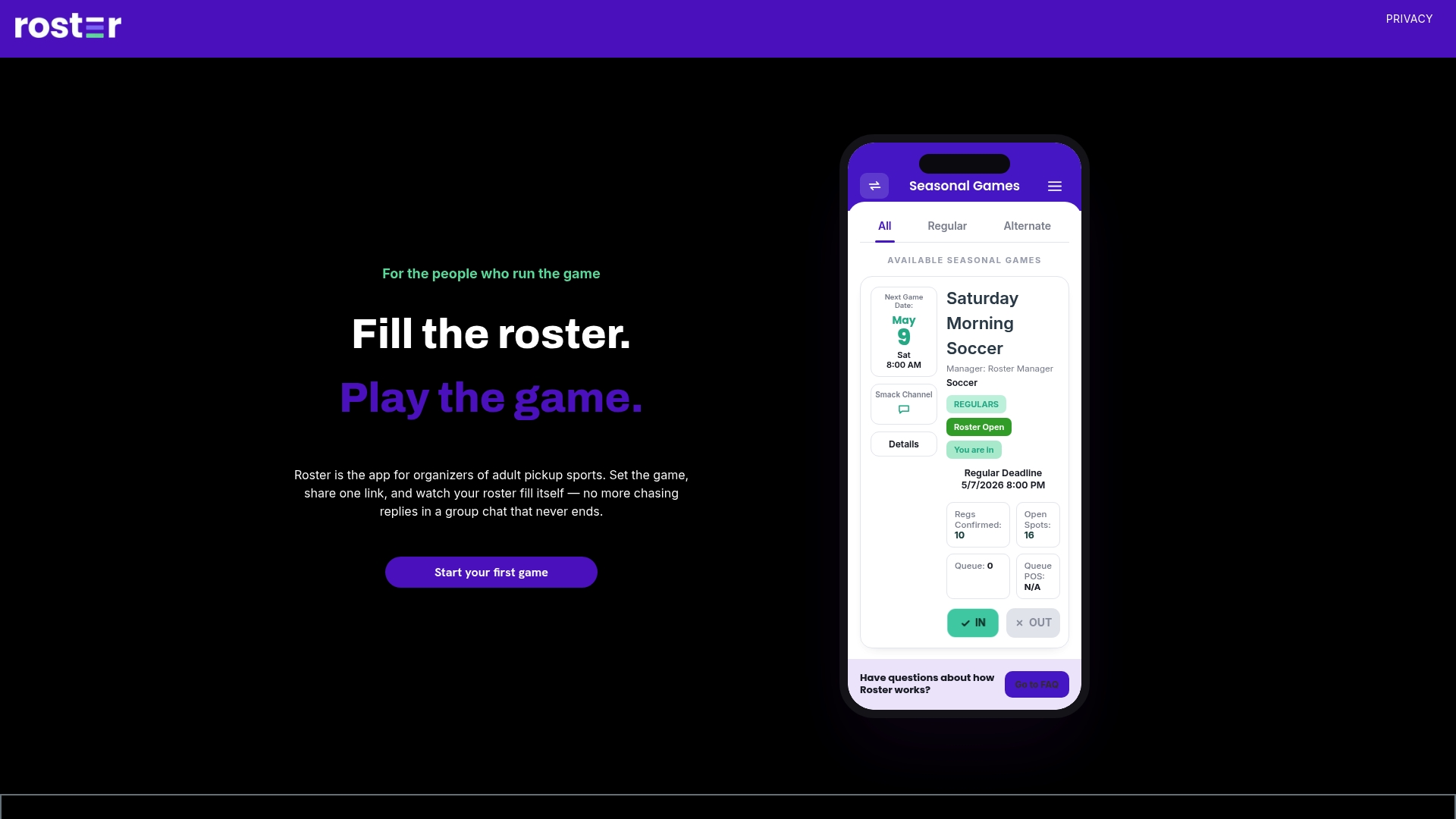
If you are tired of last-minute sub hunts, set up your first game on Roster and see how a single link changes game day.
FAQ
How do I find a last-minute sub for a soccer game?
Start with your waitlist, then message your ranked alternates once with the time, place and fee. If you play in a league, call the office early: one U.S. league asks teams to contact it by noon on game day. Post to an open group only after that, and approve unknown players manually.
Can anyone sub in a league game?
Not usually. Many leagues require subs to be rostered, declared before the game, or cleared by staff, and some declare a forfeit if an unrostered player takes the field. Read your league's rules before you invite anyone, and ask the league office if a rule is unclear.
How much should a sub pay?
There is no standard. One published example charges $10 per sub appearance, for up to two games, before the player must pay the remaining league fee to join the roster. For a private group, set a fee that covers your costs, put it in the invite, and apply it to everyone.
How do I keep a fair waitlist?
Publish an RSVP cutoff, list waitlisted players in the order they joined, and fill open spots strictly in that order. Check who is present at kickoff and give any no-show's spot to the next person. Apply the stated penalties for late changes the same way every time.
How do I vet a sub I don't know?
Ask about their recent level of play, get a name and phone number, and have a regular vouch for them if possible. In formal leagues, check ID and have them sign the waiver before the game. Treat the first game as a trial and tell them the rules up front.
Sources
- PLAYER HUB, Chicago Fire Adult Soccer
- Soccer, City of Santa Monica Adult Sports
- Fútbol Pickup (Soccer), Meetup
- Friday morning game, Pleasanton soccer pickup group, Meetup
- Register as a Sub, playNOLA Sports
- Adult Co-Rec 35 & Older Soccer League Format and Rules, City of Roseville
- SAFL Info & Regulations, San Antonio FC
- Indoor Soccer League Rules, KEVA Sports
- Participant Safety and Risk Management Policies, US Club Soccer
- Indoor Adult League Policies and Procedures, FC Regina