
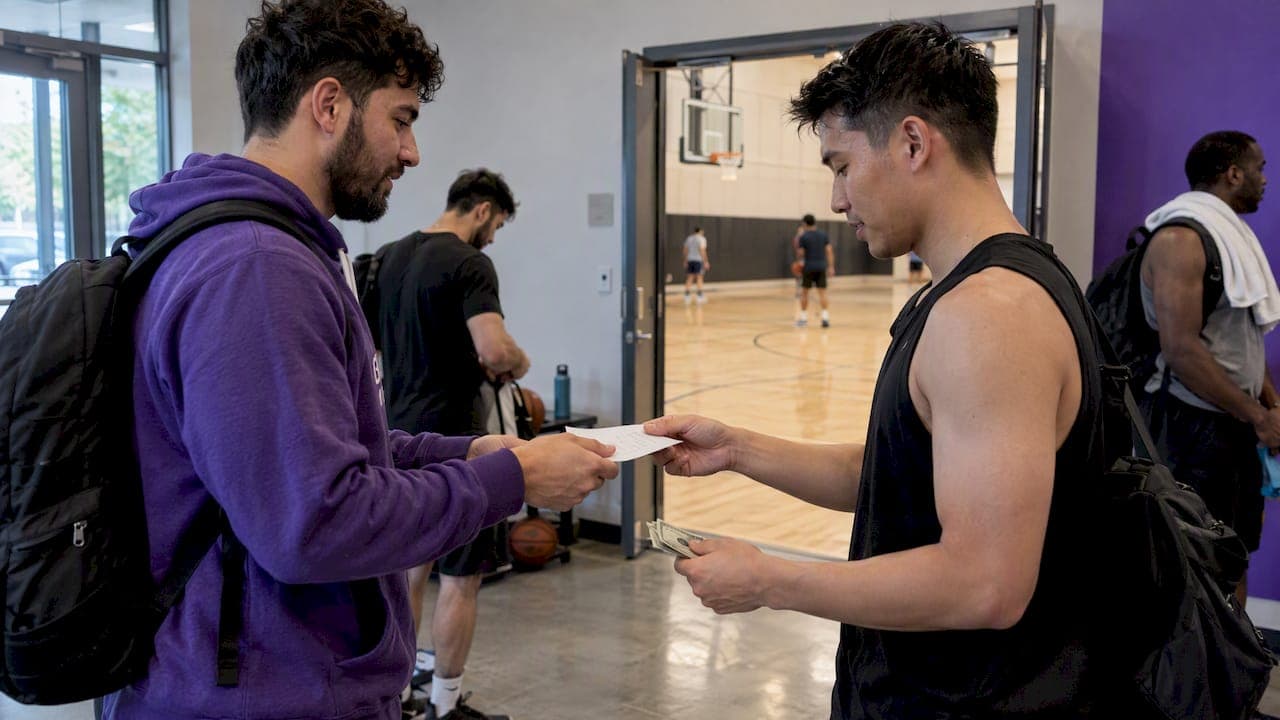
The simplest fair way to split field costs is to add up everything the group must pay for one game (field rental, referee fees, shared equipment), divide by the number of players who actually show, and collect before or right after the game. Everything else in this guide is about handling the messy parts: dropouts, late joiners, alternates and the guy who "forgot his Venmo."
This is for organizers of adult pickup soccer, basketball, softball and similar games who front the money and want to stop chasing people for $12.
TL;DR
- Count only direct costs in the split: field or court rental, referee or umpire fees, and shared gear. Keep post-game food and drinks separate and optional.
- The formula is (field fee + referee fees) ÷ players. Round up to a clean number so you never lose money on rounding.
- If your roster changes week to week, split per game. If it is stable, flat season dues are simpler. Pick one model and keep it for the whole season.
- Write down the no-show, payment deadline and field-cancellation rules before the first game, not after the first argument.
- Collect in one place, on a set deadline, with a tool that tracks who has paid.
Table of Contents
- What belongs in the split
- The math: per-player share
- Choose a billing model and stick with it
- Handle roster changes without drama
- Make the rules visible
- Perspective: why we think organizers should stop being the bank
- Where Roster fits
- Insurance and permits: the costs people forget
- A short checklist before game one
- FAQ
- Sources
What belongs in the split
Start by sorting costs into two buckets: things the game cannot happen without, and things people choose.
Direct costs (everyone who plays shares them):
- Field or court rental. Usually the biggest line. Public parks, school fields, turf facilities and indoor arenas all price differently.
- Referee or umpire fees. Only if you hire officials. Many casual pickup games skip them; organized adult leagues do not.
- Shared equipment. Balls, bibs, cones, nets, a pump, a first-aid kit. Guidance aimed at pickup soccer groups lists balls, bibs and nets with field and referee fees as the core shared costs.
- Permits and deposits. Needed on some public land. More on that below.
Social costs (only people who join pay): pizza, beers, the post-game taco run. Keep these off the game invoice entirely. Nobody should subsidize a round of drinks they did not drink.
Costs that vary by venue
Fees are very local. Some examples of the range:
- Pima County, Arizona charges $10 per hour for adult leagues or general public use of fields without lights, versus $2 per hour for youth non-profit or government leagues.
- A private league operator in Poway, California lists a $25-per-game referee fee for adult soccer and $15 per game for softball umpires.
- California State Parks' special-event guidance for its Santa Cruz District lists a $25 filing fee, a $100 late filing fee for applications less than 30 days before the event, plus permit fees and security deposits. The same document shows that larger events can also involve parking, site fees and ranger or monitor fees. These are event-specific, so a casual weekly game on a public field often has none of them, but a tournament or large gathering might.
Lights, field size, surface and time of day all move the price. If you are still shopping for space, our breakdown of what it costs to rent a soccer field shows how the numbers stack up, and the 7-day playbook for finding field time covers where to look.
The math: per-player share
The formula is straightforward. One recreational facility explains its basketball pricing this way: each player's price is the team fee plus referee fees, divided by the number of players. That works for any sport.
Per-player share = (field cost + referee fees + shared gear for the game) ÷ number of players
A worked example
Say your 7-a-side game rents a turf field at $85 an hour for two hours, and you pay one referee $25 for the game. This is an illustration, not a quote for any venue.
| Line | Amount |
|---|---|
| Field: $85 × 2 hours | $170.00 |
| Referee | $25.00 |
| Total | $195.00 |
| Players | 14 |
| Exact share | $13.93 |
| What you charge | $14.00 |
Charging $14 instead of $13.93 leaves a small cushion: $196 collected against $195 owed. Over a season that covers the occasional unpaid player without you eating the loss. If you want more of the pricing logic on turf, see our pickup soccer cost walkthrough using an $85/hr turf example.
Sensitivity: what happens at 11 or 16 players
The same $195 spread over different headcounts:
| Players | Share per player |
|---|---|
| 10 | $19.50 |
| 12 | $16.25 |
| 14 | $13.93 |
| 16 | $12.19 |
That spread is why the roster matters. A game that sits at 10 players costs each person almost $6 more than one that fills to 16. Filling spots is not just good for the game, it is the cheapest lever on everybody's share.
Choose a billing model and stick with it
There are three common structures. None is wrong. Pick based on how stable your group is.
| Model | Best for | How it works | Watch out for |
|---|---|---|---|
| Per game | Groups with a changing roster, drop-ins | Only players who play pay that game's share | More collection events; more reminders |
| Season or monthly dues | A stable core group | Everyone pays a flat amount up front | Refunds, credits and late joiners need rules |
| Hybrid | A core group plus alternates | Base dues for regulars, a per-game fee for subs | Two numbers to explain |
For changing lineups, per-game splitting is the fairest approach because only the people who played contribute to that session. A hybrid model with base monthly dues plus extra per-game fees suits groups that have regulars and substitutes.
Whatever you choose, keep it for at least a season. Switching mid-stream is what creates the "wait, I thought dues covered that" conversations.
Handle roster changes without drama
This is where most pickup groups get into trouble. Decide these cases in advance.
Someone cancels
- Early cancellation, spot refilled: they owe nothing. The replacement pays.
- Late cancellation, spot not refilled: they pay their share, because the field fee does not shrink when a player vanishes.
- Season dues and a departing player: agree upfront whether they get a refund, a credit toward another season, or forfeit the balance. The advice for pickup soccer groups is to settle this before anyone leaves.
Someone confirms and does not show
The field was booked for them. Put the rule in writing: a confirmed no-show pays the share. This is the single most useful sentence in your group rules, and it is also why a waitlist matters. If there is a waitlist, a late dropout can be replaced and nobody owes anything.

Someone joins mid-season
Prorate. Charge them for the games remaining rather than the full season, and add any one-time items such as a team jersey. Prorating a late joiner's share of shared costs for the remaining games is a common approach for teams with uniforms.
Rotating players and uneven playing time
If players sub in and out in a game with fixed court time, an equal split among everyone who shows up is the default. For formats where people rotate heavily, some groups use time-based splits, but for most adult pickup games the equal share is easier to defend and easier to run.
Make the rules visible
Money awkwardness is almost always a clarity problem, not a character problem. Put four things in the signup message or group description:
- The price per game or season, and what it covers.
- The payment deadline. For example, "within 24 hours of the game" or "before the first game of the season."
- The no-show and late-cancel rule.
- What happens if the field cancels. Rain, lightning, a double-booked pitch. Say whether you refund, credit or roll the fee to the next game.
These are exactly the points the pickup soccer cost guidance recommends writing down.
Keep a simple expense record
If you buy gear or pay a referee out of pocket, log it. A basic table with the item, total, who paid, how it is split, each person's share and the receipt is enough. Net balance for each person is what they paid minus what they owe, which one shared-expense template spells out. Set a spending cap before you buy anything for the group, and share receipts so nobody has to ask.
Perspective: why we think organizers should stop being the bank
We built Roster because the money problem and the roster problem are the same problem. When you run a pickup game over a group chat, you are tracking who said yes, who is a maybe, who dropped at 6 AM, who paid and who owes. Every one of those facts lives in a different place, usually buried 200 messages up.

Our view is plain. The per-player cost only works when the headcount is known, and the headcount is only known when signups are in one place. That is why we put the game details behind a single shared link: players claim a spot, the roster fills in real time, and if someone drops, the next person on the waitlist takes the spot. A filled roster is the fairest and cheapest roster, because the fixed field cost spreads over more people.
We also think organizers should not be doing accounting on top of everything else. Players pay their manager, usually by Venmo, and the manager needs to see at a glance who has. That is the part of the job nobody signed up for, and it is the part that makes good organizers quit.
— Daniel
Where Roster fits
If you are organizing adult pickup games, Roster handles the parts of this guide that eat your week. You set the game details and share one link. Players sign up as regulars or alternates, the app tracks open spots and the waitlist in real time, and the group chat lives next to the roster instead of replacing it. Payments between players and the manager are tracked through peer-to-peer Venmo, so you can see who has paid without a spreadsheet.
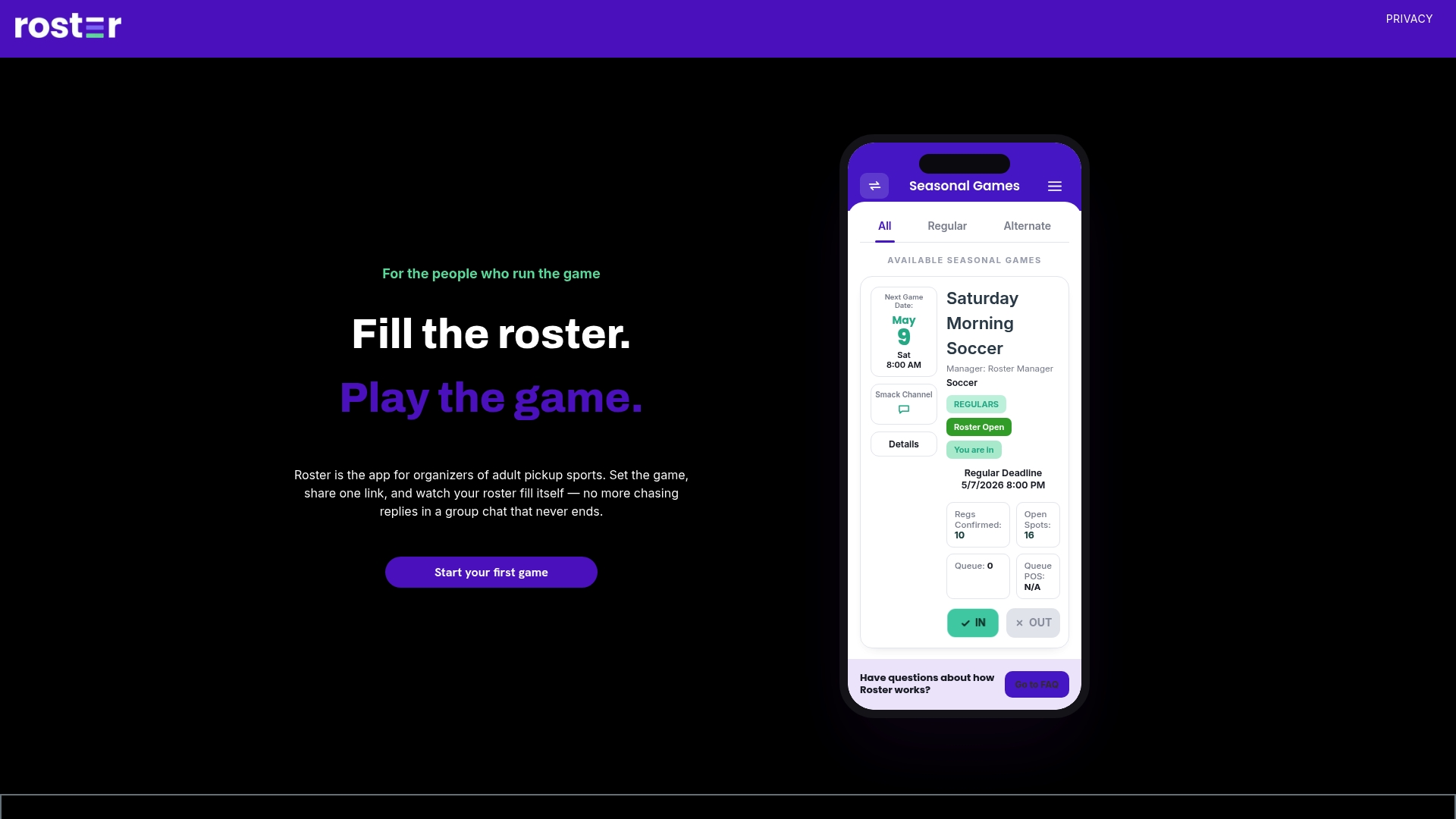
Managers are billed based on rostered participation, not on a subscription, and players never pay Roster. See how it works on the Roster home page. If you are still working out how to run the whole game, our guide to five decisions for organizing pickup soccer is a good next step.
Insurance and permits: the costs people forget
Two items surprise organizers once a game grows beyond friends in a park.
Insurance. Some venues, especially private facilities and municipal fields, ask for a certificate of insurance before they will confirm a booking. That cost is a real expense of running the game and belongs in your budget, split like field rental. We cover what to ask for in our guide to pickup game insurance and the COI.
Permits. Casual use of a public field may need nothing. Reserved or organized use may need a permit, and large or recurring events can involve filing fees, deposits and, in some state parks, monitor fees, as the California example above shows. Call the parks department before the season, ask what applies to a weekly adult game, and build any fee into your price.
A short checklist before game one
- Total the per-game cost: field, referees, gear, permit or insurance share.
- Pick a model: per game, season dues or hybrid.
- Round the share up to a clean number.
- Write the no-show, cancellation and field-cancel rules.
- Set the payment deadline and the payment method.
- Decide how alternates pay and who gets first call on open spots.
- Keep food and drinks off the invoice.
FAQ
How do you split referee fees in pickup games?
Add the referee fee to the field cost and divide the total by the number of players, so everyone pays the same. If you only hire officials for some games, build the fee into those games' share rather than averaging across the season. Check what officials charge locally: one adult soccer league in Poway, California, lists $25 per game, but rates differ by region and level.
Should everyone pay the same amount?
For most adult pickup games, yes. An equal split among players who show up is easy to explain and hard to argue with. Exceptions are usually about status, such as alternates paying a per-game fee while regulars pay season dues.
What if someone pays late or never pays?
Set a deadline and a consequence in advance, such as no spot on the next game until the balance is cleared. Rounding the share up a little gives you a buffer, but the real fix is a clear rule and a tool that shows who has paid.
Do I include food and drinks in the split?
No. Post-game food and drinks are social costs, and they work best as a separate, optional split among the people who actually joined.
Is it fair to charge no-shows?
Yes, if the rule was written down before the game. The field fee is fixed once booked, so someone who confirms and does not show leaves the rest of the group covering their share. A waitlist lets a late dropout be replaced, so they owe nothing.
Sources
- Multi-Use Venues / Sports Facilities, Pima County, AZ
- Sportsplex USA, Poway, CA
- Special Event Guidelines 2026, California State Parks
- Basketball Info for Teams, BSSC
- Pickup soccer: how to split field, gear and beers
- Sports team budget template
- How to Split Shared Hobby Costs Without Awkward IOUs