

You build an adult sports community by making showing up easy and predictable: one fixed time and place, one clear way to sign up, a few written norms, and a reason for people to come back next week. The games are the easy part. The hard part is the logistics around them, and that is where most groups stall. Roster handles that part: you set the game details, share a single link, and the app fills open spots in real time and keeps a waitlist for dropouts, so you spend your energy on the people instead of the spreadsheet.
TL;DR
- Pick one recurring day, time and safe, simple location, then keep it steady long enough for people to build a habit.
- Say exactly who the game is for, what to bring and what happens if someone cancels, so newcomers feel welcome and regulars are not surprised.
- Replace group-chat RSVPs with one signup link and an automatic waitlist so spots never sit empty and you never chase replies.
- Hold a pre-season get-together, rotate teams and name a friendly point person to turn players into regulars.
- Track a few simple numbers each month: fill rate, repeat players, no-shows and new faces.
Table of Contents
- Start small: one game, one time, one place
- Design for how adults actually live
- Say who the game is for
- Set norms before the first whistle
- Replace group-chat chaos with one signup link
- Turn players into regulars
- Measure whether the community is growing
- Our perspective
- Put your first game on Roster
- FAQ
- Sources
Start small: one game, one time, one place
A community is a group of people who see each other repeatedly. That means your first job is not recruiting a hundred players. It is running one game that happens on schedule.
The Minnesota Youth Soccer Association's community pick-up soccer tutorial gives the practical starting advice. Choose a day and time that fits your own schedule, and note that popular windows include Friday nights, Saturday mornings or right after a regularly scheduled meeting. Use a safe, simple space such as a gym, a parking lot, a patch of grass, a tennis court or a local park. The same guide says a free starter kit is available through MSYSA outreach.
Some practical rules of thumb for your first month:
- Pick a slot you can honor for at least a season. A game that moves every week trains people not to plan around it.
- Choose a location that is easy to find and easy to park at. Put the exact meeting spot in the invitation, not just the park name.
- Start with the people you already know. Ask each of them to bring one friend. A group of ten to fourteen who actually show up beats a list of fifty who might.
- Play the same sport at the same level for a while. You can add variety once you have a core.
If you are setting up soccer specifically, our walkthrough on five decisions to organize pickup soccer covers format, field and signup choices in more detail.
Design for how adults actually live
Adults have jobs, kids, commutes and unpredictable weeks. A community that ignores that loses people quietly. The United States Tennis Association (USTA) ran a year-long task force on this problem and published the findings in its social tennis league startup guide. It found that the average USTA league player is 45, and that younger adults want something that takes no more than two hours, runs on a weeknight within a six to eight week series, includes a social hour afterward, and allows co-ed teams with individual or team signup.
Tennis is one sport, but the pattern carries over to any adult game:
- Short and bounded. Two hours with a clear end time is easier to say yes to than an open-ended evening.
- A defined series. Six to eight weeks is a commitment people can picture. It also gives you a natural moment to reset the roster.
- Social time built in. Many adults come for the people as much as the game. A drink or a snack afterward is part of the product.
- Flexible signup. Let people join alone or with friends. Solo joiners are how your community grows past your own circle.
For more on making games open to newcomers, see how adults find and run inclusive pickup games.
Say who the game is for
Vague invitations produce mismatched crowds. "All welcome" sounds friendly but leaves a beginner wondering whether they will be run over and a competitive player wondering whether to bother. Write the invitation so one glance answers the questions people are too shy to ask:
- Place and exact meeting point
- Start and finish time
- Cost, if any, and how it is collected
- The level you intend, in plain words such as "new players who know the basic rules" or "competitive, 5-a-side, fast pace"
- What to bring, and whether any equipment is shared
- What happens in bad weather and where updates will appear
- What to do if you can't make it
Write it once, keep it with the game, and reuse it. When it is on the same page as the signup button, newcomers do not need to message you to find out.
Set norms before the first whistle
Communities hold together when people trust that games are fair and safe. Set the expectations early, in writing, while everyone is still in a good mood. The Downers Grove Park District's adult league captain's materials offer a useful model: captains are asked to communicate player and spectator expectations, game rules, the communication process and consequences for conduct violations. Players are expected to respect officials' decisions, avoid abusive language and avoid behavior that endangers others.
For a casual pickup group, that translates into a short list:
- Respect. No harassment, no discrimination, no berating teammates or opponents.
- Self-officiating. Players call their own fouls honestly and settle disputes quickly. Name who has the final say if two players disagree.
- Fair teams. Rotate how teams are picked so the same strong players are not stacked together every week.
- Safety basics. Appropriate footwear and attire, no hazardous jewelry, and a rule that anyone injured sits out.
- Lateness and forfeits. Decide how long you wait before starting short-handed.
Organized leagues often go further. DC Fray's pickleball rules, updated January 2026, require players to be at least 21, to carry adequate health insurance and to agree to a liability waiver, and they allow a 10-minute grace period past the start time before a game is forfeited. Rutgers University's intramural handbook states that participation is voluntary, lists risks that include muscle strain, fractures and heart attacks, and encourages participants to have health insurance.
A casual weekly game does not need that much paperwork, but the lesson is useful: spell out the risks and expectations before anyone plays. If your group meets on a facility or park-district property, ask the owner what waivers or insurance it requires, and if you are unsure about your own liability as an organizer, talk to a local attorney or insurance agent.
Replace group-chat chaos with one signup link
Most adult groups start in a group chat. It works for six friends. At twenty people it becomes a stream of "I'm in," "maybe," "can I bring someone?" and "wait, what time is it?" The organizer ends up counting replies at 6 AM, texting people who went silent and finding out at kickoff that two players will not make it.
This is the stage where communities most often burn out their organizer. A few principles help, whatever tool you use:
- One source of truth. The roster lives in one place. The chat is for banter and reminders, not for counting heads.
- Defined spots. Decide the number of players the game needs and cap signups at that number.
- A waitlist with rules. Publish how waiting players get in, so nobody feels bypassed.
- A cancellation window. Tell people how early they should drop out so a replacement can be found.
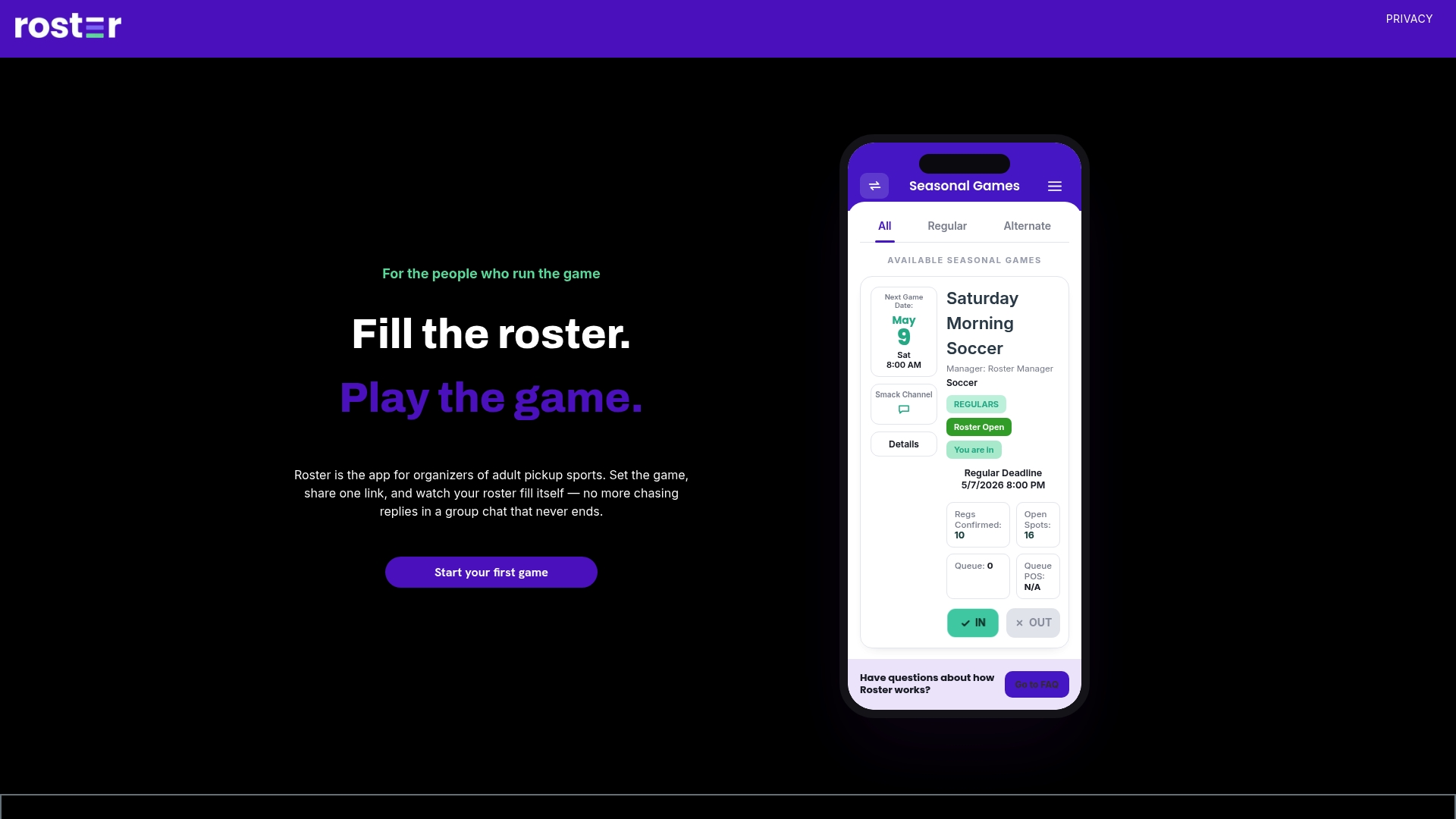
This is what Roster is built for. You set the game details and share one link. Players sign up there, open spots fill in real time and a waitlist covers dropouts, so the roster fills itself. You can manage regulars and alternates, schedule single games or whole seasons and keep a group chat in the app. If your group pays each other through Venmo, payment tracking sits alongside the roster too. Our guide to growing a pickup group with one link and friend invites shows how that single link becomes your recruiting tool, and the organizer checklist for promoting pickup games covers how to cut no-shows.
Turn players into regulars
Getting someone to try a game once is recruiting. Getting them to return is community building. Three habits matter most.
Hold a kickoff gathering
The USTA guide recommends a pre-season player party the week before the season begins, where players meet, teams are assigned or drafted. It also notes that after the first season many teams return as complete units, which makes the organizer's job much easier. You do not need a venue booking or a budget: a table at a nearby bar or a picnic blanket at the field is enough.

Give people a point person
People return to groups where someone knows their name. Name a friendly host, which may be you, who greets newcomers, explains how the game works and introduces them to a few regulars. When that role is clear, shy players feel seen rather than tolerated.
Use a season shape that rewards showing up
The USTA Southern section's community tennis playbook describes a four-week round-robin model in which players are placed in groups and each week play 24 games, eight with each person in their group. The point is that everyone plays with everyone, which maximizes social contact. You can borrow the idea in any sport: rotate teammates, run a mini-tournament at the end of a season or keep a light leaderboard for bragging rights.

If your group follows the pro game as well, a short pregame preview gives players something to talk about on the sideline. Fast pregame primers for soccer fans can start the conversation before a kickoff you are all watching later.
Measure whether the community is growing
You do not need analytics software to tell whether a community is healthy. You need four or five numbers, checked once a month. These are practical measures rather than industry benchmarks, so set your own baseline in the first month and compare against yourself.
| Measure | How to calculate it | What it tells you |
|---|---|---|
| Fill rate | Players who showed up divided by spots available | Whether your game size is right |
| Repeat rate | Players who came to two or more games this month divided by all players | Whether people are forming a habit |
| No-show rate | Signups who did not attend or cancel divided by signups | Whether your cancellation rules work |
| New faces | Players attending for the first time | Whether your invitations are reaching beyond your circle |
| Waitlist length | People waiting for a spot | Whether demand exceeds supply and you should add a game |
How to read them:
- High fill rate but low repeat rate means newcomers try it and leave. Look at the welcome, the skill match and the post-game social time.
- High repeat rate but no new faces means you have a closed clique. Ask regulars to invite one person each.
- A steady waitlist is the clearest signal to add a second game or a second night.
- Rising no-shows means your cancellation window or reminders need work.
When signups, spots and waitlists live in one place, most of these numbers can be read straight off the roster rather than reconstructed from old messages.
Our perspective
We built Roster because the people who start adult sports communities are usually the same people who get worn out by them. Somebody has to count the replies, find the sub, remind everyone and chase the last spot. That somebody is a volunteer with a day job.
Our view is that organizers should spend their time on the part that matters: the people and the game. Everything else should run itself. One link to share, a roster that fills spots as they open, a waitlist for dropouts and a place to talk that is not a 200-message thread.
The best community is the one that gets people off their screens and onto a field with each other. Software is only worth having if it gets out of the way and makes that happen more often.
Daniel
Put your first game on Roster
If you are ready to run your game, Roster gives you the tools to set it up in one place: scheduling for games and seasons, real-time signups for regulars and alternates, roster and waitlist tracking, group chat and Venmo payment tracking between players and the organizer. Share one link and let the roster fill.
Set up your game on Roster and take the group-chat counting off your plate.
FAQ
How many people do I need to start an adult sports community?
You need enough for one game to work, which depends on the sport. Start with the people you know and ask each to bring a friend. A reliable core that shows up beats a long list of maybes, and you can open the link wider once the first games run smoothly.
Where should an adult pickup game be held?
Any safe, easy-to-find space works. The MSYSA tutorial suggests a gym, parking lot, patch of grass, tennis court or local park. Check whether the location needs a permit or reservation, and put the exact meeting spot in your invitation.
How do I keep people from dropping out at the last minute?
Set a cancellation window, publish it with the game details and keep a waitlist so an empty spot is filled quickly. When replacement is automatic, a dropout costs the group less, and people feel less guilty about canceling early.
How do I welcome beginners without scaring off experienced players?
Describe the level of the game in plain terms in the invitation, and rotate teams so strengths are spread out. A friendly point person who greets newcomers and explains the format helps everyone relax, including players of different abilities.
Sources
- MSYSA Community Pick-Up Soccer Tutorial
- USTA Social Tennis League Startup
- Downers Grove Park District Adult League Captain's materials
- DC Fray Pickleball Rules
- Rutgers Intramural Sports Participant Handbook 2025-2026
- USTA Southern Community Tennis Playbook