

To increase pickup attendance, make the game easy to say yes to, make a commitment feel real, and make a dropout cost the group almost nothing. In practice that means one clear invite with every detail in it, one place to RSVP, a firm cutoff, a waitlist that fills open spots on its own, and a steady rhythm that gives people a habit. Everything below is built around those five moves.
This guide is for the person who runs the game: the one who books the field, counts heads, and sends the "are we still on?" text at 5 p.m. It covers adult pickup soccer, basketball, volleyball, flag football, and any other sport where the game lives or dies on headcount.
TL;DR
- Attendance is mostly a logistics problem. Players skip games when details are fuzzy, the RSVP is vague, or no one notices their absence.
- Put every decision-making detail in one invite: time, place, level, cap, parking, and cost.
- Use one RSVP link, a hard player cap, and a waitlist, so a dropout becomes a swap instead of a hole.
- Remind players twice, set a cancel-by time, and give regulars and alternates clear roles.
- Run the game on a predictable schedule so showing up becomes a habit.
Table of Contents
- Why pickup games lose players
- 1. Put every decision-making detail in the invite
- 2. Replace the group chat RSVP with one link
- 3. Set a player cap and a waitlist before you need them
- 4. Make a dropout easy, and early
- 5. Remind twice, and make the reminder useful
- 6. Use regulars and alternates on purpose
- 7. Screen signups when the game needs a certain level
- 8. Promote the game where your future players already are
- 9. Build a rhythm people can plan around
- What to do when someone cancels or doesn't show
- Where Roster fits
- Our perspective
- FAQ
- Sources
Why pickup games lose players
Most empty spots on a pickup roster are not about motivation. People want to play. They lose the thread.
A game gets announced in a group chat with forty other messages. Someone replies "maybe." Someone else says "I'll let you know." Two days later nobody is sure who is in, so the organizer starts chasing. Players who had a soft yes find a better offer, get tired, or simply forget, and because the commitment was never recorded anywhere, nobody feels they let anyone down.
That pattern points to the fix. You are not trying to guilt people into showing up. You are trying to remove the three things that cause absences:
- Friction before the game. Unclear time, location, or level means players hesitate.
- Vague commitment. "Maybe" is not an RSVP.
- No safety net. When a dropout leaves a hole, the whole game wobbles, so every absence feels expensive and awkward to announce.
The nine tactics below address each one.
1. Put every decision-making detail in the invite
A player says yes faster when they can picture the evening. Event organizers across many sports publish the same core details on a game page: the format, the start time, the venue name or address, the rules or level, venue access and parking, the player cap, and the price and how to pay. A tournament platform's event-page guidance lists these among the items to share so attendees can decide and plan.
For a weekly pickup game, the checklist looks like this:
- Sport and format: 7v7 soccer, 5-on-5 full court, 6s volleyball.
- Day, start time, and end time. Include when the field time ends so people can plan the night.
- Exact location, including which field, court, or door.
- Parking and access: where to park, whether the gate is locked, who has the key.
- Level: casual, intermediate, competitive. Mismatched skill is a quiet reason people stop coming.
- Player cap and what happens past it.
- Cost and how it is collected.
- What to bring: light and dark shirts, water, shin guards.
We break down the wording in our guide to game invite message elements that fill rosters. The short version: if someone has to message you to ask where to park, you have already lost some of them.
2. Replace the group chat RSVP with one link
Group chats are great for banter and bad for counting. A "thumbs up" is not a roster, and scrolling back through 80 messages to see who said yes is exactly the chore that burns organizers out.
Use a single link where every player takes one action and holds one status: in, out, or waitlisted. That gives you a single source of truth. Nobody has to ask "are we at ten yet?" because the answer is on one screen.
This is the core idea behind Roster: you set the game details once, share one link, and players sign up there. The app tracks who is on the roster, who is an alternate, and who is waiting. If you want a step-by-step process for the RSVP flow itself, our 6-step pickup game RSVP checklist walks through it.
3. Set a player cap and a waitlist before you need them
A cap sounds like it limits attendance. It does the opposite. When a game has ten spots and the spots are visibly filling, a yes feels like securing something, and a maybe feels like risking it.
Set the cap at the number that makes the game good, not the number you hope for. For a 5v5 game that is ten players. Then add a waitlist:
- Anyone past the cap joins the waitlist in order.
- When a rostered player drops, the next person on the list is offered the spot.
- The waitlist is also your forecast. A long one tells you it is time to add a second game or a second night.
Decide the waitlist rule early, ideally before the roster is full. Once you are scrambling, you will make inconsistent calls and people will notice.
4. Make a dropout easy, and early
This feels backwards, but the easiest way to cut last-minute no-shows is to make it simple to cancel in advance. If backing out requires a text to the organizer and an apology, many players avoid it and then quietly do not appear.
Give players a one-tap way to drop and a cutoff that you state in the invite, for example "drop by noon on game day and your spot goes to the waitlist." An early dropout is a gift: it gives the next player time to rearrange their evening. A 4 p.m. ghost gives nobody anything.
In racquet sports, organized programs already work this way. One tennis and pickleball center uses RSVP deadlines and calls registered players when a session is canceled for weather or has too few players, so people do not make a wasted trip. A casual game can borrow the idea: use the RSVP count to decide by a set time whether the game is on, and tell everyone once.

5. Remind twice, and make the reminder useful
One announcement is not enough, and ten reminders is too many. Two touchpoints cover most of the need:
- Two days out: a short confirmation prompt. "Game Thursday, 7 p.m. You're on the roster. Can't make it? Drop now so someone can take your spot."
- Game day: the practical details. Field number, weather call, who is bringing the ball, and a last chance to release a spot.
Each message should do a job. Reminders that only say "don't forget!" get muted. Reminders that include a decision (confirm or release) get answered.
Keep chatter out of the logistics thread. If your players love trash talk, let it live in the group chat, and keep game counts and changes in the place where the roster lives.
6. Use regulars and alternates on purpose
A roster full of equally committed people is rare. A better model is two tiers:
- Regulars: players who commit to the season. They get first claim on every game.
- Alternates: players who fill in when a regular cannot make it. They sign up game by game.
This structure raises attendance in two ways. Regulars know the game depends on them, so their commitment is clearer. And when one drops, a pool of willing alternates is already there, so the game stays whole without a frantic round of texts.
Roster is built around exactly this split. Regulars hold season spots, alternates take open spots game by game, and the app fills openings in real time and manages the waitlist for dropouts. If you are deciding how to run a soccer game specifically, five decisions to organize pickup soccer covers the setup, including how to avoid the early-morning RSVP scramble.
7. Screen signups when the game needs a certain level
Some games are open to anyone. Others need a bit of care: a competitive league night, a co-ed game with a balance target, or a game on a private field. Attendance suffers when the wrong mix shows up, because the good players stop coming.
If that is your game, approve signups manually, ask a short question at signup (experience, position, who referred you), and tell people up front that you review requests. Our 6 steps to vet pickup game signups shows how to do it without turning into a gatekeeper.
Only ask for what changes a decision. A long form is its own kind of friction.
8. Promote the game where your future players already are
Increasing attendance is also about widening the pool, so your regulars and alternates are drawn from more than your first ten friends. A few places that tend to work for local adult games:
- Your own contacts. Ask each regular to bring one person.
- Neighborhood and workplace groups, rec-center boards, and local running or social clubs.
- The field or court itself. A simple sign or QR code that opens the RSVP link turns passersby into alternates.
- Former players. People who drifted away often come back when asked directly with a specific date.
Whatever you post, link to the same RSVP page, so every new person lands on the same details. Our organizer checklist for promoting pickup games covers where to post and what to say.
9. Build a rhythm people can plan around
Habit is the strongest attendance tool there is. A game that happens every Tuesday at 7 p.m. at the same field becomes part of someone's week. A game that moves around and gets announced two days ahead competes with everything else in their life.
Here is how to build the rhythm:
- Pick a fixed slot and keep it for a full season, even when turnout dips once or twice.
- Schedule the whole season at once. Publish dates so people can block their calendars.
- Thank people. A short message after the game, naming who made it work, costs nothing and makes the next one more likely.
- Notice patterns. If the same player keeps dropping, move them to alternate without drama. If the same night keeps underperforming, test another one.
- Keep it social. Players come back for the people. A beer afterward or a shared photo does more for retention than any rule.
Over time, the game becomes a community rather than a list of names, and that is what keeps turnout high through the winter weeks and the busy ones.
What to do when someone cancels or doesn't show
Even a well-run game has a bad night. Have a plan so you are never improvising.
If someone cancels in advance: release the spot to the waitlist at once and thank them for the notice.
If someone cancels late: offer the spot to alternates first, since they have already said they are available at short notice. If you cannot fill it, decide ahead of time whether the game goes ahead short-handed, switches format (a 6v6 to a 5v5), or is called.

If someone no-shows: a private, friendly message beats a public callout: "Missed you tonight, everything okay? We're holding your spot for next week, but let us know if that changes." One miss is life. A pattern deserves a direct conversation and possibly a move to alternate status.
Write the rule into the invite so nobody feels singled out. For more on this, see how to reduce sports no-shows in pickup games.
Where Roster fits
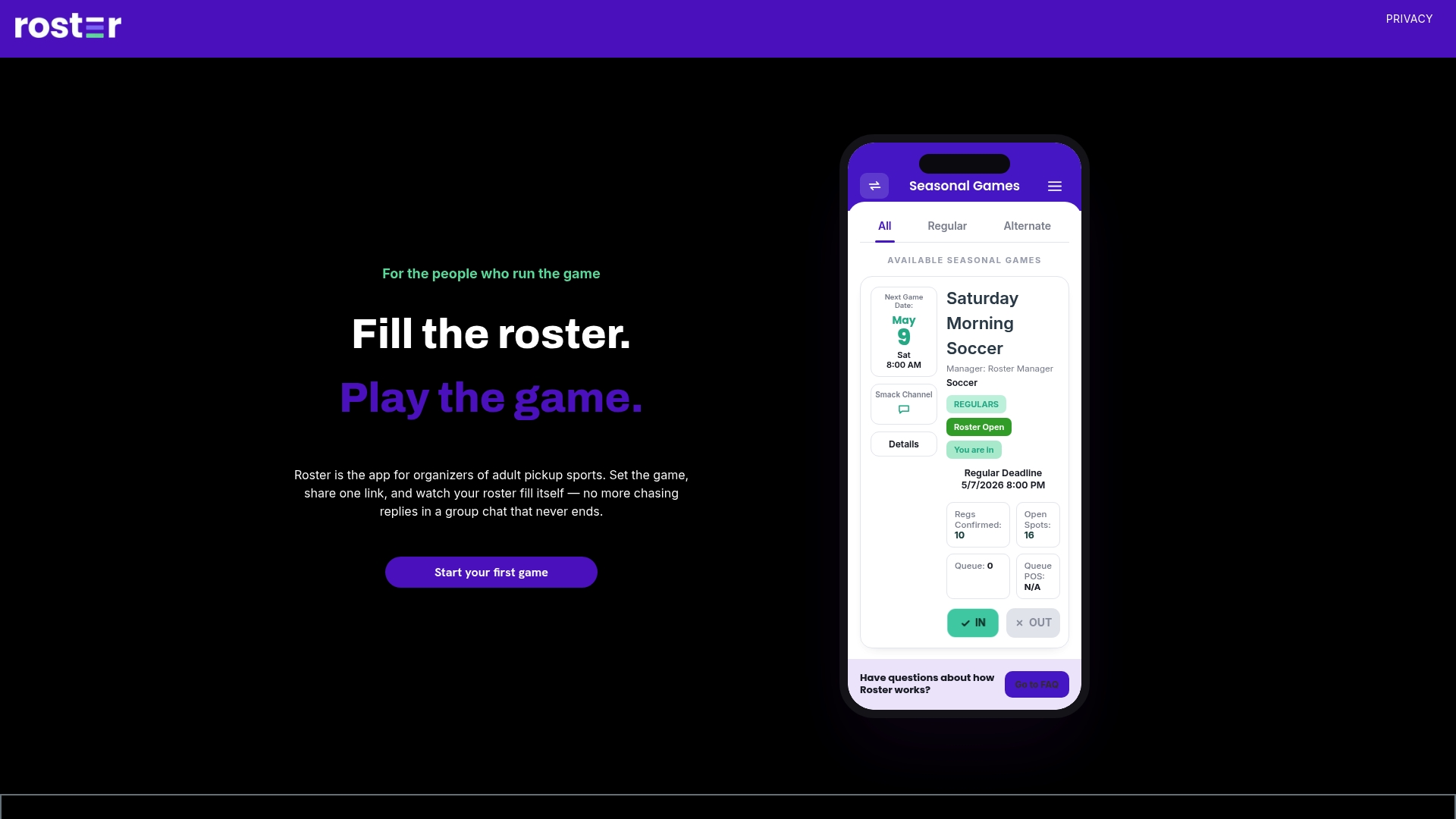
Roster is a mobile app for organizers of adult pickup sports. You set the game details, share one link, and players sign up there instead of in a thread of replies. The app manages regulars and alternates, tracks roster spots, fills open spots in real time, and creates a waitlist when someone drops. It also supports game and season scheduling, group chat, and Venmo payment tracking between players and managers.
If you are tired of counting thumbs-up emojis, you can set up your next game at Roster.
Our perspective
Most organizers think they have a motivation problem. We think they have a bookkeeping problem. People who say "maybe" in a group chat are not flaky by nature. They were never given a clear way to commit, and nobody was ever given an easy way to step out.
That is why we built Roster around one shared link and a roster that updates itself. When a spot opens, it gets offered to the waitlist. When regulars and alternates have different roles, everyone knows what is expected. The organizer stops being the group's secretary and gets to play.
The bigger goal is simple: fewer screens, more people on the field. If the logistics take care of themselves, the game gets what it needs, which is people standing in the same place at the same time.
Daniel
FAQ
How many players should I invite to a pickup game?
Invite enough to fill your cap and keep a short waitlist behind it. If a 5v5 game needs ten players, a waitlist of two to four people usually covers the dropouts without overbooking the court. Overbooking blindly can leave you with too many people on the day, so a waitlist that fills spots in order is cleaner.
What is the best time to send reminders?
Two reminders are enough for most games: one about two days before, asking players to confirm or release their spot, and one on game day with the final details. The early one matters most, because it gives the waitlist time to step in.
How do I handle a player who keeps flaking?
Talk to them privately first, assume there is a reason, and offer a lower-commitment role. Moving a regular to alternate keeps them in the community while protecting the roster for people who can commit to every game. State that rule in your invite so it feels like policy, not a punishment.
Should I charge players to improve attendance?
A small, clear cost can make a commitment feel real, as long as it is stated in the invite along with how to pay. Whatever you choose, keep the rules simple and consistent, and track payments in one place so you are not chasing people for money in a group chat.