
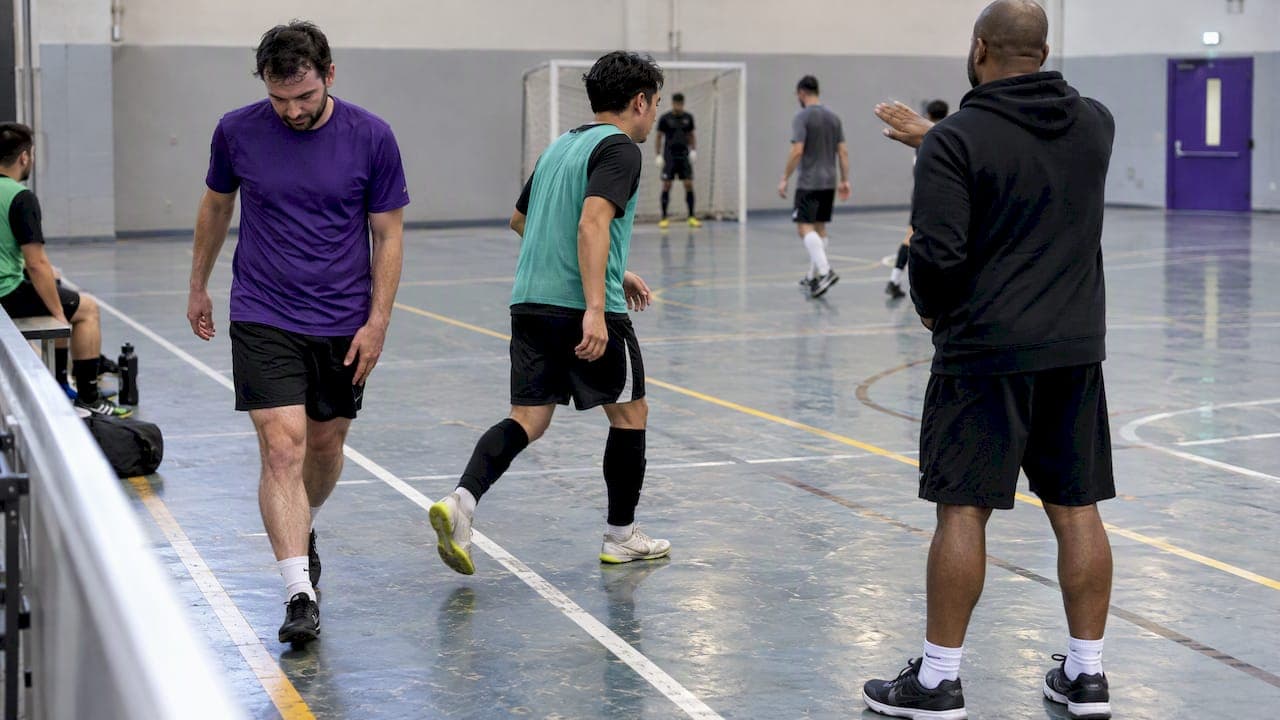
An injury substitution policy is a short, written rule that says what happens when a player gets hurt mid-game: who stops play, who can sub in, whether the hurt player can come back, and who decides. Official soccer already has answers for most of this. Your pickup game or rec league needs a plain-English version of them, because nobody at a Tuesday night game is carrying a rulebook.
Below, we walk through what the official rules say, where U.S. organizations differ, and how to turn it all into a policy you can paste into your game page.
TL;DR
- Referees stop play for serious injuries only. For minor ones, play continues until the ball is out, and an injured player generally leaves and waits one minute after the restart before returning.
- Suspected head injuries are the exception to "normal" sub limits: the player comes off, and does not return without clearance from a healthcare professional.
- Rules vary a lot by level (FIFA, MLS, youth, college, rec), so a pickup game should write its own policy rather than borrow one wholesale.
- A good policy names a decision-maker, says who replaces the injured player, and covers return to play, refusals and the opponent's sub.
- Pre-arranged alternates and a waitlist make injury subs painless, because a replacement is already lined up.
Table of Contents
- What official soccer says about injured players
- Can a substitute replace an injured player?
- Concussions are handled differently
- Writing your injury substitution policy
- How alternates and waitlists make injury subs easy
- Our perspective
- Put the policy where players will see it
- Other policies worth writing at the same time
- FAQ
- Sources
What official soccer says about injured players
Start with the source most other rules copy. Under IFAB's Laws of the Game, the referee stops play only for serious injuries and makes sure the player leaves the field for assessment or treatment. For a minor injury, play usually continues until the ball is out of play. Players generally cannot be treated on the field, with exceptions such as a goalkeeper or a collision between players of the same team.
The key return rule: an injured player who leaves for treatment may re-enter only with the referee's permission, and only after play has restarted and a minute has passed. IFAB's off-field treatment and assessment protocol explains the logic: medical staff get time for an initial assessment, then the player steps off and stays off until the one-minute mark. It also keeps the match from stalling for long stretches.
One more point matters for organizers. If a player refuses to leave after medical staff have been authorized to come on, the referee must caution them for unsporting behavior. That answers the common question of whether a player can refuse to be substituted. In a sanctioned match, not for long. In your pickup game, there is no referee to caution anyone, so your policy has to say who makes the call.
What this means at a pickup game
Most adult pickup games have no referee and no medical staff. That is not a reason to skip the structure. Borrow the three ideas that carry over cleanly:
- Serious injuries stop the game immediately. Minor ones wait for the ball to go out.
- An injured player leaves the field to be assessed rather than being treated in the middle of play.
- Someone with authority decides whether the player returns, and it is not the injured player alone.
For the first few minutes after a sprain, people also ask what to do next. A foot and ankle surgeon's overview of the 24 to 72 hour ice versus heat rule for a sprain is a reasonable next stop once the game is over and the player is off the field.
Can a substitute replace an injured player?
In most formats, yes, and that is the point of a policy. But how many subs a team has left depends on the competition.
The range is wide. In U.S. youth soccer, the 2025-2026 National Championships permit unlimited substitutions for 15U through 18/19U at set moments in the match plus halftime. A Texas club association's game-day procedures allow unlimited substitutions in its U11 to U18 Eastern Conference groups on a team's own throw-ins, goal kicks or kickoffs, while its U13-and-older Regional League allows seven per half. Those same procedures encourage common sense to keep stoppages short.
A recreational league in the Pacific Northwest, for example, writes the injury case directly into its playing rules: when a referee stops play so a coach can tend to a player, that team may substitute before play resumes, and the opponent may then make a matching one-for-one substitution. That one-for-one idea is worth copying. It keeps an injury from handing either side a numbers edge.
Quick comparison of how rules differ
| Level | How injury subs work | Source |
|---|---|---|
| IFAB Laws of the Game | Injured player leaves for treatment, may re-enter with referee permission after a minute of play | IFAB Law 5 |
| MLS | One permanent concussion substitution regardless of normal subs used; opponent gets an extra sub | MLS Competition Guidelines |
| US Youth Soccer National Championships | One extra sub per team if a player is permanently removed for a suspected concussion | 2025-2026 competition rules |
| NCAA soccer | Re-entry after bleeding or concussion signs only after medical clearance; general injury re-entry restricted by period | NCAA rule 5.6.7 summary |
| Adult pickup | Whatever you write down | Your policy |
The lesson: there is no single national standard to copy. Pick the pieces that fit a game with no referee and a roster that changes weekly.
Concussions are handled differently
When a head injury is possible, normal substitution logic stops applying. This is the one part of your policy where we would not improvise.
Under U.S. Soccer's approach as described in a US Club Soccer protocol overview, a player with a significant blow or concussion symptoms is removed right away, and cannot return until a healthcare professional clears them. In competitions without unlimited subs, a player suspected of a head injury may be substituted for evaluation without it counting against the limit, and may re-enter if evaluated and found not to have a concussion. The same document is clear that coaches and parents cannot overrule a qualified healthcare professional on return to play.

The professional level follows the same principle. MLS allows one permanent concussion substitution per match, whatever normal subs have been used, and gives the opponent an additional substitution too. IFAB's additional permanent concussion substitutions protocol lets competitions adopt a maximum of one such substitute per team per match, usable regardless of how many normal subs have been spent.
In youth soccer without referees, the burden shifts. In the youngest age groups, where there is no referee, responsibility for concussion removal protocols rests with coaches and parents. The same logic applies to adult pickup: with no official, the organizer's written rule is the safety net.
For your policy, that translates to a simple line: anyone who takes a hard hit to the head or shows symptoms comes off for the rest of the game and does not return until a doctor or other qualified healthcare professional says so. Not "I feel fine." Not "it was just a bump."
Writing your injury substitution policy
Here is a structure that works for adult pickup and rec games. Adjust the wording to match your game.
The elements to cover
- Who decides. Name one person per game: the organizer, a designated captain, or a certified referee if you hire one. A player cannot be the sole judge of their own injury.
- When play stops. Stop immediately for head, neck, back, or any injury where the player cannot get up. For anything else, finish the play and stop when the ball goes out.
- Where the player goes. Off the field, to the sideline, for assessment. This mirrors the IFAB approach of removing a player for evaluation instead of treating them in play.
- Who replaces them. The next confirmed alternate, then the waitlist. If neither exists, the game plays short or the opposing team gives back a player to even it.
- Return to play. Allowed after a short rest if it is a minor knock, with the decider's agreement. Not allowed after any sign of concussion or bleeding that cannot be controlled, without clearance.
- Refusals. If someone insists on playing against the decider's call, they sit out the rest of the session. Without a referee to caution them, the organizer has to be the one who says so.
- The other team. Match the substitution one for one so the injury does not tilt the score.
A copy-ready version
You can paste something like this into your game description and adapt it:
Injury policy. If a player is hurt, play stops for any head, neck, back or serious injury, and otherwise at the next out-of-bounds ball. The injured player leaves the field and is assessed by the game organizer. A player with a suspected head injury does not return that day and should see a healthcare professional before playing again. The next alternate on the list replaces the injured player. If the opposing team is short, they may bring on a replacement to even the numbers. A player who is asked to sit out must sit out.
This stays short on purpose. A policy that nobody reads is the same as having no policy.
Rules for small-sided games
Small-sided formats such as 5v5 or 7v7 change the math. A single missing player is a larger share of the team, so the pressure to "play through" is higher. Build in a rolling substitution rule for these games, where players can come off and on freely at any dead ball. That way a hurt player can sit out without the team collapsing, and the injury sub becomes ordinary rotation instead of a dispute.
How alternates and waitlists make injury subs easy
The hard part of an injury substitution is rarely the rule. It is finding someone to take the spot. If you run a game from a group chat, an injury at minute 15 means scrolling back through messages to find who said "maybe."
A lined-up pool solves that. Pickup games work best when the organizer has already decided who the regulars are, who the alternates are, and who is waiting. Our guide to a copy-ready alternate player policy covers how to set that pool up, and the five decisions for organizing pickup soccer shows where the injury rule fits among the others: roster size, signup cutoff, and what happens when someone drops.

The same thinking applies to the tone of the game. A clear written rule protects the organizer from the awkward argument about who sits. If tempers rise after a hard tackle, our piece on handling aggressive players with three scripts gives wording for those moments.
Our perspective
We built Roster for people who run adult pickup games, and the same problem comes up over and over: the policy lives in someone's head. The organizer knows the rule, the regulars half remember it, and the newcomer finds out when an argument starts.
Our view is that an injury policy is mostly a communication problem, not a rules problem. The official rules are good enough. Where games go wrong is that a replacement is not available, nobody knows who decides, or the hurt player feels pressure to keep going because the team is already short. Fix the roster side and most of the pressure disappears. If an alternate is confirmed and a waitlist is real, then asking a player to sit out costs the team very little.
We also think the organizer should be willing to be the unpopular one on head injuries. It is a short awkward moment against a long consequence. Write the rule once, send it with the game link, and let it do the work.
— Daniel
Put the policy where players will see it
A policy only works if players see it before game day. Put it in the game description, repeat it in the first message of the season, and pin it where the group will look. With Roster, you set the game details once and share a single link; players sign up there, open spots fill in real time, and dropouts feed a waitlist, so the replacement for an injured player is already in the pool. You can get the app and set up your game and add your injury policy to the details your players read when they sign up.
Other policies worth writing at the same time
Injury rules sit beside a handful of other short policies, and writing them together saves repeat arguments.
- Heat. Hot-weather games bring their own injury risk. Our look at WBGT-based requirements for a sports heat policy covers when to pause or cancel.
- Weather. A rain backup plan for adult pickup sports keeps a wet field from turning into a slip-and-fall.
- Spectators. Friends and family on the sideline can add noise during an injury. A pickup spectator policy sets expectations in advance.
- Money. If you split field costs, say whether an injured player who leaves early still pays their share. A look at what pickup soccer costs to run helps you set that fairly.
FAQ
Can a substituted player come back into the game after an injury?
It depends on the rules in use. Under IFAB's Laws of the Game, an injured player who leaves for treatment can re-enter with the referee's permission after play has restarted and a minute has passed. Some competitions, such as NCAA soccer, restrict re-entry after a general injury by period but allow it after medical clearance for bleeding or concussion signs. In your own game, write down the rule you want and apply it the same way every time.
Can a referee stop the game when a player is injured?
Yes, but only for serious injuries. For minor ones, the referee lets play continue until the ball is out of play. After a serious injury, the player leaves the field for assessment or treatment, with limited exceptions such as goalkeepers.
Can a player refuse to be substituted?
In an officiated match, a player who refuses to leave after medical staff are authorized to enter must be cautioned for unsporting behavior. In pickup soccer there is usually no referee, so your policy should name who makes the call. For a suspected head injury, nobody on the sideline should overrule a healthcare professional on return to play.
What should an injury substitution policy include?
At minimum: who decides, when play stops, where the injured player goes, who replaces them, when they may return, and what happens with a suspected concussion. Add a one-for-one substitution for the opposing team if you want to keep the sides even. Keep it short enough to read in under a minute.
Sources
- IFAB Law 5: The Referee
- IFAB off-field treatment and assessment protocol
- IFAB additional permanent concussion substitutions protocol
- MLS Competition Guidelines
- US Club Soccer head injury protocol overview
- US Youth Soccer 2025-2026 National Championships competition rules
- USCTX game day procedures
- NCAA soccer rule 5.6.7 injury and signs of concussion
- AYSO Region 183 player development and concussion protocols
- Recreational soccer playing rules
- 24 to 72 hour rule for ice vs heat after a sprain