
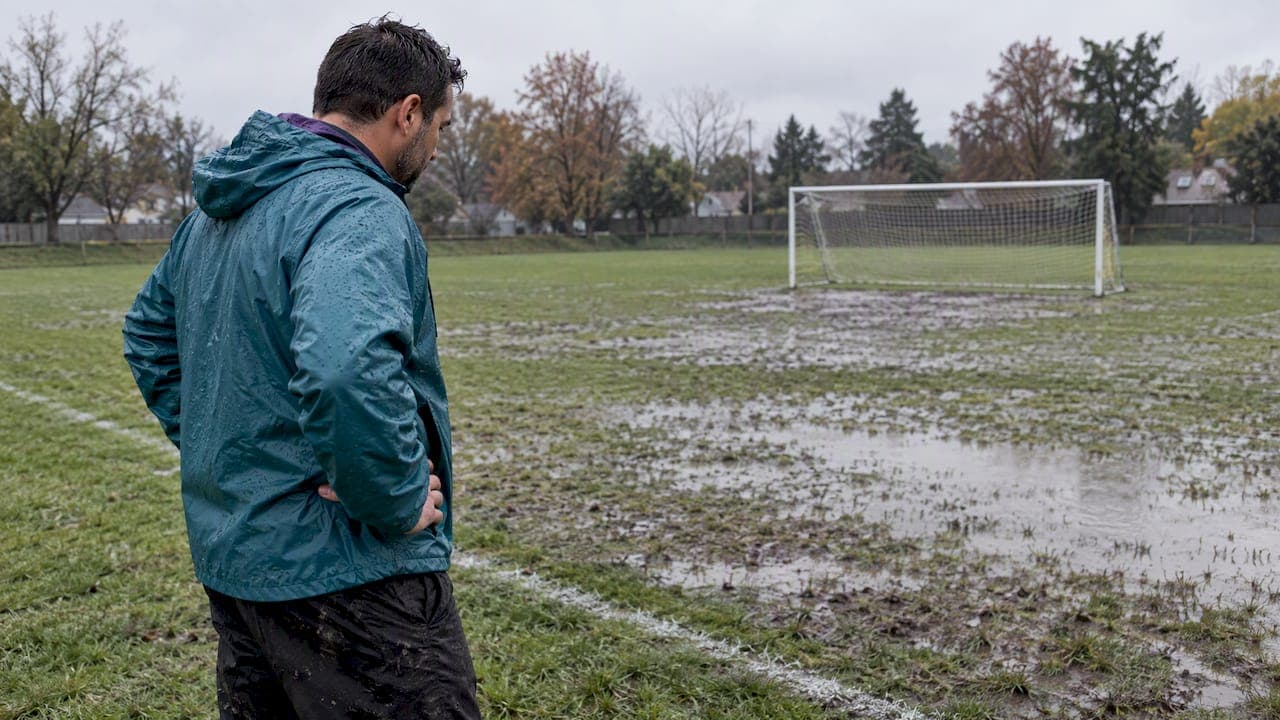
A good rain backup plan for pickup sports comes down to four decisions you make before the forecast turns: what weather cancels the game, who makes the call, where you can play instead, and how everyone finds out. Make those four choices once, write them down, and a gray Thursday stops being a 40-message group chat and becomes a 30-second announcement.
This guide is for the person who runs the weekly soccer, basketball, softball, flag football or ultimate game and ends up as the unpaid weather desk. It covers the difference between rain you play through and weather you leave, how to line up a fallback venue, what to do with your roster when a game moves, and how to keep players coming back after a rainout.
TL;DR
- Rain alone rarely cancels a game. Lightning does: stop play at the first thunder or flash and wait at least 30 minutes after the last one, per the National Weather Service.
- Write a short weather policy before the season. A published rule turns "the organizer ruined our night" into "the policy says so."
- Line up an indoor or alternate field in the preseason and get a direct contact at the venue. Last-minute searching rarely works.
- Pick one decision-maker and one announcement channel, and set a decision time (for example, two hours before kickoff).
- Keep your roster and waitlist in one place so a moved or canceled game does not cost you half your players.
Table of Contents
- Rain versus dangerous weather: what actually cancels a game
- The lightning rule you should know cold
- Write the policy once: a template you can paste
- Choose the person and the time of the call
- Build the fallback: where to play when the field is out
- Tell people fast, and tell them once
- Protect your roster when the game moves or cancels
- A worked example: Thursday soccer, storms in the forecast
- Our perspective: the weather decision is a roster problem
- Make rain planning easier with Roster
- Pre-season rain checklist
- FAQ
- Sources
Rain versus dangerous weather: what actually cancels a game
Start by separating two things that get lumped together. Rain is a comfort and field-condition problem. Lightning is a safety problem. Your plan treats them differently.
Many rec leagues spell this out. One New York recreational soccer league's rain policy says plainly that soccer is played in the rain and that rain by itself does not mean games are canceled. That is a sensible default for adult pickup too: players who show up for a pickup game generally know it might be wet.
So your cancellation triggers usually fall into three buckets:
- Lightning or thunder. Non-negotiable. More below.
- Field condition. Standing water, torn-up turf, or a field a parks department has closed. Some complexes sit in flood plains and stay closed after a storm even when the sun is out the next day, as one North Carolina soccer complex notes in its inclement weather policy.
- Other hazards. Heavy wind, flash flood warnings, or heat that follows the storm. For the heat side, see our guide to WBGT-based requirements in a sports heat policy.
Everything else, from drizzle to a steady shower on a sound field, is a "play on" call that you can leave to the group.
The lightning rule you should know cold
The National Weather Service's guidance for organized outdoor activities is simple to remember: when you see lightning or hear thunder, suspend play, and do not resume until at least 30 minutes have passed since the last thunder or lightning. That is the 30/30 approach, and the clock resets with every new flash or rumble.
Three details trip up organizers:
- Blue sky is not an all-clear. Lightning can strike miles from the storm. The NWS notes that it often strikes more than three miles from the center of the thunderstorm, well outside the rain, so a dry field with a dark cloud on the horizon is still a risk.
- Dugouts and shelters do not count. Small structures such as dugouts, sheds and picnic shelters are not safe places during lightning. The only completely safe options are a substantial enclosed building or a hard-topped metal vehicle with the windows up.
- You need to know where to go before you need it. Identify the nearest real building and the parking lot your players will use, and tell them in your game description.
The NWS also recommends that organizers designate a weather monitor, and that this person not be the coach or referee, because someone busy running the game is poorly placed to watch the sky. In a pickup game, that can be one regular who checks radar before kickoff and keeps an eye out during play. For a full checklist, we put one together in our lightning policy for sports organizers.
Write the policy once: a template you can paste

A written policy is the cheapest rain insurance there is. U.S. Soccer's medical team publishes extreme weather resources for soccer organizations, and the idea carries over to any sport: clear criteria planned in advance protect organizers from pressure in the moment. Tournament guidance makes the same point, recommending that you define specific conditions that trigger delays or cancellations rather than deciding case by case.
Here is a version sized for an adult pickup group. Adjust the numbers to your sport and venue.
Weather policy
- We play in light to moderate rain if the field is safe.
- Any thunder or lightning stops play. We wait 30 minutes after the last thunder or flash before restarting, and the clock resets with each new one.
- [Name] makes the call by [time], two hours before kickoff, and posts it in [channel].
- If the field is closed, flooded or unplayable, the game moves to [backup venue] when it is available, or it is canceled.
- During a storm, everyone goes to [building] or a car, not the sideline shelter.
- Canceled games are rescheduled on [day] when possible.
Post it in the game description, pin it in the chat, and mention it once at the start of each season. The point is not legal cover. It is that when you cancel, nobody can say you made it up.
Choose the person and the time of the call
The most common rain failure in pickup sports is not a bad decision. It is a late one, or three people announcing three different decisions.
Set these in your policy:
- One decision-maker. Usually you. Name a backup in case you are traveling or stuck at work.
- One decision time. Two hours before the game works for many groups, because it is early enough for people to change plans and late enough for the forecast to firm up. If a storm cell is clearly arriving mid-game, you can make an earlier or second call.
- One channel for the final word. Whatever else people discuss, the announcement lives in one place, so nobody has to scroll to find it.
For wording, our one-page communication checklist with copy-ready templates saves you from composing messages at the last minute.
Build the fallback: where to play when the field is out
A backup plan with no backup location is just a cancellation plan. If you want to keep the game, you need somewhere to go, and you need it lined up before the season.
Team Game Finder's scheduling guide makes a blunt point: finding a last-minute alternative on a rainy day is close to impossible because demand spikes, and a direct line to a venue manager is often what separates a moved game from a canceled one. Good fallback options include:
| Option | Best for | What to confirm in advance |
|---|---|---|
| Indoor turf facility | Soccer, flag football, ultimate, softball drills | Hourly rental rates, minimum booking, how late they accept same-day requests |
| School or community gym | Basketball, volleyball, small-sided soccer | Who holds the keys, insurance requirements, shoe rules |
| Covered or lighted alternate field | Light rain, wet-grass days | Drainage, whether the parks department closes it too |
| Second outdoor site on different ground | Fields that flood | Whether it is a different surface type that drains faster |
A few practical habits help:
- Call in the offseason. Ask the facility manager about same-day policies and whether they keep a standby list for weather-driven bookings.
- Get a number that gets answered. A front-desk email is slower than a manager's cell.
- Know your headcount. Indoor space is often priced by the hour for the whole field, so a smaller group may need a smaller game format.
- Plan the format change. Five-a-side on turf plays differently from 11-a-side on grass. Decide in advance which version you will run.
Indoor operators pitch exactly this problem. Facilities describe year-round indoor play as the answer to weather-driven turnover for weekly leagues, as in this profile of an indoor sports complex. If your group plays all winter, an indoor standing booking may be worth more than a rainy-day fix.
Tell people fast, and tell them once
Most organizers dread the group chat on a rainy afternoon: "Is it still on?" "Anyone checked the radar?" "Are we playing?" Each question invites ten replies, and the real update gets buried.
Two rules keep it clean:
- Announce before you are asked. If the forecast looks marginal, post a heads-up: "Watching the radar, decision at 4 p.m." That answers the question before it starts.
- Use plain, repeatable wording. "Game is ON at the usual field." "Game is MOVED to [venue], same time." "Game is CANCELED, we'll reschedule for [day]." Three phrases, no debate.
Consistency matters more than cleverness. Even in golf, where tee times are tightly controlled, one booking platform's guide to fair cancellation policy rules stresses that the rules and timing should be clear to everyone up front. The same logic applies to your pickup game: decide the cutoff, publish it, apply it every time.
Protect your roster when the game moves or cancels
Rain does more damage to your roster than to your field. A moved game means a new time, a new location and a new round of "can you still make it?" People who said yes for 7 p.m. at the park may not make a 9 p.m. slot at an indoor facility. A canceled game followed by a vague "we'll figure it out" loses people for the rest of the season.
To keep a roster intact:
- Re-confirm, do not assume. When a game moves, treat it as a new signup. Ask who is in at the new time and place.
- Use your alternates. If three regulars drop because of the new time, open those spots to alternates right away rather than playing short.
- Keep a waitlist. A rainout often leaves a rescheduled game with fewer commitments than you need. A waitlist lets late-confirming players fill gaps without you chasing them.
- Reschedule fast. Announce the makeup date in the same message as the cancellation if you can. We go deeper in our guide on how to cancel a pickup game without losing half your roster.
If your group has a no-show problem on good-weather nights, rain makes it worse. Our posts on reducing sports no-shows and a no-show fee policy cover how to set expectations before the first drizzle.
A worked example: Thursday soccer, storms in the forecast
Say you run an 8 p.m. Thursday soccer game with 14 signed up and 3 alternates, at a park with a field that drains badly.
- Monday: Forecast shows a 60 percent chance of thunderstorms Thursday evening. You post a heads-up: decision Thursday at 6 p.m., and the backup is a turf facility booked on standby.
- Thursday, 5:30 p.m.: You check radar. A line of storms is due at 8:15 p.m. Lightning means you would likely lose the game partway through.
- Thursday, 6:00 p.m.: You call it. The game moves to the indoor facility at 9 p.m., five-a-side rotation instead of seven-a-side.
- 6:05 p.m.: You announce the move once. Four regulars cannot make 9 p.m. Their spots go to alternates from your list.
- Result: A full game, a venue that was already lined up, and no one debating the call because it follows the policy.
None of this required heroics. It required that you decided in August.
Our perspective: the weather decision is a roster problem
We build Roster for people who organize adult pickup games, and what we hear from them is that bad weather is rarely the thing that wears them out. The messages around it do. One storm creates a dozen questions, each answered in a different place, and by the end the organizer is both forecaster and referee of a conversation.
Our view is that the weather call should be boring. Write the policy, name the person, pick the backup venue, and treat a rainout as one more change to the roster rather than an emergency. What organizers lose in a rainout is usually not the game, it is the people: someone who was confirmed, then confused, then quietly stopped showing up.
That is why we think a game should live behind a single link, with regulars, alternates and the waitlist visible in one place. When the time changes, you update one thing, and open spots can fill from the list instead of from your phone's contact list. Players should spend less time on their screens arguing about the radar and more time on a field with other people, which is the reason most of us organize in the first place.
— Daniel
Make rain planning easier with Roster
If you manage a weekly game, Roster gives you one shared link where you set the game details and players sign up. It tracks roster spots in real time, fills open spots as people drop, keeps a waitlist, and lets you manage regulars and alternates, plus a group chat for game communication. When rain moves the game, you are working from a clear list, not scrolling back through a thread. You can start with your next game at rostersports.com.
Pre-season rain checklist
Print this, or paste it into your notes.
- Weather policy written and shared with the group
- Weather monitor named for each game (not the person running play)
- Nearest safe building identified and written in the game details
- Decision-maker and backup named
- Decision time set (for example, two hours before kickoff)
- Backup venue contacted, with a direct number saved
- Alternate game format chosen for indoor or smaller space
- Makeup date or day-of-week rule agreed
- Alternates and waitlist ready to fill dropped spots
FAQ
Should we play pickup in the rain?
If there is no thunder or lightning and the field is safe, light to moderate rain is a judgment call that most groups can leave to the players. Check the surface, since slick or flooded ground raises the injury risk. Put "we play in rain, not in lightning" in your policy so no one is surprised.
How long do we wait after thunder before starting again?
The National Weather Service recommends waiting at least 30 minutes after the last thunder or lightning before resuming, and restarting the clock if either happens again. Seeing blue sky does not shorten that wait.
Who should decide whether the game is canceled?
One named person, with a named backup, using criteria written in advance. Where possible, a separate person should watch the weather during play so the organizer is not trying to run the game and monitor the sky at the same time.
What if we cannot find an indoor backup?
Build a rule for it: the game is canceled by a set time and rescheduled on a set day. Then start looking in the offseason for next time, because same-day space is hard to find. A school gym, community center or second field with better drainage can fill the gap.
Sources
- Lightning Safety and Outdoor Sports Activities, National Weather Service
- When a Safe Building or Vehicle is Nearby, National Weather Service
- Lightning Myths, National Weather Service
- Managing Extreme Weather Conditions, U.S. Soccer
- Tournament Weather Delays Guide, Brakto
- How to Handle Last-Minute Schedule Changes, Team Game Finder
- Hit the Field - Again, Punch Magazine
- Rain Policy, Wallkill Valley Recreation Soccer
- Inclement Weather Policy, Rainbow Soccer
- Tee Time Cancellation Policy, BallChute