
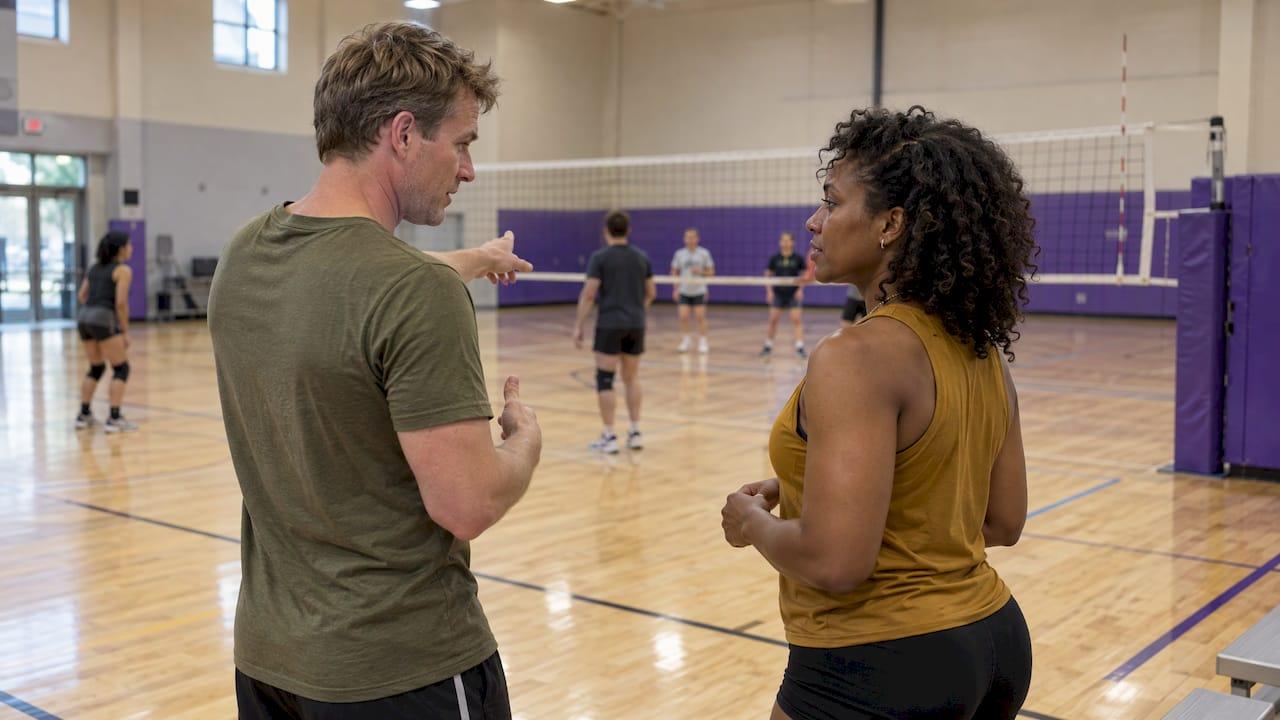
A co-organizer is the person who owns a defined slice of running a game, so the lead organizer stops being the only one who answers every text. The roles that work are narrow and named: one person owns signups and the roster, one owns game-day logistics, one owns money and communication. Each has a task, a deadline and the authority to decide. We built Roster so the signup and roster slice runs on one shared link instead of by hand, which leaves co-organizers free to do the parts only people can do.
TL;DR
- The lead organizer owns the final call and is the point of contact. Co-organizers own specific jobs, not "helping out."
- The jobs that split cleanly are signups and roster, game-day logistics, money, and communication.
- Every role needs a task, a deadline, a named person and decision-making authority, or the lead ends up doing it all.
- Pick one official place for schedules and roster status. If it is not there, it is not official.
- Agree in advance how cancellations, no-shows and disputes get handled, so no one improvises at 5:45 p.m.
Table of Contents
- What a lead organizer does versus a co-organizer
- The five jobs worth handing off
- Give every role four things
- One official place for roster and updates
- Handling cancellations, last-minute changes and disagreements
- A sample split for a 12-player weekly game
- Where Roster fits
- Our view on sharing the work
- FAQ
- Sources
What a lead organizer does versus a co-organizer
Start with the lead, because the co-organizer role is defined by what the lead hands off.
League handbooks show the full list of duties that someone has to carry. The COPA Soccer Training Center 2024 adult league handbook requires each team to have a team manager. That person schedules games, confirms scores, keeps the roster accurate, handles all team communication as the point of contact, and checks the team in with the referee. USTA Florida's captain resources add lineup exchanges, score reporting and registration checks for adult tennis, and make the captain the accountable single point of contact, responsible for contacting the league coordinator about any scheduling doubt instead of waiting to be called.
That is a lot for one person. In a pickup game the same duties exist, just with less paperwork: someone has to get ten or twelve people to show up, keep the numbers right, and sort out the field, the balls, the pinnies and the money.
A practical way to describe the split:
| Lead organizer | Co-organizer | |
|---|---|---|
| Scope | The whole game or season | One named area |
| Decisions | Final call on rules, format, disputes | Day-to-day calls inside their area |
| Contact | Main point of contact for players and the venue | Backup contact for their area |
| Accountability | Everything that is not assigned | Only what was assigned, but fully |
The last row is the one that matters. A co-organizer without a defined area is just a friend who is sometimes helpful.
The five jobs worth handing off
You do not need five co-organizers. One person can hold two jobs. But these are the seams where the work divides naturally.
1. Signups and roster
This person invites players, tracks who is in, keeps the list of regulars and alternates, and fills open spots when someone drops. It is the most repetitive job and the one that eats the most evenings, which is why it is the best candidate for automation. A college intramural participation manual from St. Olaf puts monitoring the roster and player eligibility on the captain, and notes that teams with alert, organized, efficient captains most often make the playoffs. Organization pays off in the standings, not just in sanity.
The Brodie League enrollment policy goes further: captains confirm each player is properly enrolled, and every addition or substitution goes through the official registration system, with the league able to ask for roster verification at any time. The principle carries over to a casual game. One list, one owner, and changes go through the list, not through a side text.
2. Game-day logistics
This person confirms the field or court, brings the ball, pinnies or goals, unlocks the gate, and checks that the teams are balanced before kickoff. USTA Florida's captain guide splits it into a day-before checklist (verify the lineup, arrange alternates, plan carpools) and a before-match checklist (collect money and pay court fees, bring balls, meet the other captain to set ground rules). Borrow that shape: a short list the night before and a short list at the venue.
3. Money
Someone collects field fees and tracks who has paid. The USTA Midwest adult social league guidelines have the organizer set a per-player price that covers expenses. Pick one person to own that number and the collection, and keep it separate from the person who decides who plays. Mixing the two is how awkward conversations start.
4. Communication
This person posts schedule changes, weather calls and reminders. They do not have to answer every question, only make sure the official message goes out once, in the right place. More on that below.
5. Recruiting and culture
Social leagues live or die on whether new people keep arriving and feel welcome. The USTA Midwest guidelines have the organizer recruiting through social media and handling updates, and suggest different platforms for different age groups. In a pickup group, this co-organizer greets newcomers, introduces them to the regulars and notices when someone has gone quiet. It is the job nobody lists and everyone misses when it is gone.

Give every role four things
Vague help produces vague results. An event manual from the Tartu youth work center in Estonia states the problem well: if everyone does everything, in the end no one really does anything. It recommends each role include a clear, measurable task, a deadline, a responsible person and decision-making authority. Without those, it warns, the project lead ends up doing most of the work and decisions come late.
Applied to a weekly game, that looks like this:
- Task: "Keep the roster at 12 confirmed players."
- Deadline: "Final headcount by 6 p.m. the day before."
- Person: One name, not "the guys."
- Authority: "You can promote someone off the waitlist or cancel if we are under 8, without asking me."
The authority line is the one organizers skip. If your co-organizer has to ask you before every decision, you have added a step, not removed one.
SignUpGenius's youth-sports coordinator checklist makes a related point: name your key helpers early and assign game-day roles before the season starts, so the load is spread and everyone can see who owns what. That advice is written for youth teams, but it holds for adults, who are even less likely to volunteer when asked in the middle of a game.
One official place for roster and updates
The quickest way to make co-organizing fail is to have the work split across five chats. A club-management blog from Playbook Sports argues that the top cause of team confusion is too many places that feel official. Its fix: declare one platform as the single source of truth, say at the start of the season that if it is not there, it is not official, and keep one-way announcements separate from two-way chat so important alerts do not get buried.
We agree with the principle and have written about it for pickup organizers in our guides on announcement-only team chat and a one-page communication checklist with copy-ready templates. The short version for co-organizers:
- The roster and the schedule live in one place. Everyone, including every co-organizer, edits it there and nowhere else.
- Official announcements (a cancellation, a field change) go out once, from the communication owner.
- Banter, rides and "who has a spare ball" stay in the group chat.
- When a player asks a co-organizer something in a private text, the answer is "it's on the game page," followed by the link.
That last habit does more than any tool. It teaches players where to look.
Handling cancellations, last-minute changes and disagreements
This is where co-organizers earn their keep, and where an agreement made in advance saves the most pain. There is no rulebook for pickup games, so write your own and share it. A few that work in practice:
Set a cancellation threshold. Decide the minimum number of players needed to play, and the time by which you check. "If we are below 8 confirmed at 4 p.m., we call it." Then it is not a judgment call and nobody is blamed. Our guide on canceling a pickup game without losing half your roster walks through how to word the message so people come back next week.
Decide who calls it. Name one person with authority to cancel for weather or low numbers, and one backup. If the lead is on a flight, the backup does not need to wait.
Use a waitlist, not a scramble. When someone drops out, the next person in line is offered the spot in order. Taking spots in order removes the "why did he get in and I didn't" argument before it starts.
Settle disputes in the open, briefly. For a heated call or a rule disagreement, USTA Florida's captain guidance puts rule interpretation on the captain in un-officiated matches. In a casual game, that means the lead organizer or whichever co-organizer is on site makes the call, and the group moves on. Afterward, if the same issue keeps coming back, add it to the written ground rules.
Keep the tone welcoming. Say "we have a full roster this week, you're first on the waitlist" and not "you didn't sign up in time." Same fact, different feeling, and the newcomer comes back.
If you want a fuller picture of building a structure around all of this, our walk-through on starting an adult rec league in one season covers the season-level setup.

A sample split for a 12-player weekly game
Here is a concrete arrangement for a group with a lead and two co-organizers. Adapt the names and numbers.
| Role | Owner | Task | Deadline | Authority |
|---|---|---|---|---|
| Lead organizer | You | Rules, format, disputes, venue booking | Season start | Final call |
| Roster co-organizer | Co-organizer A | Keep 12 confirmed, manage waitlist | 6 p.m. day before | Can promote from waitlist, can cancel under 8 |
| Game-day co-organizer | Co-organizer B | Gear, field access, team balance | 30 min before kickoff | Can adjust teams |
| Money | Co-organizer B or lead | Collect field fees, track who has paid | Within 48 hours of game | Can follow up with late payers |
| Communication | Roster co-organizer | Post schedule changes and reminders | Same day each week | Can send official announcements |
SignUpGenius's checklist recommends a short weekly update on the same day each week, and that cadence works for adults too. A Thursday-night "game is on, 11 of 12 confirmed" message sets the rhythm and trains people to respond.
Where Roster fits
The roster and signup job is the one that most often swallows the lead organizer, and it is the one we built Roster to take over. You set the game details and share a single link. Players sign up through the link, so you are not tracking RSVPs across group chats. Roster fills open spots in real time, and when someone drops out it creates a waitlist so the next player can step in. The app handles regulars and alternates, schedules games and seasons, includes group chat, and tracks peer-to-peer Venmo payments between players and the manager.
In terms of the roles above, that covers most of the signup and roster job and a good part of the money and communication jobs. Your co-organizers can then spend their time on what only people can do: greeting the new player, fixing the field issue, making the call when the weather turns.
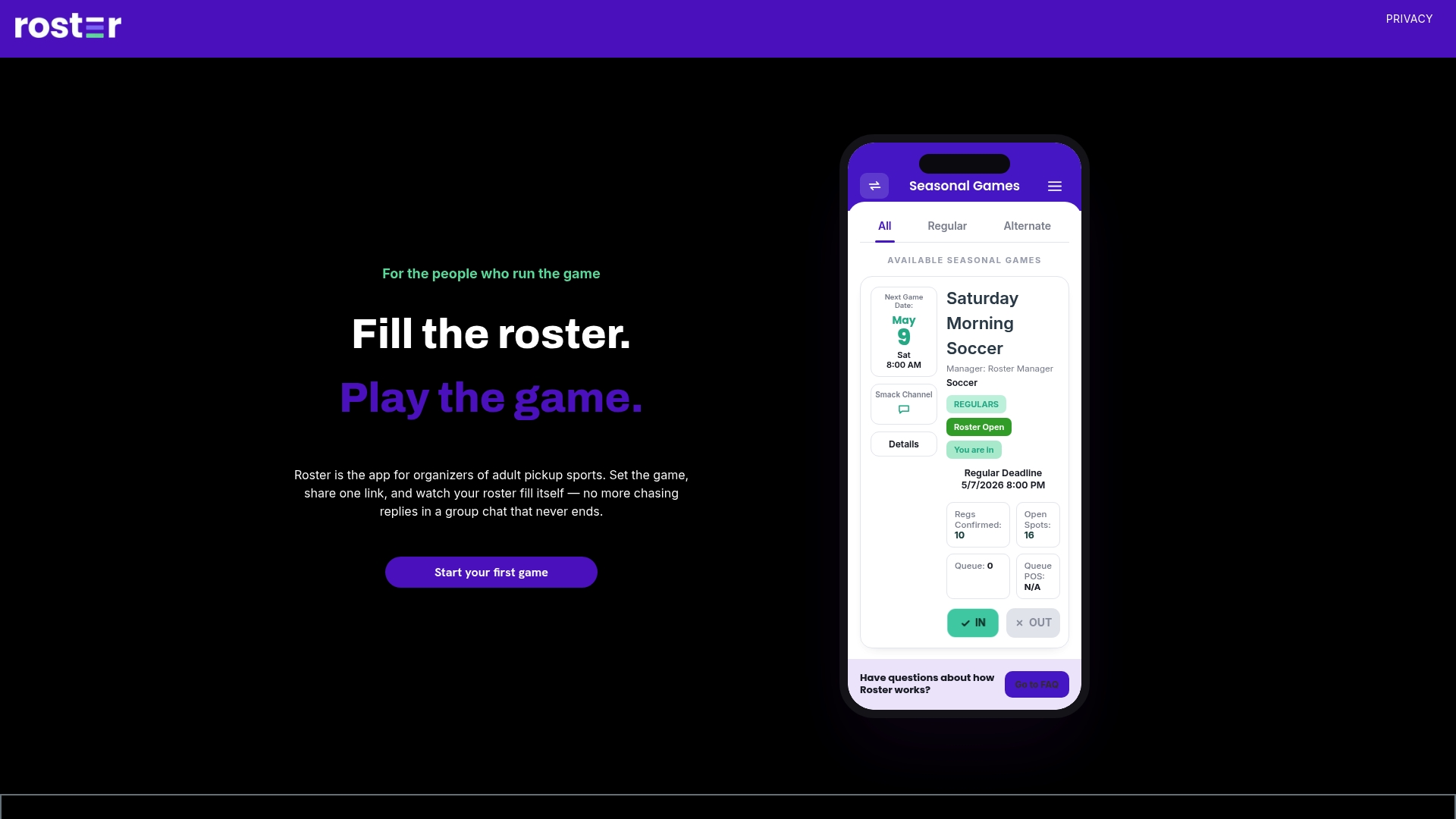
If you run pickup soccer, basketball or hockey, you can see how organizers set up a game around one link in our guides to organizing pickup basketball and organizing pickup hockey. To set up your own game, start at Roster.
Our view on sharing the work
Most organizers we talk to describe the same arc. You start a game because you love playing. A year later you are the person who spends Tuesday night counting yes, maybe and thumbs-up emojis, and you are no longer sure you enjoy the game.
We think the fix has two halves. The first is people: give your co-organizers real jobs with real authority, so you are not the bottleneck. The second is the system: if the roster lives in a thread, every co-organizer has to read the whole thread to know what is going on. If it lives in one shared list that updates itself as people sign up and drop out, anyone can look and know.
That is why Roster is built around one link, an automatic waitlist and a roster everyone can see. We want the work of organizing to be small enough to share, and small enough that sharing it feels easy. The goal is more time on the field, and less time on the phone.
Daniel
FAQ
What is the difference between a co-organizer and an assistant?
A co-organizer owns a defined area, such as the roster or game-day setup, and can make decisions inside it. An assistant does tasks you hand over one at a time. If you find yourself approving every move, you have an assistant, and giving the role a deadline and authority turns it into a co-organizer role.
How many co-organizers does a pickup game need?
Most weekly games run well with a lead and one or two co-organizers. Add more only when a job, such as recruiting or money, is clearly too big for the existing people. A larger league may reasonably split by division or day, with one person per slot.
Who should handle money in a pickup group?
Pick one person, ideally someone other than whoever decides who plays, and give them a clear per-player amount and a deadline. Keeping roster decisions and money separate heads off arguments. Roster tracks peer-to-peer Venmo payments between players and the manager, so the collection job has a clear record.
How do I stop players texting every co-organizer separately?
Declare one official place for the schedule and roster, and answer private questions with a link to it every time. Playbook's guidance is that if something is not on the official platform, it is not official. After a few weeks players check there first.
What should co-organizers agree on before the season starts?
Agree on the minimum number of players, who can cancel and by what time, how waitlist spots are offered, how fees are collected, and who makes the call in a dispute. Write it down in a short message and pin it where everyone can see it.
Sources
- COPA Soccer Training Center 2024 Adult Leagues Handbook
- St. Olaf College Recreation Participation Manual
- USTA Florida Captain Resources
- USTA Midwest Adult Social League Guidelines
- Brodie League team enrollment policy
- Game in Tartu manual, Tartu Youth Work Center
- The Youth Sports Team Coordinator Checklist
- Running a Club? How to Keep Everyone on the Same Page