

To limit players by position in a pickup game, set the total roster first, then cap only the positions that can break the game: goalkeeper, a fixed forward or back line, or a required mix such as coed minimums. For most casual games, a total cap plus one or two position rules is enough. Everything else can stay loose.
This guide shows how real adult leagues write these rules, how to size your own, and what to do when five people all want to play striker.
TL;DR
- Cap the total number of players first. Position limits sit on top of that number and never replace it.
- Limit only positions that decide whether the game works: goalie, a fixed line, or a gender-mix requirement.
- With 3 to 4 players a side you do not need positions at all. Structure starts to matter above 5 a side.
- Many leagues set the roster cap at about twice the on-field number, which leaves room for no-shows without crowding the bench.
- Post the rules in the game details before anyone signs up, so nobody argues about them on the field.
Table of Contents
- What "limit by position" means in a pickup game
- How real adult leagues write position rules
- How to size the roster before you cap positions
- Which positions actually need a limit
- A simple way to write the rule
- Handling the messy moments
- Perspective: why we cap the total and keep positions light
- Put your limits to work with Roster
- FAQ
- Sources
What "limit by position" means in a pickup game
In trading, a position limit is a ceiling on how much exposure one party can hold. In pickup sports the idea is simpler: a ceiling on how many players can fill one role at the same time. Examples are one goalkeeper per side, two forwards in a seven-a-side layout, or no more than six men on the field in a coed game.
There are two separate limits, and organizers often mix them up:
- On-field limits. How many players can play a role during the game.
- Roster limits. How many people can hold a spot in the game at all, including substitutes.
You need both. A roster limit keeps the game from turning into a crowd. An on-field limit keeps the play balanced and safe.
How real adult leagues write position rules
The leagues below are not pickup games, but they have already solved the wording problems you will face. Borrow what fits.
A fixed layout: Footy 7s
The Footy 7s rules define the layout as 2 forwards, 3 midfielders and 2 backs, with a maximum of 7 players on the field at once. One of the midfielders can be nominated as the Scoring Forward. The same rules require a minimum of 4 players to start and allow an unlimited interchange bench, with substitutions at any time.
The takeaway: a strict layout only works when substitution is easy. If anyone can rotate in at any moment, a hard position cap does not cost anyone playing time.
A gender-mix cap: Soccer for Adults
The Soccer for Adults rules specify teams of eleven, with a minimum of seven players to start. They also require at least three female players on the field, not counting the goalkeeper. A team that cannot field three women cannot play more than six men at any time, meaning six male field players and one male goalkeeper.
This is a position-style limit written as a ceiling on one group. It shows the best way to phrase these rules: state the minimum, then state what happens when the minimum is not met.

A lineup cap: coed kickball
PlayMore's 2025 kickball rulebook plays 9 on 9 and requires at least 1 man and 1 woman in the lineup and in the field for an official game. It limits teams to 6 men on the field and in the top 9 of the lineup. It also lets late arrivals join at the end of the lineup, as long as the team has not batted through its order once.
The late-arrival rule is worth copying. It answers "what if someone shows up after we start?" before anyone asks.
A fixed total, flexible positions: basketball
Salt Lake County's adult basketball guidebook lets a team carry up to 20 players and requires at least four rostered players at game time to avoid a forfeit. Basketball has no formal position caps. The league controls the total and the minimum instead. That is a good model for any sport where positions are fluid.
How to size the roster before you cap positions
Position limits make no sense until you know how many people you expect. Start with the roster.
Use a ratio
DFW Footy's FAQ says its roster size limit is typically twice the number of field players. In a 7v7 league that means 14 players. It names exceptions: 9v9 is typically 16, 11v11 is typically 18, and corporate leagues get extra spots for company employees.

ARCSA takes a looser approach. Its rules page says that starting in Spring 2017 it moved from "Roster Limits" to "Roster Recommendations." For 11v11 it recommends no more than 25 players, and for 7v7 no more than 15.
If you want printable team sheets to go with those recommendations, a set of printable roster sheets can save you from building a template from scratch.
Here is how these numbers compare:
| Format | Players on field (per side) | Typical roster cap | Source |
|---|---|---|---|
| 7v7 | 7 | 14 (2x field players) | DFW Footy |
| 7v7 | 7 | 15 recommended | ARCSA |
| 9v9 | 9 | 16 typical | DFW Footy |
| 11v11 | 11 | 18 typical | DFW Footy |
| 11v11 | 11 | 25 recommended | ARCSA |
A pickup game is looser than a league, so treat these as ceilings for a standing group, not targets. For a one-off game, a fair rule is to invite enough people to cover your starting number plus a few likely dropouts, and let a waitlist handle the rest. We cover the math in more detail in how to set roster limits for your pickup game.
Match the field to the headcount
The Minnesota Youth Soccer Association's community pick-up tutorial tells organizers to place people on opposite sides as they arrive, so teams stay balanced by total numbers. It also notes that field size may need to change with the headcount: 5v5 uses a smaller field than 11v11, and a big turnout may call for a larger field or two smaller ones.
That is a useful reminder. If your cap on a position feels too tight, the real problem may be that the field is too small or too big for the number of people.
Which positions actually need a limit
Not every role needs a cap. Use this test: does the game break, or become unfair, if too many people pick this role?
| Role | Needs a cap? | Why |
|---|---|---|
| Goalkeeper (soccer, hockey, water polo) | Yes, usually one per side | Two keepers on one side changes the game. Too few means nobody wants the spot. |
| Forward line | Sometimes | A fixed forward count (like 2 in 7s) keeps shape. Casual games can skip it. |
| Pitcher or catcher (softball, kickball) | Rarely | Rotate by inning instead. |
| Gender or skill mix | Yes, if your group is coed or mixed-level | Write it as a minimum per side, with a fallback if it is not met. |
| Basketball positions | No | Cap the total, not the roles. |
For soccer, Socster's pickup rules suggest that with 3 to 4 players a side you do not need to assign positions. Once you pass 5 a side, you can ask two players to hang back and defend, or ask one player to stay forward. That is a light touch and it works: name the one or two jobs that keep the game from becoming a swarm, and leave the rest free.
A simple way to write the rule
Use this four-line template in your game details:
- Total spots: how many players the game holds (for example, 14 for 7v7).
- Minimum to play: the number below which the game is off.
- Position or mix rule: one sentence, such as "one goalkeeper per side, rotating every 15 minutes" or "at least 3 women on the field per side."
- Fallback: what happens if the rule cannot be met (play short, shift teams, or cancel).
The fallback line is the one most organizers skip, and it is the one that prevents arguments. Soccer for Adults does this well: it does not just require three women, it states the exact cap on men when the requirement cannot be met.
Handling the messy moments
Too many people want the same position
Do not solve this by turning people away. Rotate. A keeper rotation every 10 to 15 minutes, or by goal conceded, gives everyone a turn and removes the pressure to claim a role at signup. Spell the rotation out in the game details so it is the rule, not a favor.
Too few people for a position
If nobody will play goal, ask for a volunteer in advance and say plainly that keeper duty rotates. If the shortage is a gender minimum or similar rule, apply your fallback line. Playing short is usually better than canceling, as long as both sides play with the same number.
Players who can play several positions
Ask people for a main role and a backup. Those who list a flexible role fill gaps without anyone being forced into a spot. Do not cap flexible players by position. Count them in the total only.
Late arrivals and dropouts
A late arrival rule should be as simple as the kickball one: they join at the next natural break, in the role the team needs most. For dropouts, a waitlist is the cleanest fix. The next person in line takes the spot and the position balance stays intact. If you run a regular group, our guide to capping guests per player covers how to keep plus-ones from distorting your numbers.
Injuries mid-game
Decide in advance who replaces an injured player and whether the other side gives up a player to keep things even. We wrote up what to put in writing in our injury substitution policy guide.
Changing formats on the day
Attendance rarely matches the plan. Have a ready-made fallback for each headcount. With 12 players you might go 6v6 with one keeper each. With 9 you might drop to 4v4 plus a rotating neutral. Footy 7s shows how this can work: the field holds seven, but the bench is unlimited and substitutions can happen at any time, so extra players are never idle for long.
Perspective: why we cap the total and keep positions light
We built Roster for organizers who spend their week chasing replies in a group chat. After watching how pickup games run, we think most position problems are really headcount problems.
When the roster is accurate and everyone can see it, you rarely need a long list of position rules. People know who is in, who is waiting, and when a spot opens up. Roster is designed so that you set the game details once, share a single link, and let spots fill in real time, with a waitlist behind them.
Our advice is to be strict about the thing you can count (total spots, regulars and alternates) and light about the thing you cannot (who plays where). Write one or two position rules where they protect the game, put them in the game details, and let the rest sort itself out on the field.
The best pickup games feel easy because the organizer already did the hard thinking. A clear cap, a visible waitlist and a short rule set mean you spend your time playing, not refereeing text threads.
Daniel
Put your limits to work with Roster
Once you have decided your total cap and your one or two position rules, the work is in keeping the list accurate. Roster lets you set the game details, share one link, and fill open spots in real time. When someone drops, the waitlist moves up, so your numbers stay balanced without a single follow-up message.
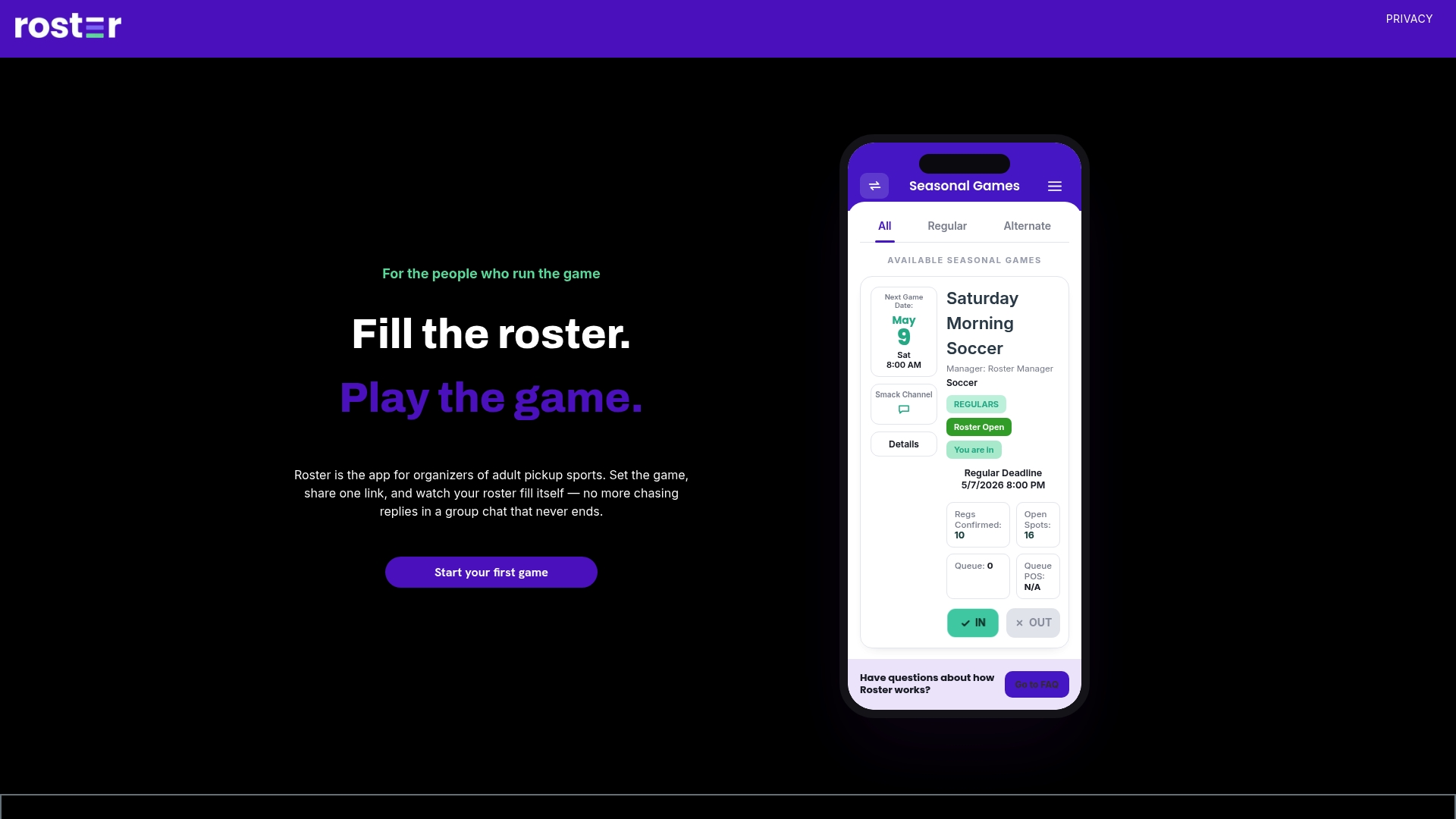
Ready to try it for your next game? Set up your game on Roster or see how it works. If you are still planning the week, our 7-day playbook for finding field time and filling rosters and our guide to organizing pickup soccer without the 6 AM RSVP scramble walk through the rest.
FAQ
How many players should I allow per position in a pickup game?
In most casual games, cap only the goalkeeper (usually one per side) and leave other positions open. If you want structure in a larger game, a light rule works better than a full layout, such as asking two players to stay back on defense once you pass 5 a side. Fixed layouts like 2 forwards, 3 midfielders and 2 backs suit organized 7s formats with unlimited substitution.
What is a good roster limit for 7v7 or 11v11?
DFW Footy typically sets 14 for 7v7 and 18 for 11v11, which is about twice the field players for smaller formats. ARCSA recommends no more than 15 for 7v7 and no more than 25 for 11v11. For a pickup group, start near twice the on-field number and adjust based on how many people usually drop out.
How do I keep a coed pickup game balanced?
Write the mix as a minimum per side and add a fallback. Soccer for Adults requires at least three women on the field and caps men at six field players plus a keeper if that minimum is not met. PlayMore's coed kickball requires at least one man and one woman and limits men to six in the field and top nine of the lineup.
What should I do when a position is overfull or empty?
Rotate instead of excluding. Rotate the keeper on a timer, ask for volunteers for empty roles in advance, and use a waitlist to replace dropouts so the balance holds. Put the rotation and the fallback in the game details so the rule is set before anyone arrives.
Do I need position limits at all?
Not always. With 3 to 4 players a side, positions are unnecessary. A total cap and a minimum to play usually do most of the work, and you can add a position rule later if the same problem keeps coming up.
Sources
- Rules, ARCSA
- Soccer for Adults rules
- 2025 Kickball Rulebook, PlayMore
- Footy 7s Rules, Social Sport Help Centre
- Community Pick-Up Soccer Tutorial, MSYSA
- Pickup Soccer Rules and Positions, Socster
- Adult Basketball Guidebook, Salt Lake County
- FAQ, DFW Footy