
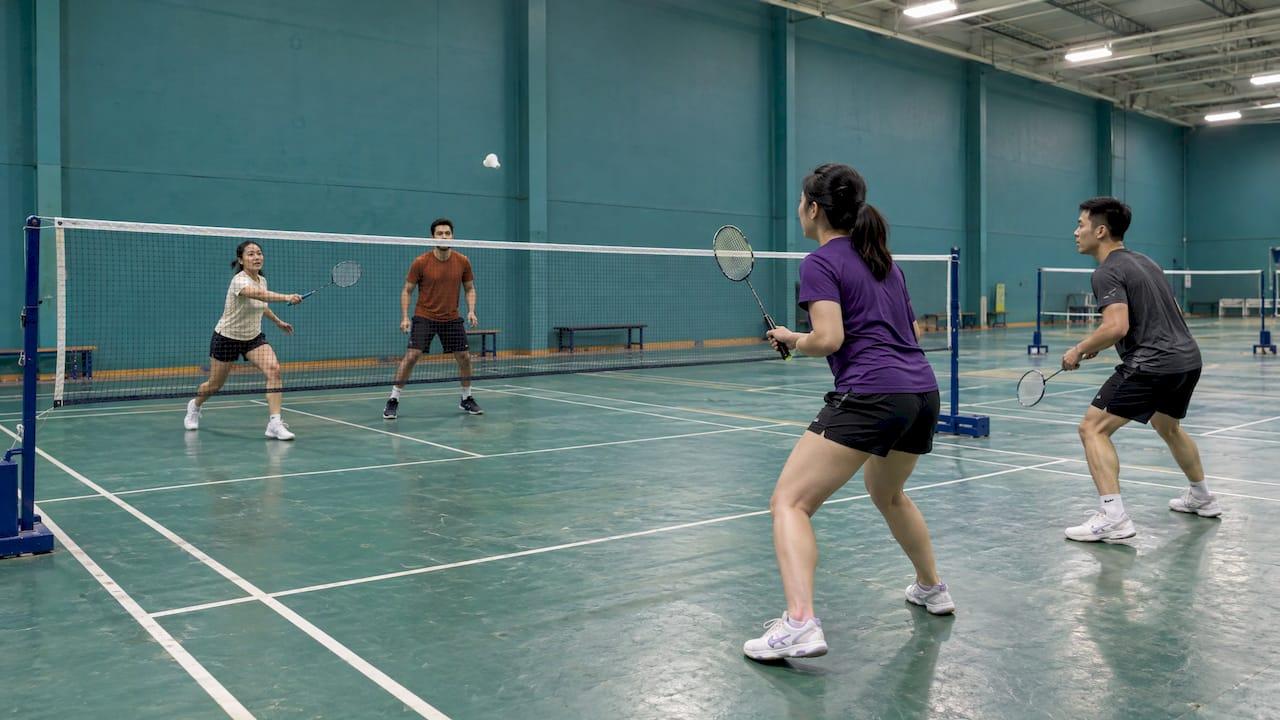
The best pickup tournament for an adult group is a short, non-eliminating event where partners rotate, rounds are timed and nobody sits around for an hour after one loss. Round robin mixers, king of the court and blind draw doubles all fit that description. The format is only half the work, though. The other half is knowing who is actually showing up, which is why we built Roster: one link for signups, with open spots filled and a waitlist for dropouts.
Below you will find ideas by format and theme, sample schedules, ways to keep mixed skill levels fair, a gear and space checklist, and a plan for the late cancellations that break most informal events.
TL;DR
- Choose a rotating-partner or non-elimination format so every player gets full playing time, whatever their skill.
- Time your rounds. Short rounds keep the event moving and make a blowout over quickly.
- Add one theme or side challenge (costumes, skills contest, charity angle) rather than five.
- Plan court count and finish time before you invite anyone, then recruit a few extra players for dropouts.
- Use one signup link with a waitlist so open spots refill without a group-chat scramble.
Table of Contents
- Start with the format, then add the fun
- 10 pickup tournament ideas that work for adults
- Sample schedules you can copy
- Keep it fair when skill levels differ
- Set simple rules before game day
- Space, equipment and safety
- The part that sinks most events: attendance
- Run your next tournament on one link
- Our view: the tournament is not the hard part
- FAQ
- Sources
Start with the format, then add the fun
A tournament idea is really two choices: how people are paired and how a winner is decided. Themes sit on top of that. If the structure is wrong, no amount of costumes will save the day.
For casual adult play, three structures cover almost everything:
- Round robin. Everyone plays everyone, or plays with a different partner each round. Nobody is eliminated.
- Ladder or court movement. Winners move up, losers move down, and the top spot is decided by the clock.
- Bracket. Single or double elimination. Familiar, but it leaves early losers standing around.
The USTA's manual for its relaxed adult events recommends a non-eliminating, competitive round robin with no or limited waiting to play, an awards ceremony at the end, and a total event length that can be as short as three hours. That is a good template for any sport, not just tennis.
10 pickup tournament ideas that work for adults
1. Rotating-partner round robin (the mixer)
Eight players on one court is a comfortable size for pickleball. The Sedona Pickler describes a seven-round schedule where everyone gets a different partner each round, with games to 11 and win by 2, or timed rounds of 8 to 12 minutes. Because partners shuffle, strong players carry a different teammate each time and the balancing happens on its own. The same logic works for doubles in tennis, padel, volleyball and badminton.
2. King or queen of the court
Set up several courts and mark one as the top court. Players start randomly placed, play quick matches, and winners move up while losers move down. MVP Visuals describes matches to 7 points or a 5-minute timed game, with whoever holds the top court when time runs out crowned the winner. Their organizer tip is simple and worth copying: use a timer with a loud buzzer and a visible leaderboard. We cover rules, variants and templates in our king of the court format guide.

3. Blind draw doubles
Players sign up individually and partners are drawn at random. Blind draw doubles and luck-of-the-draw pairings are on most lists of fun formats, and for good reason: nobody has to find a partner, so solo signups feel welcome. It suits any doubles or two-person sport.
4. Non-elimination bracket
If your group loves a bracket, give every team a guaranteed number of games. A consolation bracket or a pool-play stage followed by playoffs does the job. The Doubles Dink for Cancer toolkit describes pool play followed by a single-elimination playoff, using rally scoring to 15, win by 1. Everyone plays through pool play, and only the top finishers move on.
5. Pick-a-sport field day
Instead of one sport, run several short ones. Positive Tracks suggests deciding between a traditional game or smaller 3v3, 4v4 or 5v5 games, giving each game a set amount of time when several run at once, and using music to start and stop play. Teams collect points across games, and the champion is whoever has the most in total.
6. Multi-sport community cup
This is the big version of the field day. The Community Cup in Columbus, Ohio is a one-day challenge with 14 events, from cornhole and dodgeball to tug of war and a relay race. In 2026 it drew more than 1,700 participants on 50 teams. In the Bay Area, the Atheon Games are a semi-competitive single-day competition where teams play two or more ball sports plus a mental game and the winner is decided on total points. You do not need that scale. Three events and a scoreboard give a group of 20 the same feel.

7. The "ageless" round robin
Platform Tennis describes an "Ageless" format where players sign up individually, partners rotate, and made-up rules favor the oldest person on court, such as a mulligan each match or the right to claim one point at any time. It works well in groups that span decades.
8. Handicap tournament
The same Platform Tennis page covers a handicap format for multiple levels on one court. In an 8-game set, a team up one game gives the other side a 15-love start in the next game, up two games means 30-love, and up three means 40-love. The lead shrinks automatically, so games stay close.
9. Themed events
Themes cost almost nothing and change the mood. Ideas from the research include retro 70s and 80s attire, superhero showdowns, a Hawaiian luau and holiday tournaments, plus glow-in-the-dark play and music-themed events. Pick one, announce it in the signup, and let people opt in to the costume.
10. Skills side contests and charity angles
Between rounds, run an accuracy challenge, a fastest-serve contest or a longest-rally contest. These give waiting players something to do. A charity angle gives the day a purpose: the Community Cup's Charity Challenge raised $6,915 in 2026. Even a modest entry fee donated to a local cause changes how people talk about the event.
Sample schedules you can copy
Timed rounds are the simplest way to guarantee a finish time. The USTA manual gives timings for its round robins that translate to any rotating event:
| Players | Rounds | Time per round |
|---|---|---|
| 4 | 3 | 35 minutes |
| 5 | 4 | 25 minutes |
| 8 or more | 5 to 7 | 12 to 15 minutes |
Those figures come from the USTA Level 7 adult tournament manual, which also uses no-ad scoring and one point per game won to keep things quick.
If you are planning around court time, the Doubles Dink toolkit gives useful sizing for a pool-play doubles event: 2 courts for 2 hours for 10 players, up to 8 courts for 8 hours for 160 players. A regular pickup group of 8 to 16 sits at the small end of that range.
Keep it fair when skill levels differ
Mixed ability is the number one reason casual events feel awkward. You have three tools:
- Let the rotation balance. With shuffled partners, the Sedona Pickler points out that strong players carry a different teammate each round. Keep rounds short so a mismatch ends quickly and everyone meets new faces.
- Use handicaps. The 15-30-40 head start above, or a bonus rule for the least experienced pairing, narrows the gap without anyone feeling singled out.
- Say it is casual, out loud. The same guide recommends stating the casual intent at the start, having a tie-break plan and a finish time, and handing new players a quick rules refresher and a scoring cheat sheet before the first serve.
Doubles help too. The Doubles Dink for Cancer toolkit calls doubles the most fun and accessible format for all skill levels, and it encourages organizers to be creative about timing, such as a date-night event on the first Friday of the month.
Set simple rules before game day
Write the rules on one page and decide these five things in advance:
- Scoring. Games to 11, win by 2, or a fixed timer. Pick one.
- Round length. Use a timer. The Sedona Pickler suggests printing the schedule and taping it to a fence or net post so players can find their next court without asking you.
- Tiebreakers. Point differential first, then head-to-head, then a quick sudden-death game.
- Start and stop signal. Music or a horn, so you are not shouting across courts.
- Prizes. Small and silly beats large and serious. A trophy that travels to the next winner costs nothing.
Our five pre-session decisions for pickup pickleball walk through the same planning for a regular session, and most of it carries over to a tournament day.
Space, equipment and safety
Positive Tracks recommends choosing a field or court in a safe location away from traffic and parking lots, and suggests schools or local recreation areas as good starting points. Its checklist of items is practical:
- A registration table
- A bracket or schedule board
- Balls, goals or racquets
- Optional referees
- Signs and prizes
- A timer and a bullhorn
- Printed rules and music
Check whether your park or school field needs a reservation or permit for a group event, and confirm that with the facility's own office. Bring water and a basic first-aid kit, and know the nearest place to call for help if someone is hurt. Make sure the lines of play are clear of fences, benches and bags before the first round.
The part that sinks most events: attendance
A round robin for eight needs eight. Seven players means a bye every round, and nine means someone sits out. Tournaments built around rotation are more sensitive to a single dropout than a casual pickup game.
The answer is a structure that fills itself:
- Know your number. Decide the ideal and minimum player count before you share the invite.
- Keep alternates. A short list of people who are happy to jump in at the last minute is worth more than a bigger main roster.
- Use a waitlist. When someone drops, the next person is offered the spot immediately instead of you texting down a list.
- Close the loop. Share one link rather than posting the details in several chats, so the answer to "who's in?" is always in one place.
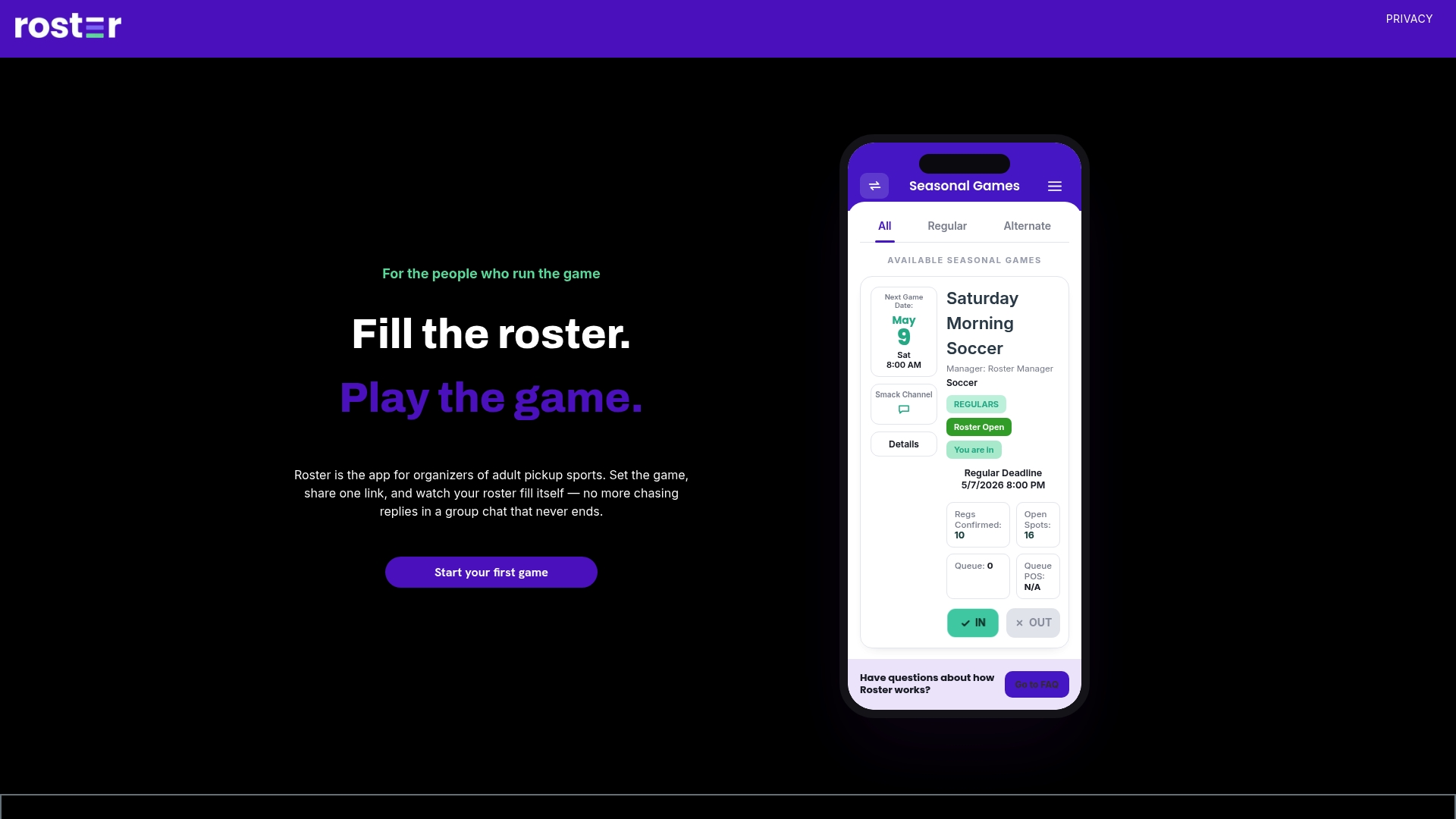
This is the job Roster does. You set the game details and share a single link. Players sign up, open spots are filled in real time, and dropouts create a waitlist. Regulars and alternates are tracked separately, so you can see at a glance who is rostered. If you run a recurring event, our five-step recurring game scheduling workflow shows how to set up the whole series once. And if your tournament is a one-off that you hope will become a regular league, starting an adult rec league in one season is the natural next step.
Run your next tournament on one link
If you organize adult pickup games, Roster is built for exactly that: you set the game details, share one link, and the app handles signups, roster spots and the waitlist. It also supports season scheduling, group chat and peer-to-peer Venmo payment tracking between players and managers, so entry fees do not turn into a spreadsheet. You can get the Roster app and have your first tournament signup live in one sitting.
Basketball organizers can see how the same approach works on a court in our guide to running pickup basketball with one link.
Our view: the tournament is not the hard part
Every organizer we talk about at Roster has the same story. The format is easy. Round robin, king of the court, a blind draw: you can set any of them up on the back of an envelope. What eats your weekend is the group chat, the "I'm a maybe" replies and the Thursday-night scramble for a ninth player.
That is why Roster is built around a single shared link. You set the game details once, people sign up, open spots fill in real time and a waitlist catches the dropouts. You are not tracking RSVPs by hand and you are not scrolling back through a hundred messages to see who said yes.
We also believe adult sports should get people off their screens and onto a field with other people. A tournament idea is only good if it gets people showing up in person, and the less time you spend managing logistics, the more energy you have to make the day fun.
Daniel
FAQ
What is the easiest pickup tournament format for a casual group?
A rotating-partner round robin with timed rounds. Everyone plays every round, partners change, and the finish time is fixed. For eight players on one court, a seven-round schedule gives every player a different partner each round.
How many players do I need for a pickup tournament?
It depends on the format. A round robin works from four players, and eight is a comfortable size for one court in a rotating doubles event. King of the court needs several courts and enough players to keep them all busy. Recruit a few more than you need so a dropout does not force you to change the schedule.
How long should a pickup tournament last?
Plan on about three hours for a casual round robin. The USTA's relaxed adult format can be run in as few as three hours, and timed rounds of 12 to 15 minutes keep larger groups on schedule. Set the finish time in the invite so people can plan their day.
How do I handle last-minute dropouts?
Recruit above your target number, keep a short list of alternates and use a waitlist so the next person is offered the spot right away. With Roster, a dropout opens a spot on the same signup link and the waitlist takes over, so you are not messaging people one by one.
Sources
- USTA Adult Tournaments: Level 7 manual
- How to Run a Pickleball Round-Robin for 8 Players, Sedona Pickler
- 17 Fun Pickleball Tournament Ideas, MVP Visuals
- Doubles Dink for Cancer Event Director Toolkit
- Pick A Sport Tournament, Positive Tracks
- Community Cup, Community Columbus Sports
- The Atheon Games
- Entertaining Event Formats for All Levels, Platform Tennis
- Fun Pickleball Tournament Ideas and Formats, Pickleland