

A fair pickup game starts before anyone picks a team: everyone knows who is in, how spots are filled, and how sides get made. Then you pick a method that matches your group, whether that is random, a snake draft or winners-stay, and you stick to it. Most arguments come from unclear rosters and shifting rules, not from the split itself. If you run adult pickup soccer, basketball or anything else, this guide covers the methods, how to balance skill, what to do with odd numbers and latecomers, and how to keep the process visible so people trust it. Roster is built for the first half of that problem: one link where players sign up, spots fill in real time, and dropouts go to a waitlist.
TL;DR
- No single method is fair for every group. Random is quick and looks neutral, but it does not guarantee even skill. Organizer-made teams can balance skill but only work if you know the players.
- Pick one method, announce it ahead of time, and use it every week. Consistency is what players read as fairness.
- Settle the roster first. Uneven numbers, late arrivals and dropouts cause more friction than the split itself.
- Rotate the work and the sides: winners-stay, shifting captains and mixed lineups keep regulars and newcomers in the same game.
- A shared signup link with a visible roster and waitlist removes the "who is actually playing?" argument.
Table of Contents
- What fair means in an adult pickup game
- Five ways to pick teams, and when each fits
- How to balance teams when skill varies
- Settle the roster before you settle the teams
- Make the process transparent
- Rotate roles and sides to keep it inclusive
- Where Roster fits
- FAQ
- Sources
What fair means in an adult pickup game
Fair does not mean identical teams. In a casual game with 12 to 20 adults of mixed ability, perfectly even sides are rare. Fair means three things your group can check:
- Equal access. Everyone who signed up under the same rules gets a spot or a place on the waitlist, in the order the rules say.
- A method nobody can bend. The way teams are made does not change based on who is standing there or who is complaining.
- Games worth playing. Lopsided scores are the quickest way to lose regulars, so the method should aim at competitive games without humiliating anyone.
The first point is the one organizers skip. If spots are handed out through a long group chat, people who check their phones late lose out, and the "fair" teams are built on an unfair roster. We come back to that in the roster section below.
Five ways to pick teams, and when each fits
Research on team assignment in youth sports from the University of Arkansas names three common approaches: random assignment, self-selection and facilitator assignment. It notes that random assignment is easy and looks fair but offers no guarantee of equal skill, while a facilitator can spread skill evenly but risks bias when they do not know the players well. Adult pickup groups use those same ideas in a few practical forms.
| Method | How it works | Best for | Watch out for |
|---|---|---|---|
| Random split | Count off, draw numbers, pull colored bibs from a bag | Mixed groups, new groups, social games | Can stack one side with the best players |
| Captains' draft | Two captains pick in turn | Groups who know each other well | The last pick feels bad; captains may pick friends |
| Snake draft | Order reverses each round (A, B, B, A, A, B) | Groups with a rough skill ranking | Needs a ranking people accept |
| Organizer-made teams | One person balances the sides in advance | Leagues, regular weekly games | Bias if the organizer does not know everyone |
| Winners stay | Initial split, then losers rotate out for waiting players | Games with more players than spots | Needs short games and a clear rotation rule |
Random split
Counting off, drawing numbered chips or handing out bibs from a bag is the simplest and the hardest to argue with. It works because nobody can accuse the organizer of favoritism. The weakness is the one the Arkansas research points to: chance can put three strong players on one side. If you play a random split, play to a score or time limit short enough that a lopsided first game can be reset with a reshuffle.
Captains' draft
The schoolyard method still works when captains are chosen fairly and the group is comfortable with it. To keep it kind, have captains alternate picks and rotate who captains from week to week. Avoid always using the two best players as captains, since it hands them control of every game and leaves the same people picked last every time.
Snake draft
In a snake draft the pick order reverses each round, so the captain who got the first pick gets the next two picks after the other captain's first one. It evens out the advantage of picking first. It is the best manual way to balance skill when the group has even a rough sense of who is strong, because the top players are split across teams by design.
Organizer-made teams
When the same people show up every week, many organizers build the sides themselves, putting the strongest players on different teams and mixing in newcomers. The Arkansas research flags the risk: it works when the organizer knows the players, and it breeds resentment when they do not. If you go this route, say how you balance (for example, "two strongest on opposite sides, then alternate") so players see a rule behind it, not a hunch.
Shooting for sides and other local customs
Basketball has its own tradition. A 2015 SB Nation survey of 672 people found that most pick teams by lining up and shooting, with either the first half of the makers going to one team or makers alternating between teams. The alternating pattern was played almost exclusively by respondents in America. It is a quick, visible, skill-neutral way to sort a pile of players, and it works because everyone sees it happen. If your gym or park already has a custom like this, keep it and write it down.

How to balance teams when skill varies
Balance does not need a spreadsheet. Three light-touch approaches cover most groups.
Tier the players. Sort the regulars into three loose groups: strong, solid, still learning. Deal each tier across the sides, like dealing cards. You only need to place about 12 to 20 people, so a minute of thought per week is enough.

Balance by role, not just skill. In soccer, make sure each side has a goalkeeper willing to play the position and at least a few players who like defending. In basketball, spread out the big players. A team of eight forwards is unbalanced even if everyone is equally good.
Let play fix it. If the first game is lopsided, change it. Swap one or two players between sides at halftime or after the first score target, and announce it as routine, not as a verdict on anyone. Players accept a swap when it is framed as a standing rule for everybody.
Keep skill ratings private if you use them. Posting a ranking invites arguments, and even good-natured groups can turn on it. A tier list in the organizer's head, applied consistently, is enough.
Settle the roster before you settle the teams
Uneven numbers, late arrivals and dropouts break more pickup games than any team-picking method. Decide these rules once and share them.
- Set a roster limit. A fixed number of spots keeps teams even and the field or court uncrowded. Our guide on how to set roster limits for your pickup game walks through choosing the number.
- Use a waitlist with a clear order. When someone drops, the next person on the waitlist moves up. People accept being waitlisted when the order is visible and does not depend on who texted fastest.
- Name regulars and alternates. Regulars hold a standing spot, and alternates fill in when a regular cannot make it. Everyone knows which they are.
- Set a late rule. For example: after 10 minutes past start time, an open spot goes to a waiting alternate. State it before the first no-show, not after.
- Handle odd numbers with a floater. With 11 players, one person rotates between sides each game, or the extra player becomes a rotating goalkeeper or neutral player. Rotate the role so it is not always the same person.
If spots are limited, the way you release them matters too. A first-come, first-served rule is easy to explain, but it only feels fair when everyone gets the same notice at the same moment. The same logic applies to other limited-slot situations, and this piece on a fair queue for limited spots explores why a visible, rules-based line beats a free-for-all. For pickup games, the equivalent is announcing the game once, at a consistent time, to everyone. Our post on choosing pickup game times that fill your roster covers how to pick that timing.
Make the process transparent
Players trust a method they can see. A few habits do most of the work:
- Write the rules down once. A short message pinned in the group: roster limit, waitlist order, late rule, how teams are made. When someone disputes a call, point to it.
- Run the method in the open. Draw bibs, count off or draft where everyone can see. Avoid deciding sides privately in a side chat.
- Show the roster. Everyone should be able to see who is in, who is an alternate and who is on the waitlist without asking you.
- Apply rules to yourself. If the organizer sits out when the roster is full, people believe the rest.
- Move conversation out of the group chat. A thread of 200 messages hides the rules. One shared link with the current roster replaces most of it.
That is what a single shared signup link is for. Players see the game details, take a spot, and the roster updates as people join or drop. You are not the referee of who texted first.
Rotate roles and sides to keep it inclusive
Games feel fair over weeks, not just within one night. Some simple rotations:
- Rotate captains. Let a different person pick or lead each week, including newer players.
- Rotate the odd player out. If you are one short or one over, track who floated last time.
- Mix the pairings. If the same four friends are always on one side, split them every few games so newcomers play with different people.
- Use winners-stay on busy nights. When you have more players than spots, the losing side swaps in waiting players. Everyone plays, and strong players end up distributed across combinations.
- Welcome new players deliberately. Put a newcomer with a friendly regular instead of leaving them to be picked last. Our guide to inclusive pickup games covers how organizers make that welcome routine.
Where Roster fits
Roster is a mobile app for adult pickup organizers. You set the game details and share one link. Players sign up, open spots fill in real time, and when someone drops, a waitlist keeps the game full. It manages regulars and alternates, supports a group chat for the game, and tracks peer-to-peer Venmo payments between players and the manager. For the fairness questions above, that means the roster is visible and the order of spots is not up to who replied first.
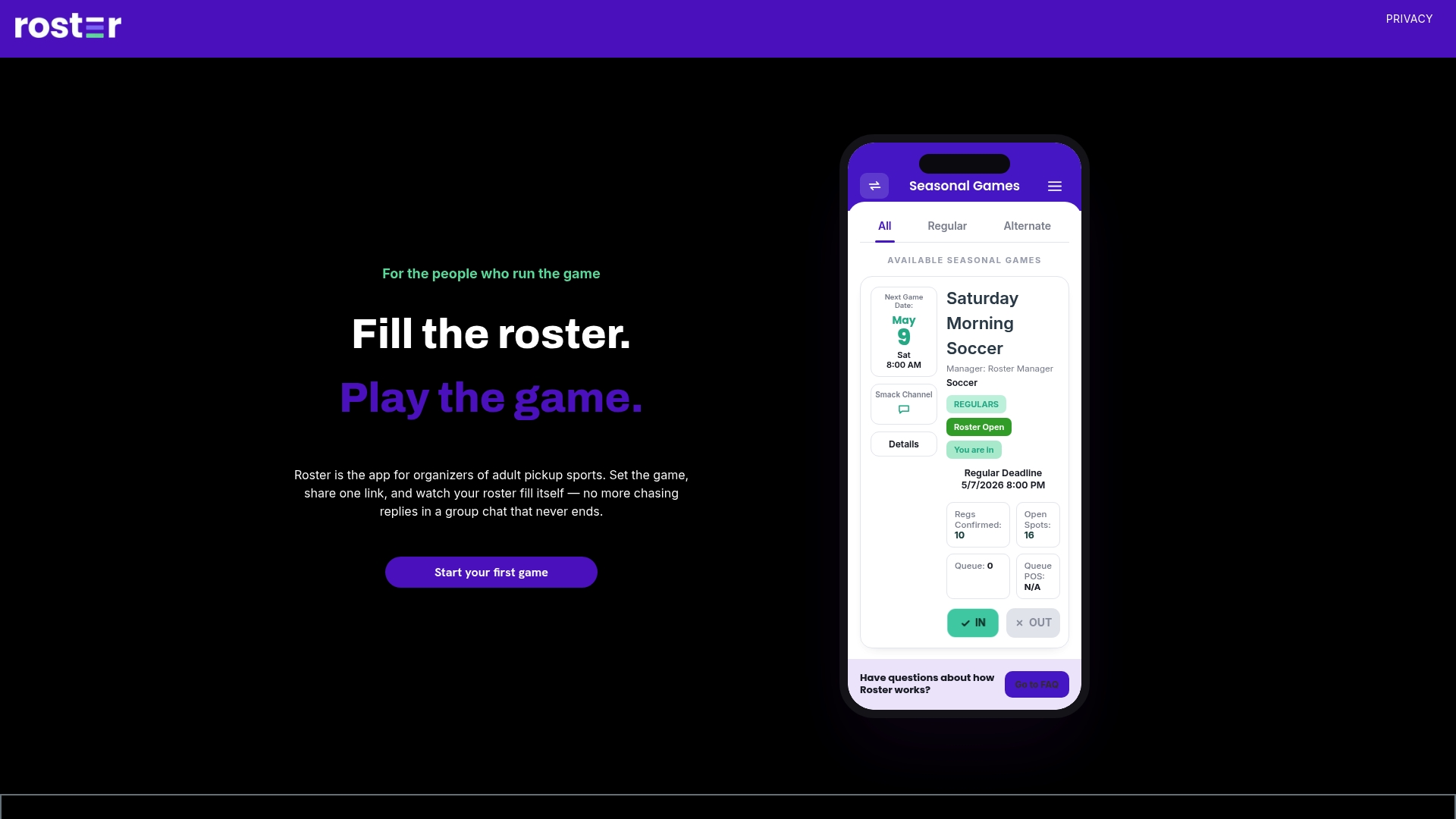
If you organize basketball, our walkthrough on running pickup basketball with one link shows the setup. When you are ready to try it with your own group, start at Roster.
Perspective
We built Roster because organizers kept telling the same story: the hard part of pickup is not the game, it is the logistics around it. Who is in? Who is on the waitlist? Did the last person to drop tell anyone? By the time teams are being picked, half the arguments have already happened in a group chat.
Our view is that fairness starts with the roster. If everyone can see the same list, and spots move in a visible order, then the team-picking method matters less than people think. A coin flip, a snake draft or winners-stay all feel fair when the group trusts who is in the game.
That is why we focus on one shared link, real-time spots, a waitlist and clear regulars and alternates. It takes the bookkeeping off the organizer, so you can spend the night playing and getting to know people in person, not staring at your phone.
Daniel
FAQ
What is the fairest way to pick teams for pickup?
There is no single answer, but a snake draft based on a rough skill tiering is the best manual way to balance sides, and a random split is the easiest to defend as unbiased. Many groups combine them: random for the first game, then adjust or rotate with winners-stay. Whatever you pick, announce it in advance and use it every week.
How do you handle an odd number of players?
Rotate a floater between the two sides, or have one player act as a rotating goalkeeper or neutral player. Track who did it last so it is not always the same person. If numbers are often odd, a roster limit set to an even number and a waitlist solves most of it.
What should I do about late arrivals and dropouts?
Set a rule before it happens: after a stated grace period, an open spot goes to the next person on the waitlist. Late arrivals join the next rotation instead of interrupting a game in progress. Roster's waitlist fills dropped spots automatically, so you are not messaging people one by one.
How do I stop captains from picking only their friends?
Rotate captains weekly, use a snake order, and consider letting the organizer approve the final split. Another option is to skip captains entirely and use a random split or a tiered deal that you announce up front.
How do I keep newer players from always being picked last?
Use a method that does not rank people publicly, such as counting off, bibs, shooting for sides or organizer-made teams. Pair newcomers with welcoming regulars, and rotate the mix so no one is stuck on the same side every week.
Sources
- Team assignment strategies in youth sports, University of Arkansas
- What are the rules of pick-up basketball? SB Nation survey
- Fair queue for limited spots