
A good rainout message answers three questions in the first line: is the game on, off or moved, what changed, and what do I need to do. Send it from one place, at a time you promised in advance, and follow it up when conditions change. Do that and the pile of "are we still playing?" texts never starts. This guide gives you the wording, the timing and ready-to-send templates for adult pickup and rec games.
TL;DR
- Lead with the verdict in capital letters: CANCELED, DELAYED or MOVED, then the game, date and time.
- Put old and new details on separate lines and say what players must do, even if the answer is "nothing."
- Pick a decision time and one channel before the season starts, and use that channel every time.
- Treat lightning as a safety call, not a judgment call: stop play and wait 30 minutes after the last thunder.
- Keep the rainout notice, the roster and the follow-ups in the same place so no one has to scroll for them.
Table of Contents
- Why rainout messages go wrong
- What every rainout message needs
- Copy-ready rainout message templates
- When to send the message
- Lightning is a different kind of message
- Decide the rules before it rains
- Keep everything in one place
- How to know every player saw it
- After the rainout: the follow-up message
- Common mistakes to avoid
- What we think about rainout messages
- Run your game from one link
- FAQ
- Sources
Why rainout messages go wrong
Most rainout chaos is not caused by the weather. It is caused by a message that leaves room for doubt. "Looks pretty wet, we might call it" gets read by twelve people as twelve different things. Three of them show up, two stay home, and someone asks in the chat whether anyone has heard anything.
Adult pickup games make this harder than league play. Nobody has a league office, a rainout hotline or a paid scheduler. The organizer is a volunteer, the players are busy, and the only communication tool is whatever chat the group already has. Messages about the field get buried between memes and carpool questions.
The fix is to treat a rainout like any other recurring task: decide the rules once, write the message once, and reuse it. Everything below is built to be copied.
What every rainout message needs
A change message is read on a phone, often in a hurry, often by someone who is already in the car. It has to survive a two-second glance. Include these pieces, in this order:
- The verdict. CANCELED, DELAYED or MOVED, first word, no softening.
- The game, identified the way players know it. Day, time and field or location, for example "Thursday 7:00 PM, Field 3."
- The reason, briefly. "Field closed for standing water" or "lightning in the area." One short phrase is plenty.
- What changed and what stayed the same. If the game moves, give the old and new details on separate lines so nobody mistakes the old time for the new one. Add what stays the same, such as jersey color or arrival time, to head off the panic reply.
- What the player must do. For a cancellation, usually nothing. For a moved game, usually confirm. Say which.
- When the next update comes. "Makeup details by Saturday noon" stops people from asking before you know.
If you need an answer from players, add a reply-by time. "Reply by 5 PM so we can fill your spot" works. "Let me know" does not.
Copy-ready rainout message templates
Swap in your details. Each one is short on purpose.
Cancellation
CANCELED: Thursday 7:00 PM soccer at Riverside Field 3. Field is closed for standing water. Nothing you need to do. Makeup date posted by Saturday noon.
Postponed, new date unknown
OFF tonight (Thursday). Reason: heavy rain, field unplayable. New date to be confirmed. Your spot is kept. We will post the new date here by Saturday noon.
Delay
DELAYED: Thursday game. Lightning in the area. Play is paused. Next update at 7:30 PM. Stay in your car or indoors until then. If we cannot start by 8:15 PM, we cancel.
Moved to a new field
MOVED: Thursday game. Was: Riverside Field 3 Now: Eastside Park Field 1, 412 Maple Ave Time: same, 7:00 PM. Arrive by 6:50. Same as before: light and dark jerseys, bring water. Please confirm you are still in by 5:00 PM.
Moved to a new time
TIME CHANGE: Thursday game. Was: 7:00 PM Now: 8:00 PM Same field, Riverside Field 3. Arrive by 7:50. Confirm by 5:00 PM so we can fill open spots.
Weather watch, no decision yet
HEADS UP: We are watching the radar for tonight. Final call by 4:30 PM. Until you see a message here, the game is on.
That last one is useful because it sets a decision time and a default. Players know exactly when to stop wondering.
When to send the message
Timing is the part organizers skip, and it matters as much as the wording. Players are deciding whether to leave work early, find a babysitter or drive across town. A message at 6:45 for a 7:00 game is too late to help anyone.
Real recreation programs publish fixed decision times, and you can borrow the idea. St. Mary's County, Maryland, announces weather cancellations no later than 3:00 p.m. on weekdays and 7:00 a.m. on weekends and holidays, and its staff re-check conditions at 10:30 a.m. after morning cancellations to announce afternoon and evening status by 11:00 a.m. Mid State Sports Leagues in Nashville makes rain and snow calls by 4:30 p.m. on game day and posts further cancellation updates through the night if needed.
For a casual adult game, a simple version works:
- Evening games: decide by mid-afternoon, a few hours before kickoff, so people can plan their commute.
- Weekend morning games: decide the night before if the forecast is clear, and set a second check an hour or two before start.
- Anything borderline: send the weather watch message above with a named decision time.
Then keep your word. If you said 4:30, send something at 4:30, even if it is "Game is on." Silence at the deadline brings the questions right back.
Updates when conditions change
Conditions change, and your message has to be able to change with them. Reply in the same thread, start with "UPDATE:" and repeat the new verdict at the top. Do not make people read back through three messages to work out which one is current. If a game you canceled turns out to be playable, say so plainly: "UPDATE: Game is back on, 7:30 PM start."
Lightning is a different kind of message
A rainout is a convenience call. Lightning is a safety call, and it should never depend on who feels bold. The National Weather Service advice is simple: when thunder roars, go indoors, and wait 30 minutes after the last thunder before going back outside. Every new rumble resets that clock.

Build that rule into your messages. A lightning delay message should tell players to go to a car or building right now, and give the time of the next update. Do not ask the group to vote. Our lightning policy checklist for sports organizers covers the rule in more detail so you can post it once before the season and point to it.
Decide the rules before it rains
The easiest rainout is the one you already planned. Post a short weather policy at the start of the season and refer to it every time. It should name four things:
- Who decides. One person, by name. Not "the group."
- What triggers a cancellation or delay. Standing water, a closed field, lightning within a set distance, a field permit pulled by the city.
- Where it is announced. One channel.
- What happens next. Makeup game, skipped week, or credit for the date.
When those answers are written down, a rainout message stops being a debate and becomes a notice. If you want a fuller playbook for the backup side, our rain backup plan for adult pickup sports walks through indoor options and alternate fields.
Keep everything in one place
The most common reason players miss a rainout message is that it was one of forty. Someone replies with a thumbs up, another asks about parking, a third shares a video, and the notice scrolls out of sight.
There are two habits that fix this.
Use one channel for game status, every time. The moment you cancel through a side text or a quick call, the system leaks. People learn that the real news might be somewhere else, and they go looking. Choose one place and use it even on the nights when the answer is obvious.
Separate announcements from chatter. A thread where only the organizer posts game notices stays readable. Our guide to an announcement-only team chat shows how to set that up, and the one-page communication checklist for coaches has the wording to put at the top of it.

How to know every player saw it
Sending is not the same as being seen. Three small tactics help:
- Ask for an acknowledgment when it matters. For a moved game, ask players to reply "in" or "out" by a set time. For a plain cancellation, no reply is needed, and saying so keeps the thread quiet.
- Follow up once, privately, with the people who did not answer. One direct message an hour before the deadline is enough. Do not chase anyone three times.
- Repeat the key line in the game's reminder. A reminder sent the day of the game that includes the status ("Game is on, field open") catches people who skipped the earlier notice. Our guide to team game reminders covers what to send and when.
If a game is moved and you need a full roster, the follow-up matters more than the first message. Every no-reply is a possible empty spot at kickoff.
After the rainout: the follow-up message
The cancellation is half the job. The second message is what keeps people showing up for the next game. Within a day or two, send:
- The makeup date, or a clear "no makeup, we pick up next Thursday."
- Who is confirmed for the new game, and how many spots are open.
- Any change to the field, time or arrival.
A sample:
MAKEUP: Last Thursday's canceled game is now Sunday 10:00 AM, Riverside Field 3. 14 of 16 spots are confirmed. Two open. Reply if you can play.
If you want more on keeping your group together after a cancellation, our guide on how to cancel a pickup game without losing half your roster has the details.
Common mistakes to avoid
- Hedging. "Probably canceled" is not a message. Either decide or say when you will.
- Burying the verdict. If the first line is a paragraph of weather commentary, people stop reading before they reach it.
- Writing in shorthand only you understand. "Game moved to the other field" means nothing to a new player. Give the name and address.
- Forgetting the same-as-before line. Players who see "moved" often assume everything changed.
- Using three channels. One text, one post and one email means three chances for them to disagree.
- Skipping the "nothing to do" line. Without it, people reply to ask whether they should do something.
What we think about rainout messages
We built Roster for the person who ends up running the game. Most organizers are not short on good intentions. They are short on a place where the game, the roster and the messages all live together.
A rainout shows the problem clearly. The moment the weather turns, the organizer has to tell everyone, figure out who is in, deal with the waitlist and answer the same question five times. When the roster is in one place and players sign up through a single shared link, you already know who needs to hear the news, and the people on the waitlist are already lined up.
Our view is that a cancellation should take a minute, not an evening. Write the message once, post it in the game's chat, and let the roster do the rest. The goal is to get you off your phone and back on the field, with the people you actually want to see.
Daniel
Run your game from one link
Roster is a mobile app for organizers of adult pickup sports. You set the game details, share a single link, and players sign up there. The app manages the roster in real time, fills open spots, keeps a waitlist for dropouts, and gives the group a chat for game communication. That means your rainout message goes to the same people who are on your roster, in the same place they signed up.
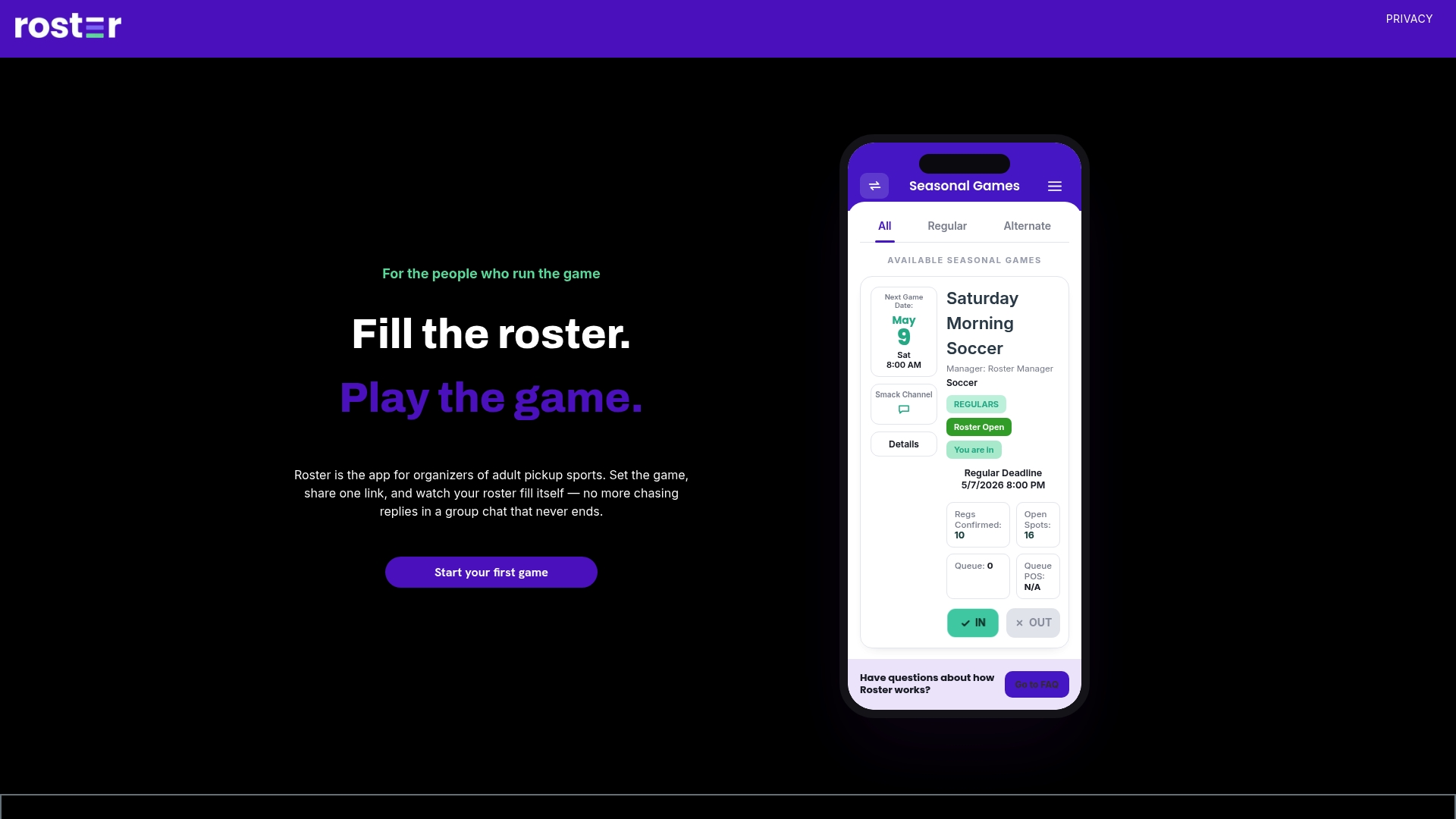
If your current setup is a long group chat and a spreadsheet, see how Roster works and set up your next game in one place.
FAQ
How far ahead should I send a rainout message?
Send it as early as you can make a confident call, and no later than a set time you announced in advance. For evening games, mid-afternoon is a common pattern, and published league policies use fixed times such as 4:30 p.m. on game day. If the weather is uncertain, send a heads-up with a decision time rather than waiting in silence.
Should I ask players to reply to a cancellation?
Usually not. For a straight cancellation, tell players they do not need to do anything. Ask for a reply only when you need an answer, such as confirming a moved game or filling spots, and give a reply-by time.
What if the weather clears after I cancel?
Post an update in the same place you posted the cancellation, starting with "UPDATE" and the new verdict. If you cannot reach enough players in time, it is usually better to stay with the cancellation than to run a half-empty game. Whatever you decide, say it plainly and say when the next update will come.
How long do we wait out lightning?
The National Weather Service advises waiting 30 minutes after the last thunder before going back outside. Each new thunderclap restarts the 30 minutes. Tell players to get indoors or into a car right away and give a time for your next update.
Where should rainout messages go?
Pick one channel for game status and use it every time. Players learn where to look, and your notices do not get lost between other conversations. A chat attached to the game itself, with the roster beside it, keeps the notice and the list of who is playing together.
Sources
- St. Mary's County, MD Inclement Weather Policy
- Mid State Sports Leagues FAQ
- National Weather Service lightning safety